24-Hour Gyms UK: Is Round-the-Clock Access Worth It?
Click Below To Share & Ask AI to Summarize This Article
Half past five in the morning. The streets are dark, the kettle’s barely boiled, and yet the car park at your local PureGym already has a handful of cars in it. Welcome to the UK’s quiet 24-hour gym boom — a trend that’s crept up on the fitness industry as shift patterns get messier and our idea of a “normal” training time keeps shifting.
Round-the-clock gym access isn’t a novelty any more. It’s a genuine selling point for chains battling it out on price and convenience, and a real consideration for anyone whose working day doesn’t fit a tidy 9-to-5. But is paying for (or choosing a gym because of) 24-hour access actually worth it, or is it a feature most people never use?
We’ll walk through who genuinely benefits, what you’re actually getting access to at 3am, the safety side nobody talks about enough, and how to work out whether it changes your decision at all.
Who Actually Needs 24-Hour Access?
Before you let a 24-hour sign swing your decision, be honest about your own week. The people who get real value from round-the-clock gyms tend to fall into a few clear groups.
Shift workers are the obvious one — nurses, paramedics, warehouse staff, hospitality workers, delivery drivers and anyone on rotating shifts whose “after work” might be 4am on a Tuesday and 2pm on a Thursday. For them, a gym that’s only open 6am–10pm is effectively useless on half their working days, which means a membership they’re paying for every month but can barely use. New parents juggling a baby’s sleep schedule often find the only predictable gap in their day is stupidly early or stupidly late, long before nursery drop-off or after the house has finally gone quiet. And then there’s a smaller group who simply prefer training outside peak hours — no queue for the squat rack, no scrum for the showers, and a gym floor that feels like your own private space rather than a Monday-evening scrum.
There’s also a less obvious group worth mentioning: people recovering from injury or managing a health condition who need to train at a specific, predictable time dictated by medication schedules, physio appointments or energy levels rather than personal preference. For them, flexibility around hours isn’t a luxury, it’s what makes consistent training possible at all.
If none of that describes you, 24-hour access is a nice-to-have rather than a deciding factor, and you’re probably better off prioritising location, equipment and class timetable instead — because paying extra for a feature you’ll never touch at 3am is money better spent elsewhere.
Which UK Chains Actually Offer It
Not every “24-hour gym” sign means the same thing in practice. Some sites run true round-the-clock access every day; others are 24 hours on weekdays only, reverting to shorter hours at weekends. It genuinely varies site by site, even within the same chain, so always check the specific club rather than assuming.
PureGym built much of its early growth on 24/7 access at flagship sites, and it remains the chain most associated with the offer in the UK. The Gym Group runs a similar model at a chunk of its locations, while some independent and boutique gyms have started experimenting with keyless, app-based entry that effectively achieves the same thing on a smaller scale. If you’re weighing up the big low-cost names against each other, it’s worth seeing how their hours stack up alongside price and facilities in our breakdown of budget gym chains, because 24-hour access is rarely the only variable that matters.
What You’re Actually Getting at 3am
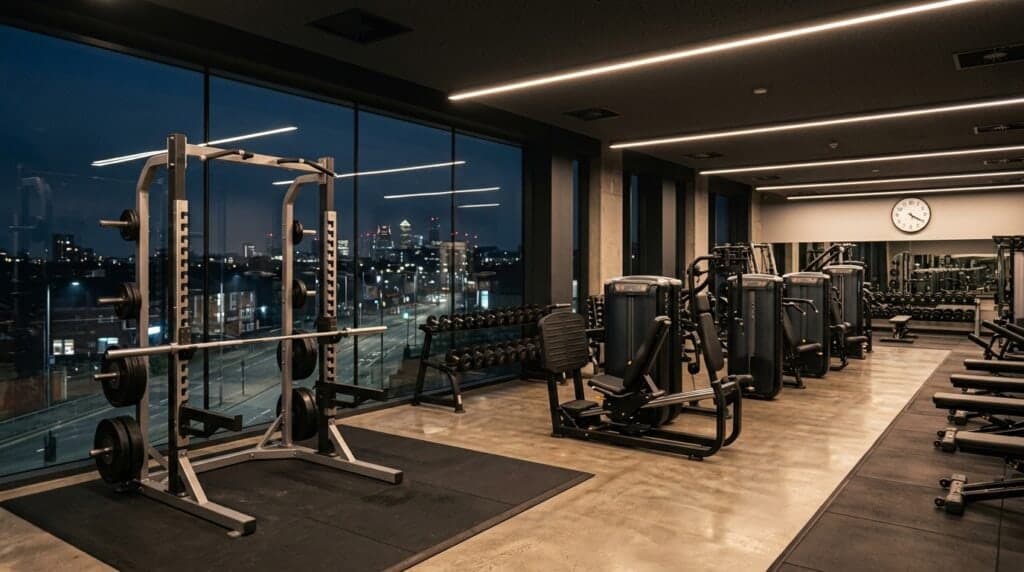
This is the bit that catches people out. “24-hour access” almost always means unstaffed access outside of core hours — typically somewhere between 10pm and 6am or 7am, depending on the site. There’s no one on the desk, no personal trainers on the floor, and no classes running. You’re let in by fob, keycard or app, and you’re on your own with the kit, a bank of CCTV cameras, and usually a help point or intercom for emergencies.
That unstaffed window is a legitimate safety consideration, not just for gym members but for any lone staff member who might be covering overnight shifts in a cleaning or maintenance capacity. The UK’s Health and Safety Executive publishes specific guidance on protecting lone workers, and reputable 24-hour gyms build their overnight procedures — panic alarms, monitored CCTV, clear emergency contact routes — around exactly that kind of risk assessment. If you’re training at odd hours, it’s worth knowing where your nearest help point is before you need it, not after.
It’s also worth being realistic about what’s missing overnight. There’s no one to show you how a cable machine adjusts, no staff member to point you towards a spare towel, and if a piece of kit breaks at 4am it might sit broken until the morning shift arrives. None of that’s a dealbreaker, but it does mean 24-hour access suits confident, self-sufficient gym-goers far better than complete beginners who might still want a bit of hand-holding on their first few visits.
Safety and Etiquette for Off-Peak Sessions
Training alone in an empty gym at 4am calls for a slightly different mindset than a packed Tuesday evening session. Tell someone roughly when you’re going and when you expect to be back, especially if you’re driving to an industrial estate retail park at an hour when it’s genuinely deserted. Park somewhere well-lit, keep valuables out of sight in the car, and if a site feels under-lit or poorly monitored on your first visit, trust that instinct and consider a different club.
Once you’re inside, the usual rules of gym etiquette still apply even when you’ve got the place to yourself — rack your weights, wipe down the bench, don’t leave kit scattered across the floor for the next person. In fact, off-peak sessions are a genuinely good way to build these habits without the social pressure of a busy floor, because you’ve got time and space to do things properly rather than rushing a shared machine.
Is the Extra Cost Actually Worth It?
24-hour access sometimes comes bundled into a standard membership at no extra charge, and sometimes it’s an upgrade tier that costs a few pounds more a month. Before you pay for the privilege, do the maths honestly: how many sessions a month would actually happen outside staffed hours? If the answer is “most of them” because your shifts genuinely demand it, the upgrade pays for itself in flexibility alone. If the answer is “maybe twice a month when I can’t sleep,” you’re probably paying for peace of mind rather than a feature you’ll use.
This is really just one more line item in a wider decision, and it’s worth working through properly rather than in isolation. Our gym choice checklist covers the full list of things worth comparing — contract length, equipment, cleanliness, class access — so 24-hour opening sits in context rather than becoming the single deciding factor.
Making Round-the-Clock Access Actually Work for You
If you do go for a 24-hour gym and plan to use the unusual hours, a few habits make it genuinely worthwhile rather than just a feature you never touch. Keep a consistent slot — same time most days — so it becomes routine rather than a decision you have to talk yourself into each time. Prep your kit bag the night before if you’re training before a shift, because fumbling for socks at 4:45am is how sessions get skipped. And lean into the quiet: off-peak hours are the best time to actually learn a lift properly, film your form, or work through a programme without feeling watched by a busy gym floor.
It’s also a good time to batch the admin parts of training that are easy to put off — updating a programme spreadsheet, stretching properly instead of rushing it, or simply taking stock of how your lifts have progressed over the past month. With no one waiting for the squat rack, there’s no pressure to rush through sets just to free up equipment, which on its own can lead to better form and fewer niggling injuries over time.
Whatever hours suit your week, the easiest way to find a gym that genuinely matches them — rather than guessing from a website’s small print — is to search on GymPal, where you can filter UK gyms by opening hours, facilities and location to see what’s actually open when you need it.
The Bottom Line
24-hour access is a brilliant feature for the people who genuinely need it — shift workers, new parents, early risers and night owls — and largely irrelevant for everyone else. The real test isn’t whether a gym offers it, but whether your week actually has gaps that only exist outside normal opening hours. Work that out first, factor in the safety basics for training alone off-peak, and you’ll make a far better decision than picking a gym on the strength of a sticker in the window.
If you’re a gym owner weighing up whether to extend your own opening hours, it’s worth thinking through the staffing and security implications properly before you flip the sign to “24/7” — list your gym on GymPal and make sure your real hours and facilities are front and centre for the members searching for exactly what you offer.

I am Adam Hall, a dedicated fitness professional with over ten years of experience in the UK’s fitness industry. I earned my Master’s degree in Sports Science from Loughborough University and have worked with several top fitness studios across the UK. My certifications include a Level 3 Personal Trainer Certificate and a specialised Strength and Conditioning Coach accreditation.
Starting my career as a personal trainer, I quickly moved up to manage multiple gym locations, overseeing their operations and training programs. Beyond managing gyms, I regularly contribute to well-known fitness magazines and have been featured in articles for “Health & Fitness” and “Men’s Health”. My passion also extends online where I run a popular blog on GymPal’s AI-powered directory platform detailing insights into choosing the right fitness venues across the UK. With hundreds of posts reaching thousands of readers monthly, my goal is to influence positive changes in how people approach health and exercise throughout the country.