Budget Gym Chains UK Compared: PureGym vs The Gym Group
Click Below To Share & Ask AI to Summarize This Article
Walk down any UK high street and you’ll spot at least two of them within five minutes of each other: a purple PureGym sign, a bright yellow Gym Group logo, maybe an Anytime Fitness tucked above the shops. Budget gyms have quietly taken over British fitness, and for good reason — no-contract memberships, low monthly fees, and locations on practically every corner from Aberdeen to Ashford.
But “budget” doesn’t mean identical. Anyone who’s used more than one of these chains knows the differences show up fast — in how busy the squat rack gets at 6pm, whether the aircon actually works in July, and how easy it is to escape a membership when you move house. Picking the wrong one means paying for a gym you dread visiting.
This guide breaks down the UK’s major low-cost chains — PureGym, The Gym Group, Anytime Fitness and Xercise4Less — on the things that actually matter: price, opening hours, kit, and how painful (or painless) it is to join and leave.
Why Budget Gyms Have Taken Over
This isn’t a small trend. According to ukactive’s 2026 UK Health and Fitness Market Report, the sector now has around 12.2 million members, roughly 18% of the adult population, and low-cost, no-contract operators have been the main engine behind that growth over the past few years. Traditional leisure centres and premium clubs simply haven’t expanded at the same pace, while budget chains have opened hundreds of sites built around one idea: strip out the pool, the spa and the staff-heavy service, and pass the savings straight to members.
That trade-off is exactly what you’re weighing up when you compare these chains. You’re not choosing between “good” and “bad” gyms — you’re choosing which combination of price, hours and facilities fits how you actually train.
Price Compared: What You’ll Actually Pay Per Month
PureGym typically sits at the cheaper end, with off-peak plans from around £18/month and full 24/7 access plans in the mid-to-high £20s, rising in central London. The Gym Group runs a similar structure, generally £18–£35/month outside the capital, with London sites often £25–£40. Anytime Fitness positions itself as the premium budget option — genuine 24/7 access with no off-peak restrictions usually costs £35–£60/month, reflecting its smaller, more consistent estate. Xercise4Less, more concentrated in the North and Midlands, tends to undercut all three with plans often below £20/month at larger warehouse-style sites.
Exact pricing swings a lot by postcode and ongoing joining offers, so treat these as a starting point rather than gospel. If you want a fuller regional breakdown of what gym-goers are paying across every tier, not just the budget chains, our guide to UK gym membership prices in 2026 covers premium and mid-market options too.
Opening Hours and Access: Who’s Really 24/7
“24-hour gym” gets used loosely in marketing, so it’s worth checking the fine print. PureGym’s cheapest off-peak tier restricts access during the busiest evening and weekend-morning windows, even though the building itself is staffed round the clock at flagship sites. The Gym Group is similarly tiered — its entry plan often has time restrictions, while the mid-tier plan unlocks full 24/7 entry.
Anytime Fitness is the one chain that markets true unrestricted 24/7 access on its standard membership, which is genuinely useful if you’re a shift worker, new parent, or someone who trains at 5am before work. Xercise4Less varies more by site — some locations run 24/7, others close overnight, so it’s worth checking the specific branch rather than assuming.
If your training window is genuinely unpredictable — swapping between early shifts, late shifts and days off — it’s worth phoning the specific branch to confirm access hours rather than relying on the chain’s national marketing, since staffing and security arrangements can differ site to site even within the same brand.
Kit, Classes and Facilities: Where the Trade-offs Show
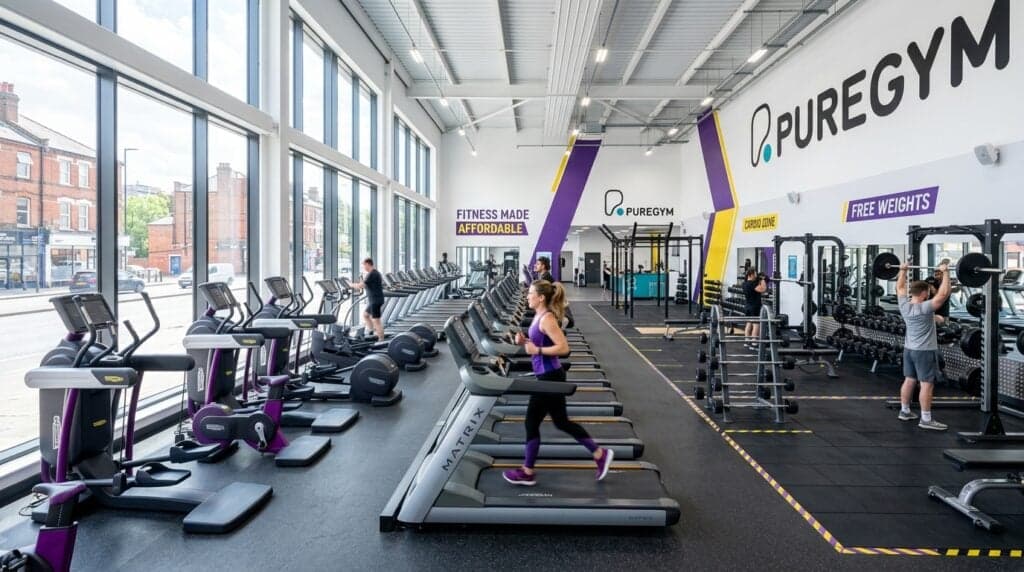
All four chains offer a solid range of cardio and resistance machines, free weights, and some form of studio space for classes, but the depth varies. PureGym and The Gym Group both run large free-weight areas at bigger sites and include group classes (HIIT, spin, yoga) in the membership price at most locations. Anytime Fitness clubs are generally smaller footprint, which means less equipment variety but often shorter queues for machines during peak hours.
Xercise4Less leans into scale — its warehouse-format clubs tend to have the most floor space and heaviest free-weight provision of the four, appealing to serious lifters, though studio class schedules can be thinner. None of the four chains include pools, saunas or spa facilities as standard; if that matters to you, you’re looking at a different tier of gym entirely.
App-based booking has become the norm across all four, and it’s worth trying before you join if class access matters to you. PureGym and The Gym Group both run their own apps for booking classes and checking live gym traffic, so you can see how busy a branch is before you leave the house. Anytime Fitness relies more on keyfob or biometric entry with less emphasis on class booking, reflecting its focus on round-the-clock independent training rather than a packed studio timetable.
Where Each Chain Is Strongest
Location strategy differs more than people realise. PureGym has grown into the largest network by site count, with a genuinely nationwide spread that means you’re rarely more than a short drive from one, from big cities down to mid-sized towns. The Gym Group has leaned harder into city centres and commuter towns, so it’s often the stronger option if you want a gym near a train station or office district rather than a retail park.
Anytime Fitness operates on a franchise model, which means individual clubs are often independently run within local communities — you’ll find it well represented in suburban high streets and smaller towns that the bigger chains sometimes skip, though total site numbers are lower than PureGym or The Gym Group. Xercise4Less has built its footprint around fewer, much larger warehouse-format clubs concentrated in the North of England, Midlands and parts of Scotland, so it’s less useful if you’re in the South East but excellent if you’re near one of its bigger sites.
Extra Costs to Watch For
The headline monthly price rarely tells the whole story. Several chains charge a one-off joining or administration fee, typically £10–£25, which sometimes gets waived during promotional periods — worth asking about before you sign up rather than after. Freezing your membership (useful if you’re injured, pregnant, or travelling for work) is usually free for a set number of weeks per year, but some plans charge a small monthly holding fee once you go beyond that allowance.
Group classes are included as standard at PureGym and The Gym Group, but some specialist sessions — reformer-style Pilates or dedicated boxing classes at larger sites — can carry a small supplementary charge. Personal training is essentially always an add-on cost across all four chains, usually booked directly with self-employed trainers who rent floor space rather than gym employees, so prices and quality vary considerably even within the same chain. It’s worth asking to trial a session before committing to a PT package on top of your membership.
Contracts, Freezing and Cancelling
The genuine selling point across all these chains is flexibility. Nearly every plan is rolling month-to-month with no long-term commitment, and most let you freeze membership for a set period if you’re injured or travelling. Where it gets messy is the cancellation process itself — notice periods typically run 30 days, payment dates don’t always align with when you submit notice, and some members get caught out by an extra month’s charge they didn’t expect.
If you’re planning to switch chains or drop your membership altogether, it’s worth reading through the notice periods and timing quirks in our guide to cancelling a gym membership in the UK before you give notice, so you’re not caught paying for a month you didn’t plan on.
So Which One Should You Actually Join?
There’s no single winner — it genuinely depends on your schedule and priorities. If price is the only factor, Xercise4Less or PureGym’s off-peak tier will usually come out cheapest. If you need guaranteed access at odd hours, Anytime Fitness is worth the higher fee. If you want the biggest choice of classes alongside a low price, The Gym Group and PureGym both compete well. And if floor space for serious lifting matters more than polish, Xercise4Less’s warehouse sites are hard to beat.
Rather than committing based on branding alone, it’s worth working through the wider decision systematically — things like distance from home versus work, class timetables, and how busy a specific branch gets at the times you’ll actually train. Our full checklist for choosing a gym in the UK walks through exactly that process step by step.
The Bottom Line
PureGym, The Gym Group, Anytime Fitness and Xercise4Less all deliver on the core budget-gym promise — low cost, no long-term contract, and enough kit to get a proper session in. The differences that matter are hyper-local: which branch is closest, whether it’s genuinely 24/7, and how busy it gets at your training time. Check the specific site before you check the logo, and you’ll end up with a gym you’ll actually keep using past January.
The quickest way to see how these chains stack up near you specifically is to compare real locations rather than national averages, since price and facilities can vary branch to branch even within the same chain. You can search and compare gyms near you on GymPal to see opening hours, facilities and member reviews side by side before you commit to a membership.

I am Adam Hall, a dedicated fitness professional with over ten years of experience in the UK’s fitness industry. I earned my Master’s degree in Sports Science from Loughborough University and have worked with several top fitness studios across the UK. My certifications include a Level 3 Personal Trainer Certificate and a specialised Strength and Conditioning Coach accreditation.
Starting my career as a personal trainer, I quickly moved up to manage multiple gym locations, overseeing their operations and training programs. Beyond managing gyms, I regularly contribute to well-known fitness magazines and have been featured in articles for “Health & Fitness” and “Men’s Health”. My passion also extends online where I run a popular blog on GymPal’s AI-powered directory platform detailing insights into choosing the right fitness venues across the UK. With hundreds of posts reaching thousands of readers monthly, my goal is to influence positive changes in how people approach health and exercise throughout the country.