How to Run a Successful Gym Open Day — Planning, Promotion and Follow-Up
Click Below To Share & Ask AI to Summarize This Article
Why Open Days Remain One of the Most Effective Sign-Up Events for Independent Gyms
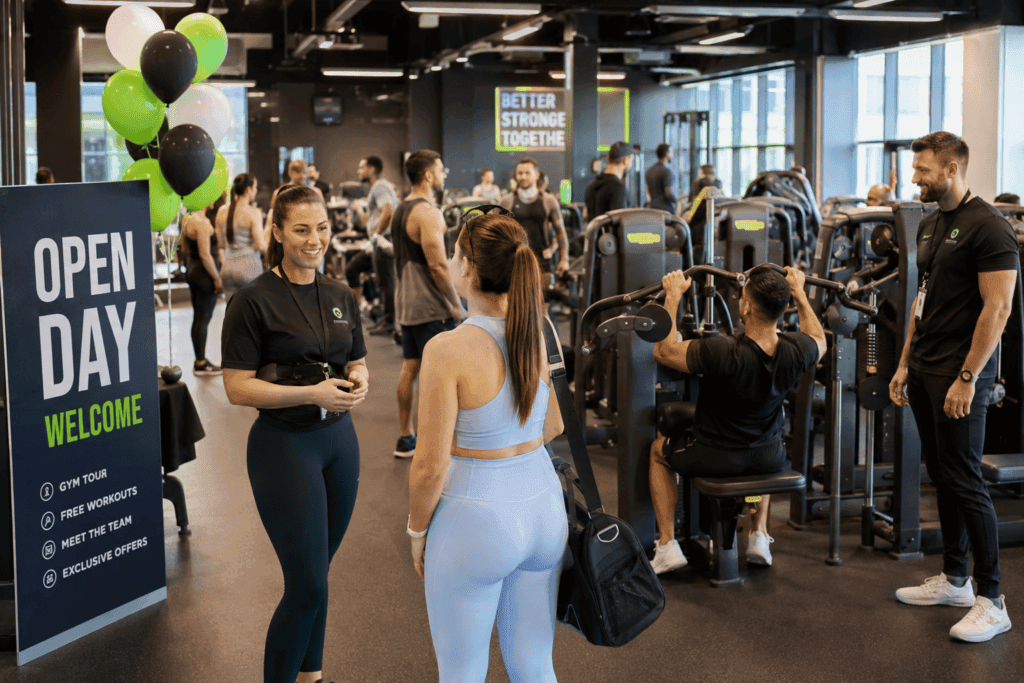
A well-run gym open day compresses weeks of normal member acquisition into a single day. It creates urgency, generates social proof (a busy gym on a Saturday morning looks and feels different from an empty one on a Tuesday afternoon), and gives prospective members an experience rather than a sales pitch. For independent gyms competing against chains with established brands and ongoing advertising, the open day is a moment where your size works in your favour — you can offer personal attention, genuine community, and flexibility that no chain can match., so differentiation is critical — your open day needs to offer something that browsing the website alone cannot.
September
The back-to-routine moment. Summer ends, school terms restart, and people who let their fitness slip over summer recommit. September open days benefit from lower advertising noise than January and a motivated audience. Families returning to routine are a particularly strong segment — a September open day that includes family-friendly taster sessions can access a demographic that January gym advertising largely misses.
After a refurbishment or new equipment arrival
Existing members are your best advocates and most eager audience when something significant changes. A new functional training zone, a new spin studio, or a major changing room refurb is a natural occasion for an open day that serves two purposes: re-energising existing members (who may be bringing friends) and giving prospective members a reason to visit now that they might not have had before.
Additional occasions: your gym’s anniversary, a charity fundraiser event (which double-functions as an open day), or a launch for a new class programme.
Planning Timeline: Eight Weeks Out to Event Day
Eight weeks before
- Set the date and confirm with all staff — open day requires full team commitment
- Define the event format: taster classes, tours, intro PT sessions, competitions, food/refreshments
- Set a specific sign-up offer available only on the day (not available the week before or after)
- Brief your PTs and class instructors on what they will deliver and what you need from them
Six weeks before
- Begin social media promotion (Facebook, Instagram, local Facebook groups)
- Design any printed materials: door drop flyers, window posters, A-boards for the gym exterior
- Contact local press with a press release — community newspapers and local lifestyle publications often cover independent gym events, especially if there is a charity angle or a human interest story
- Brief existing members — they are your promotional network and your best source of referrals for the event
Four weeks before
- Create a Facebook or Eventbrite event page to track registrations and build social proof
- Begin paid social advertising targeting local fitness-interested audiences within 5 miles
- Door drop flyers to residential streets within 1.5 miles
- Email existing members with a personal referral message: “Bring a friend who should be training here”
Two weeks before
- Reminder posts on all social channels
- Google Business Profile event post
- WhatsApp group reminder to existing members
- Final briefing to staff: who is doing what, what the sign-up offer is, how to handle objections
Event week
- Daily social posts building anticipation
- A-boards and exterior signage up from Monday
- Confirm class schedule and instructor availability
- Prepare sign-up station: tablet or laptop with membership software ready, printed terms, welcome packs
- Set up the gym for maximum visual impact: clean, well-lit, equipment neatly arranged, changing rooms spotless
What to Offer on the Day
Free taster classes
Run 2–3 taster sessions throughout the day in your most popular or visually impressive class formats. These should be shorter than normal (30–45 minutes) and designed for beginners — accessible, fun, and energetic. A great class experience is the most powerful conversion tool you have. A prospective member who has just had an excellent session is in an entirely different frame of mind from one who has been shown around the weights area.
Gym floor tours
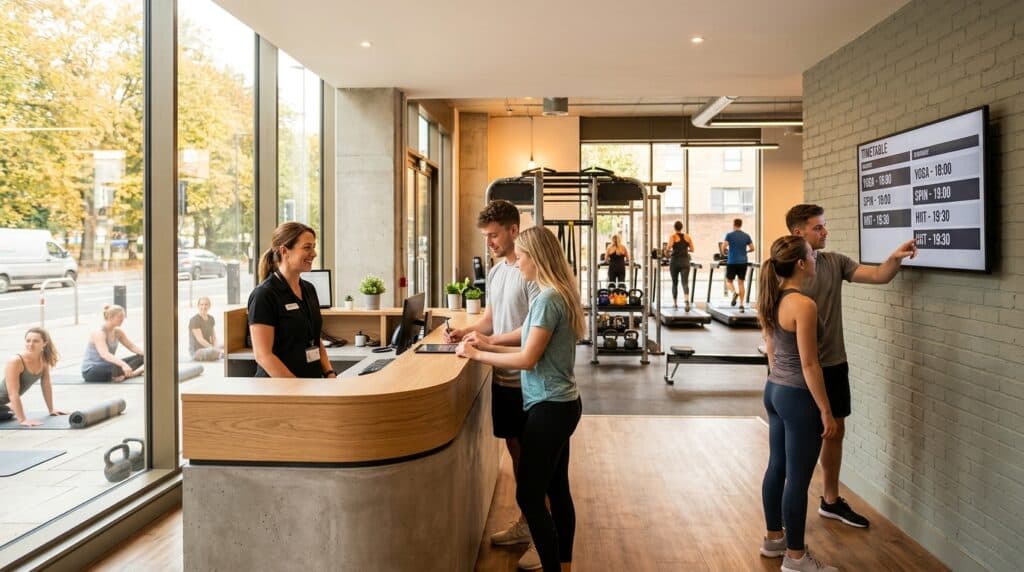
Offer structured tours every 30–45 minutes, led by a knowledgeable and enthusiastic staff member. The tour should feel like a conversation, not a presentation. Ask what the visitor is looking for; show them specifically what meets that need. A prospective member looking to lose weight should be shown the cardio equipment, the class schedule, and introduced to a PT — not given a tour of the powerlifting platform.
Free intro PT assessment
Offer 15–20 minute one-to-one PT consultations on the day. These have two functions: they are genuinely valuable to the prospective member (a real conversation about their goals with a qualified professional), and they are your most effective PT upsell. A member who has had a free consultation and been given a training recommendation is far more likely to book ongoing PT sessions.
Competitions and demonstrations
A kettlebell challenge, a rowing machine sprint, a strongman-style tyre flip competition — something participatory and energetic that creates noise, laughter, and social media content. These generate atmosphere in the gym and give attendees something to share on their own social media. User-generated content from your event has far more reach and credibility than your own promotional posts.
Food and refreshments
Protein shakes, smoothies, or healthy snacks create a social moment and keep people in the gym longer. Longer dwell time increases conversion. A prospective member who has done a taster class, had a tour, and then stayed for a smoothie and a conversation with your team has had a qualitatively different experience from one who popped in for five minutes.
The Sign-Up Offer: Making It Compelling and Time-Limited
An open day without a specific, time-limited sign-up offer leaves conversion on the table. Visitors who enjoy the experience but do not sign up on the day will intend to come back — and most will not. The on-the-day offer creates urgency that a general interest in joining does not.
Effective open day offers:
- Joining fee waived — if you normally charge a £20–30 joining fee, waiving it today creates a real financial incentive with minimal revenue impact
- First month at reduced rate — 50% off month one, or a specific price (e.g., first month for £20)
- Bundled value — membership plus a free PT session, or membership plus a 5-class pack
- 12-month offer — pay for 10 months, get 2 free — attractive to committed joiners and increases upfront payment
Whatever the offer, communicate it clearly throughout the day and ensure every staff member can articulate it simply. “Today only: join and your first month is free” is more powerful than a complex multi-tier discount structure that staff explain inconsistently.
Lead Capture: Converting Visitors Who Do Not Sign Up on the Day
Not everyone who attends will join on the day. Some are genuinely interested but want to think about it. Some have a financial constraint. Some are comparison shopping. All of them represent warm leads that a structured follow-up process can convert over the following weeks.
Capture leads on the day via a simple sign-in sheet or digital form: name, email, phone, what they are looking for. A tablet at the entrance with a brief form (“Register for our open day and we’ll follow up with our welcome offer”) works well.
Follow-up sequence:
- Day after the event: Personal email or message from the gym manager. “It was great meeting you yesterday. If you have any questions about joining, I’m happy to help. The open day offer is still available until [date — give 48–72 hours].”
- One week later: Follow-up message to anyone who has not responded. Keep it brief; do not be pushy. “Just wanted to check in — are you still thinking about joining?”
- Two weeks later: Final message with a small additional incentive if appropriate. “We’re running a brief introductory offer for people who visited our open day — [offer]. This closes on [date].”
Most conversions from non-same-day sign-ups happen within a week of the event. After three weeks, the probability of conversion drops sharply.
Measuring Open Day Success
Track three numbers after every open day:
- Attendees — how many people visited
- Same-day sign-ups — how many joined on the day
- Total sign-ups within 30 days — how many joined as a direct result (same-day plus follow-up conversions)
A well-executed open day at an independent gym should convert 15–30% of attendees to sign-ups within 30 days. Below 10% suggests either poor event quality, a weak offer, or inadequate follow-up. Review which element was the constraint and address it before the next event.
The Compounding Effect of Annual Open Days
Gyms that run open days consistently — twice a year, every year — build a local reputation as the gym that is engaged with its community. Attendees who do not join this year may join next year. Former members who attend as guests of existing members may rejoin. The event itself is marketing: an opportunity for your existing members to showcase what they love about your gym to the people in their lives. Over time, your open days become anticipated local events rather than promotional exercises — and that shift in character makes them progressively more effective.
GymPal helps UK fitness-seekers discover independent gyms like yours. Claim your free GymPal listing so every prospective member who hears about your open day and searches for you online finds a professional, complete profile.

I am Adam Hall, a dedicated fitness professional with over ten years of experience in the UK’s fitness industry. I earned my Master’s degree in Sports Science from Loughborough University and have worked with several top fitness studios across the UK. My certifications include a Level 3 Personal Trainer Certificate and a specialised Strength and Conditioning Coach accreditation.
Starting my career as a personal trainer, I quickly moved up to manage multiple gym locations, overseeing their operations and training programs. Beyond managing gyms, I regularly contribute to well-known fitness magazines and have been featured in articles for “Health & Fitness” and “Men’s Health”. My passion also extends online where I run a popular blog on GymPal’s AI-powered directory platform detailing insights into choosing the right fitness venues across the UK. With hundreds of posts reaching thousands of readers monthly, my goal is to influence positive changes in how people approach health and exercise throughout the country.