How to Train and Manage Gym Reception Staff — First Impressions and Member Retention

Click Below To Share & Ask AI to Summarize This Article
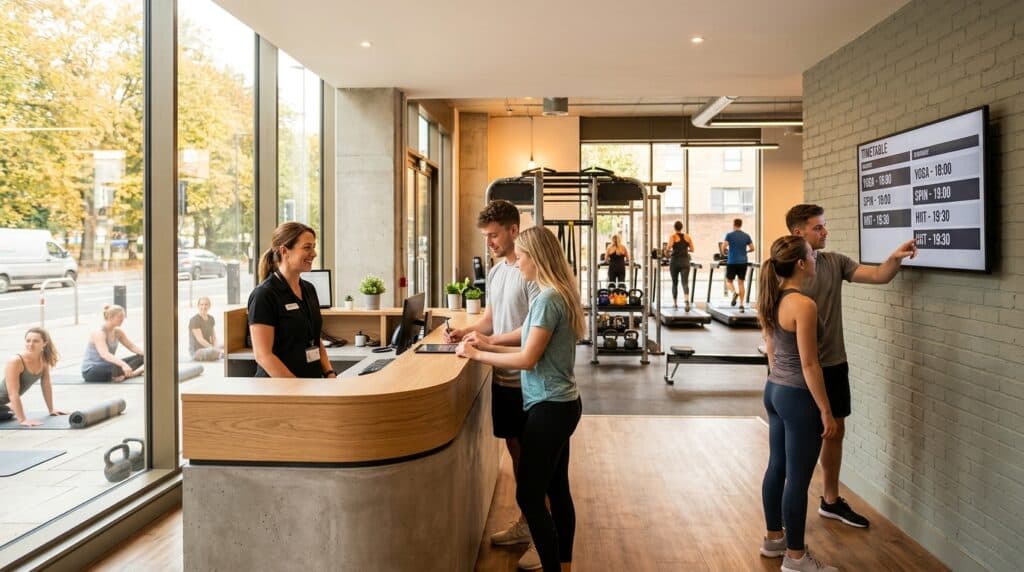
Why Reception Is Your Most Important Member Touchpoint
Every member who walks into your gym passes through reception. Every prospective member who calls or visits for the first time encounters your front desk before they encounter anything else. The quality of that interaction — whether warm and knowledgeable, or distracted and transactional — sets the tone for everything that follows. ensures they can represent your gym accurately and confidently from day one.
Week one: product and operations
- Full tour of the gym, including equipment names and uses, changing room layout, any restricted areas
- Membership tiers: pricing, inclusions, contract terms, freeze and cancellation policy
- Class timetable: what each class involves, who it is suitable for, how to book
- Staff introductions: who the PTs are, what they specialise in, how to refer members to them naturally
- Membership software: how to check in members, process new sign-ups, look up accounts, handle payments
- Opening and closing procedures: a documented checklist for every routine task
- Emergency procedures: first aid kit location, AED location, who to call in a medical emergency
Week two: service scenarios
- Shadowing experienced staff through common scenarios: showing a prospective member around, handling a membership enquiry, managing a complaint, directing a first-day member
- Role-play: a prospective member calls asking about prices. A member asks to cancel. A visitor complains about queue for equipment. Practice matters more than theory here.
- Feedback sessions: brief daily debrief on what went well and what to work on
Briefing Reception on Membership Sales — Without Making It Feel Like Sales
The most common mistake in briefing reception on converting prospective members is framing it as a sales task. “Try to get them to sign up” creates an awkward dynamic that both the receptionist and the prospective member feel. The better frame: reception’s job is to help prospective members make a good decision. If the gym is right for them, they will join.
Practical briefing points:
- Always offer a tour — a guided tour, even a 5-minute one, converts at significantly higher rates than handing someone a price list. A tour creates personal connection, allows the prospective member to visualise using the gym, and gives the receptionist the opportunity to understand what the visitor is looking for.
- Ask one question early — “What brings you in today? What are you hoping to achieve?” This question transforms the conversation from information delivery into a consultation. The answer also tells you exactly what to show them and which membership option to highlight.
- Know the current offer — reception staff should always know the current joining incentive and be able to state it naturally: “If you join today, we’re currently waiving the joining fee.” Not a hard sell — just a useful fact.
- Capture details if they do not join — “Can I take your name and number? I’ll send over our membership details so you have them to hand.” A lead captured today can be converted in a follow-up call this week.
Handling Complaints and Difficult Members at the Desk
Reception staff are the first point of contact for member complaints — whether about equipment, cleanliness, other members, class cancellations, or billing errors. A well-handled complaint retains a member; a poorly handled one creates a negative review and a cancellation.
Train reception staff in a simple complaint response framework:
- Listen fully — do not interrupt, do not get defensive, do not offer solutions before the member has finished explaining. The act of being heard reduces the emotional temperature significantly.
- Acknowledge — “I completely understand why that was frustrating. I’m sorry that happened.” Acknowledgement is not admission of fault; it is the recognition that the member’s experience matters.
- Resolve or escalate — if you can fix it (the locker is broken, the class was cancelled with no notice, the billing was wrong), fix it on the spot and follow up to confirm it is resolved. If it requires the manager’s decision, say so clearly: “I’m going to flag this to [name] today and they’ll be in touch by [time].” Then do it.
- Follow up — a brief message to the member after the issue is resolved: “Just wanted to let you know we’ve fixed [issue]. Thanks for letting us know.” This closes the loop and often converts an unhappy member into an appreciative one.
Opening and Closing Procedures: The Non-Negotiable Checklists
Opening and closing procedures should be documented, displayed at the desk, and signed off daily. This is not bureaucracy — it is the mechanism by which standards are maintained when the owner is not present. Typical gym opening checklist items:
- Equipment check: all machines functioning, no visible damage or hazards
- Changing rooms: clean, stocked (soap, toilet paper, hand towels if provided)
- Gym floor: clean, equipment in correct positions, free weights racked
- Reception: desk clean and organised, computer logged in, membership software open
- Safety: AED checked, first aid kit stocked, emergency procedures visible
- Signage: class timetable current, any special notices displayed
Closing procedures mirror the opening in reverse, with additions for security (locking equipment, securing the building, setting alarms) and end-of-day admin (reconciling any cash, noting any maintenance issues for the morning team).
How Front-Desk Quality Drives Retention
The correlation between reception quality and member retention is strong and underestimated. Members who feel known — whose name is remembered, whose progress is noticed, who receive a genuine “welcome back” rather than a mechanical check-in beep — feel a social connection to the gym that makes leaving psychologically costly. This is precisely the retention mechanism that independent gyms have over budget chains, and it is almost entirely delivered through the people at your front desk.
A simple practice with significant impact: brief reception staff at the start of each week on notable member milestones — who is approaching their one-year anniversary, who just had a personal best, who has been absent for two weeks and might benefit from a check-in message. This information is available in your membership software; turning it into action requires only a 10-minute weekly briefing. The members who receive that attention stay longer and refer more friends than those who do not.
GymPal connects UK fitness-seekers with independent gyms. Claim your free GymPal listing and ensure that when prospective members find you online, the same quality experience they get at the desk is reflected in your public profile.

I am Adam Hall, a dedicated fitness professional with over ten years of experience in the UK’s fitness industry. I earned my Master’s degree in Sports Science from Loughborough University and have worked with several top fitness studios across the UK. My certifications include a Level 3 Personal Trainer Certificate and a specialised Strength and Conditioning Coach accreditation.
Starting my career as a personal trainer, I quickly moved up to manage multiple gym locations, overseeing their operations and training programs. Beyond managing gyms, I regularly contribute to well-known fitness magazines and have been featured in articles for “Health & Fitness” and “Men’s Health”. My passion also extends online where I run a popular blog on GymPal’s AI-powered directory platform detailing insights into choosing the right fitness venues across the UK. With hundreds of posts reaching thousands of readers monthly, my goal is to influence positive changes in how people approach health and exercise throughout the country.