Gyms with Spas UK: Find Health Clubs with Pools, Saunas and Wellness Facilities
Click Below To Share & Ask AI to Summarize This Article
There’s a gym membership, and then there’s a gym spa membership. If you’ve ever finished a tough training session and wished you could slip straight into a sauna, or spend Saturday morning swimming laps before a long soak in a hot tub, you’re already thinking about the right category.
Gyms with spa facilities — often called health clubs — offer significantly more than a weights room and a row of treadmills. Think heated pools, steam rooms, saunas, plunge pools, and sometimes full treatment rooms and relaxation lounges. They’re less about banging out quick sessions and more about building a lifestyle around movement and recovery.
The catch? They’re not all created equal, and the price difference between a budget gym and a full-service health club can be significant. This guide breaks down what to look for, which UK chains deliver, what it actually costs, and how to find the right spa gym near you.
What Actually Makes a Gym a “Spa Gym”?
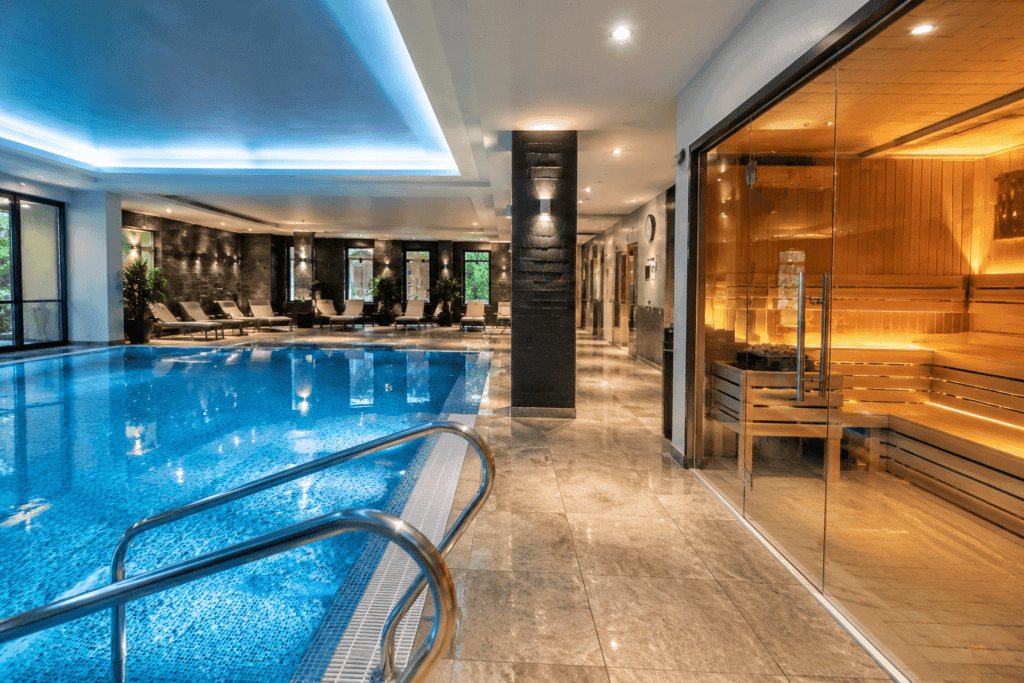
The term gets used loosely, so it helps to know what you’re comparing. A proper gym spa will typically include at least some of the following:
Core facilities:
- An indoor heated swimming pool (often 20–25 metres)
- Sauna (dry, infrared, or Himalayan salt)
- Steam room
- Jacuzzi or hot tub
Premium additions:
- Ice bath or cold plunge pool
- Treatment rooms for massage and therapies
- Relaxation lounge or quiet zone
- Wellness classes (yoga, guided meditation, aqua fitness)
- Salt room or halotherapy suite
The minimum benchmark for calling somewhere a spa gym is usually a pool plus at least a sauna or steam room. Anything below that and you’re really just looking at a gym with a warm shower.
It’s also worth noting the difference between a health club and a gym with spa bolt-on. A health club is built around the full wellness experience from the start — the layout, the facilities, the class timetable, and the membership price all reflect that. A gym with a sauna added as an afterthought can feel quite different in practice.
The Big UK Health Club Chains Worth Knowing
These are the main chains to consider if you’re after proper spa facilities across the UK.
David Lloyd Clubs
David Lloyd is widely regarded as the gold standard for gym spa facilities in the UK. Every club includes at minimum a whirlpool, sauna, and steam room. Larger clubs feature a dedicated Spa Retreat with more comprehensive treatment facilities, relaxation areas, and private treatment rooms.
David Lloyd has clubs in Birmingham, Brighton, Cambridge, Manchester, Bristol, Reading, Edinburgh, and many more. Membership prices typically start at around £60–80 per month depending on location, with premium tiers for full spa access and family memberships running higher.
Village Hotel Health & Wellness Clubs
Village Health & Wellness Clubs have 34 locations across the UK, covering Liverpool, Leeds, Solihull, Swindon, Cardiff, Coventry, and more. Each club includes a heated pool, sauna, steam room, and a whirlpool spa. Their Cardiff and Coventry sites have Himalayan Salt Saunas — worth seeking out if you’re a sauna enthusiast. Village memberships tend to be more competitively priced than David Lloyd, making them solid value at the mid-premium tier.
Bannatyne Health Clubs
With over 70 clubs across the UK, Bannatyne has strong coverage in Scotland, the North East, and the Midlands. Most clubs offer pool and spa facilities, though they vary by location — always worth checking exactly what a specific club includes before signing up. Bannatyne also runs its own spa treatment brand, so some locations have more comprehensive wellbeing offerings than others.
Third Space (London)
If you’re in London and the budget allows for it, Third Space gyms are a tier above. Marylebone has an 18-metre pool, sauna, and steam room. Mayfair features a Himalayan sea-salt walled sauna. Two new locations — Moorgate and Paternoster — opened in 2026. Memberships are premium-priced (often £150–250 per month in central London), but the facilities are genuinely world-class.
Nuffield Health
Nuffield Health operates over 110 fitness and wellbeing centres nationwide, with a particular focus on evidence-based wellness programming. Their premium centres include pools, saunas, and physiotherapy services. As a charity, Nuffield takes a more purposeful approach to health outcomes, which often translates into a slightly different atmosphere than the commercial chains.
What Does a Spa Gym Membership Cost in the UK?
Here’s a rough breakdown by tier:
| Club Type | Monthly Cost (Approx.) |
| Budget gym (no spa) | £20–40 |
| Mid-range with pool | £40–60 |
| Village / Bannatyne | £55–80 |
| David Lloyd | £70–120 |
| Third Space London | £150–250 |
| Hotel health club | £80–160 |
A few things significantly affect the price:
- Location: London and South East clubs cost considerably more than equivalent clubs in the North, Midlands, or Scotland
- Joining fees: Many chains charge a one-off joining fee of £20–100, often waived during promotional periods
- Peak vs off-peak: Some clubs offer cheaper memberships restricting usage to off-peak hours — worth it if you work flexible hours
- Family memberships: Often better value if a partner or children will also use the facilities
- Corporate memberships: Many employers have negotiated rates with major chains — worth checking through HR before paying full price
If you’re weighing up spa gym costs against a standard gym, budget gyms like PureGym, The Gym Group, and JD Gyms show just how wide the price gap is — but they offer no spa facilities. The decision really comes down to how much you’ll use the extras.
The Recovery Case for Spa Gyms
Spa facilities aren’t just a nice-to-have — there’s a genuine case for building recovery into your training routine, and the science increasingly backs it.
Regular sauna use has been linked to improved cardiovascular function, reduced muscle soreness, better sleep quality, and lower stress markers. Steam rooms support respiratory health and improve circulation. According to ukactive’s 2026 UK Health and Fitness Market Report, health clubs are increasingly being used as “hubs that support recovery services” alongside traditional exercise — with 12.2 million people now holding gym memberships across the UK.
Cold water exposure is another recovery method gaining mainstream traction. Cold water therapy at UK gyms — from plunge pools to contrast bathing circuits — has measurable benefits for reducing delayed onset muscle soreness (DOMS) and improving mood and alertness post-workout. The best spa gyms offer both heat and cold in one session, which is arguably the most effective recovery combination available without specialist equipment.
And if your spa gym has a pool, you’ve got zero-impact active recovery on tap. Pool workouts and aqua fitness are perfect between heavy training days — gentle on the joints, genuinely effective for cardiovascular fitness, and surprisingly enjoyable once you’re in.
Beyond the Big Chains: Hotel Gyms and Independent Health Clubs
The big chains get most of the attention, but there’s a broader ecosystem worth knowing about.
Hotel Health Clubs
Hotel health clubs are often underutilised by non-guests. Four and five-star hotels frequently have strong pools, saunas, and steam rooms — and many offer external memberships giving full access to the hotel spa without staying overnight. In London, places like Crowne Plaza Docklands offer heated pool, hot tub, sauna, steam room, and gym access. Similar setups exist at Marriott, Hilton, Hyatt, and Radisson properties across the UK, often with significantly better facilities than standalone gyms at comparable prices.
Leisure Centres with Spa Suites
These vary wildly by council and operator, but some leisure centres run by Places Leisure, Everyone Active, or GLL (Better Leisure) have genuinely comprehensive spa and wellness suites. Prices are often subsidised and significantly lower than private health clubs — worth checking what your local council operates before committing to a premium membership.
Boutique Wellness Studios
A growing number of boutique studios — particularly in London, Manchester, Bristol, and Edinburgh — are adding saunas, cold plunge pools, and contrast bathing facilities to their offering. These are typically smaller and more intimate than large health clubs, with a focus on community and guided recovery sessions rather than self-directed spa use. Prices can be high, but the experience is usually more personalised.
What to Check Before You Sign Up
Don’t just rely on the headline facilities list. Before committing to a spa gym membership, it’s worth checking these details in person:
- Pool size and temperature — A 10-metre pool used as a family splash zone on weekends is not the same as a 25-metre lap pool. Ask what the temperature is maintained at, too.
- Booking requirements — Some clubs require you to book pool and spa sessions in advance, especially at peak times. Find out how far ahead you need to book.
- Maintenance schedules — Saunas and steam rooms require regular deep cleaning. Ask how often facilities are serviced and whether there are regular closure periods.
- Opening hours — Spa facilities often close earlier than the main gym floor. Check the specific hours for the pool, sauna, and steam room rather than just the gym’s overall opening times.
- Contract terms — Minimum contract lengths, cancellation policies, and notice periods vary considerably between chains. Some require up to three months’ notice to cancel.
- Trial pass — Most good health clubs offer a one-day trial or guest pass. Use it on a Saturday morning — the busiest time — to get a realistic picture of how crowded the facilities get.
How to Find a Spa Gym Near You
The easiest way to find gyms with spa facilities near you is to use GymPal’s spa and wellness venue search — it filters venues by facility type, so you can quickly see which health clubs in your area have pools, saunas, and spa access without trawling through individual chain websites.
GymPal lists spa and wellness venues across the UK, covering everything from David Lloyd and Village to independent hotel health clubs and boutique wellness studios. You can filter by location, read venue details, and identify options worth visiting for a trial before committing.
The Bottom Line
A spa gym membership costs more than a budget gym — that’s unavoidable. But if you train consistently and want to invest in recovery as well as performance, the facilities justify the price. Saunas, steam rooms, and pools are tools, not luxuries; they make training more sustainable and recovery faster, which means you can do more and feel better doing it.
If you’re currently at a no-frills gym and wondering whether it’s worth upgrading, try a day pass at your nearest David Lloyd, Village, or Bannatyne first. You’ll know within a couple of visits whether the extra spend makes sense for your lifestyle.
And if you’re starting from scratch — or looking to switch — browse spa gyms near you on GymPal and find somewhere that actually matches how you want to train and recover.

I am Adam Hall, a dedicated fitness professional with over ten years of experience in the UK’s fitness industry. I earned my Master’s degree in Sports Science from Loughborough University and have worked with several top fitness studios across the UK. My certifications include a Level 3 Personal Trainer Certificate and a specialised Strength and Conditioning Coach accreditation.
Starting my career as a personal trainer, I quickly moved up to manage multiple gym locations, overseeing their operations and training programs. Beyond managing gyms, I regularly contribute to well-known fitness magazines and have been featured in articles for “Health & Fitness” and “Men’s Health”. My passion also extends online where I run a popular blog on GymPal’s AI-powered directory platform detailing insights into choosing the right fitness venues across the UK. With hundreds of posts reaching thousands of readers monthly, my goal is to influence positive changes in how people approach health and exercise throughout the country.