How to Get More Google Reviews for Your UK Gym (And Why They Matter More Than You Think)
Click Below To Share & Ask AI to Summarize This Article
carry more weight
If your profile is thin in any of these areas, you are losing potential members before they even see your website.
Seven Proven Strategies to Generate More Reviews
1. Ask at the Right Moment
Timing is everything. The best time to ask for a review is when a member is feeling positive about their experience. Natural trigger points include:
- After they hit a personal milestone (first pull-up, completing a programme)
- At the end of their first month (they have enough experience to give meaningful feedback)
- After a positive interaction with staff (a great class, helpful PT session)
- When they renew their membership
A simple, genuine request works best: “Hey, really glad you are enjoying the gym. If you have a spare minute, a Google review would mean a lot to us — it helps other people find us too.”
2. Make It Ridiculously Easy
Do not make members search for your Google Business Profile. Create a direct review link and put it everywhere:
- QR codes on reception desks and changing room mirrors
- A link in your email signature
- Automated SMS or email after key milestones
- A button on your website
You can generate your direct link by searching for your gym on Google Maps, clicking “Share,” then copying the URL. Add /reviews to the end of your Google Business Profile URL for a direct review prompt.
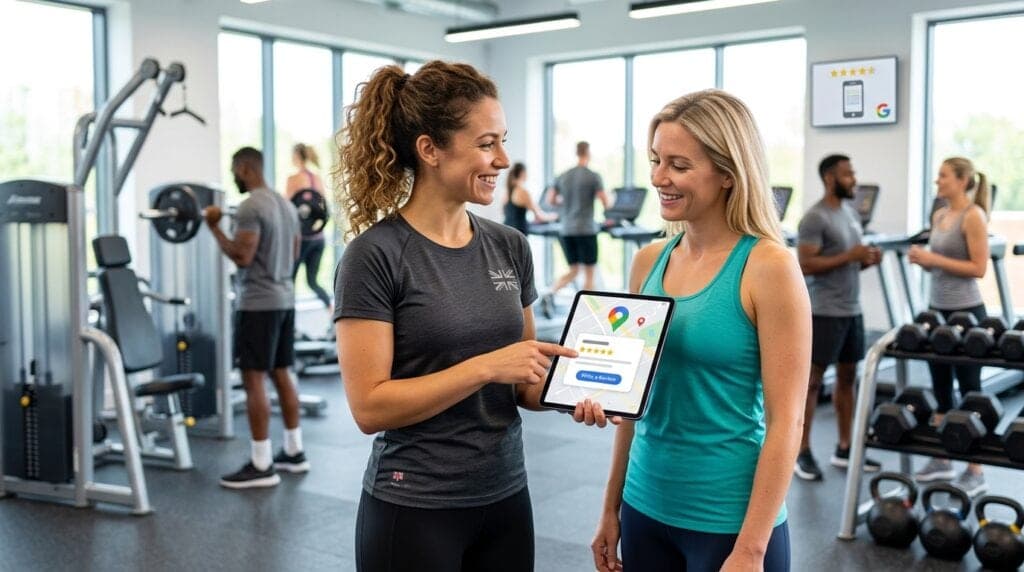
3. Train Your Staff to Ask
Your front desk team and personal trainers have more face-to-face contact with members than anyone. Brief them on the importance of reviews and give them a simple script. Make it part of the culture, not a KPI. When a member thanks a trainer for a great session, the natural response should include a gentle ask.
4. Run a Review Drive (Without Incentives)
Google’s policies prohibit incentivising reviews with discounts or freebies. However, you can absolutely run a time-limited “review drive” using legitimate channels:
- Announce it on your social media channels
- Put up signage in the gym
- Send an email to your member database explaining why reviews matter
Frame it around community: “Help us grow so we can invest more in the equipment and facilities you love.” People respond to that.
5. Reply to Every Single Review
This is non-negotiable. Replying to reviews — both positive and negative — signals that you are an active, engaged business. For positive reviews, thank the member and reference something specific they mentioned. For negative reviews, acknowledge the concern, explain how you are addressing it, and invite them to discuss it privately.
Bonus: responding to reviews actually improves your local SEO ranking, which means your gym shows up higher in “near me” searches.
6. Leverage Your Social Proof Across Platforms
Google is the primary review platform, but do not neglect others. Facebook, Trustpilot, and fitness-specific platforms all contribute to your overall online presence. Embed review snippets on your website. Share standout reviews on Instagram Stories. The more visible your reputation, the more trustworthy you appear.
This is where being listed on fitness directories gives you another advantage. A presence on GymPal, for example, puts your gym in front of people actively searching for fitness options in your area — and your Google reviews reinforce the decision to visit.
7. Create a System, Not a One-Off Push
The most successful gyms treat review generation as an ongoing process, not a quarterly campaign. Build it into your operations:
- Add “ask for review” to your onboarding checklist for new members
- Include review requests in your monthly member email
- Track your review count and average rating monthly
- Celebrate review milestones with your team
Reviews and Directory Listings: A Powerful Combination
Google reviews and directory listings like GymPal work together to build a complete online presence. Here is how:
| Channel | Role |
|---|---|
| Google Business Profile | Primary discovery engine — shows up in Maps and local search |
| Fitness directories (e.g. GymPal) | Targeted audience — people specifically looking for gyms, with filters for facilities, location, and price |
| Social media | Brand building and community engagement |
| Your website | Conversion hub — where browsers become visitors |
If your gym is not yet listed on GymPal, you are missing out on a growing audience of UK fitness seekers. Claim your free listing — it takes minutes and puts you in front of thousands of potential members who are ready to find their next gym.
How to Handle Negative Reviews
No gym is immune to negative feedback. The odd one- or two-star review is actually normal and can even enhance credibility (perfect five-star ratings with hundreds of reviews look suspicious). What matters is how you handle it.
- Respond within 24 hours — speed shows you care
- Stay professional — never get defensive or argumentative
- Acknowledge the issue — validate their experience
- Offer a resolution — invite them to contact you directly
- Follow up — if the issue is resolved, a positive update can transform a negative review into a redemption story
Prospective members read your negative reviews as much as your positive ones. They are looking to see whether you are the kind of business that listens and improves.
Track Your Progress
Set up a simple monthly review of your Google Business Profile metrics:
- Total number of reviews
- Average star rating
- Number of new reviews this month
- Response rate and average response time
- Top keywords mentioned in reviews
Free tools like Google’s own Business Profile dashboard provide all of this data. Review it monthly and adjust your approach based on what is working.
The Bottom Line
In an industry where the big chains dominate search results with sheer scale, independent UK gyms have a genuine competitive advantage: authenticity. Your members are not anonymous numbers — they are people who chose your gym for a reason. Channel that loyalty into reviews, and you will build an online reputation that no marketing budget can buy.
Start today. Ask one member. Share one QR code. Reply to one review. Small, consistent actions compound into a reputation that drives new members through your door.
Already listed on GymPal? Make sure your profile is up to date with your latest facilities, class schedule, and contact details. Not listed yet? Claim your free GymPal listing and reach thousands of UK fitness seekers looking for exactly what you offer.
Is your gym listed on GymPal? Over 10,000 UK fitness businesses are in our directory. Claim your free listing in 5 minutes — and start getting discovered by local fitness seekers today.

I am Adam Hall, a dedicated fitness professional with over ten years of experience in the UK’s fitness industry. I earned my Master’s degree in Sports Science from Loughborough University and have worked with several top fitness studios across the UK. My certifications include a Level 3 Personal Trainer Certificate and a specialised Strength and Conditioning Coach accreditation.
Starting my career as a personal trainer, I quickly moved up to manage multiple gym locations, overseeing their operations and training programs. Beyond managing gyms, I regularly contribute to well-known fitness magazines and have been featured in articles for “Health & Fitness” and “Men’s Health”. My passion also extends online where I run a popular blog on GymPal’s AI-powered directory platform detailing insights into choosing the right fitness venues across the UK. With hundreds of posts reaching thousands of readers monthly, my goal is to influence positive changes in how people approach health and exercise throughout the country.