How to Turn Your Gym Into a Local Authority on Google: An SEO Primer for UK Gym Owners
Click Below To Share & Ask AI to Summarize This Article
Why Local SEO Matters for Gyms
When someone in your town searches for “gym near me,” “best gym in [your city],” or “personal training near me,” there are typically only three to five spots on the first page of Google that matter — the local pack. If your gym is not in those results, you are invisible to the people most likely to join. is the process of making your gym rank higher in these local search results. It is not about gaming the system — it is about making sure Google understands who you are, where you are, and what you offer, so it can match you with the right people.
This guide covers the practical steps any UK gym owner can take to improve local search visibility without hiring an agency.
Step 1: Optimise Your Google Business Profile
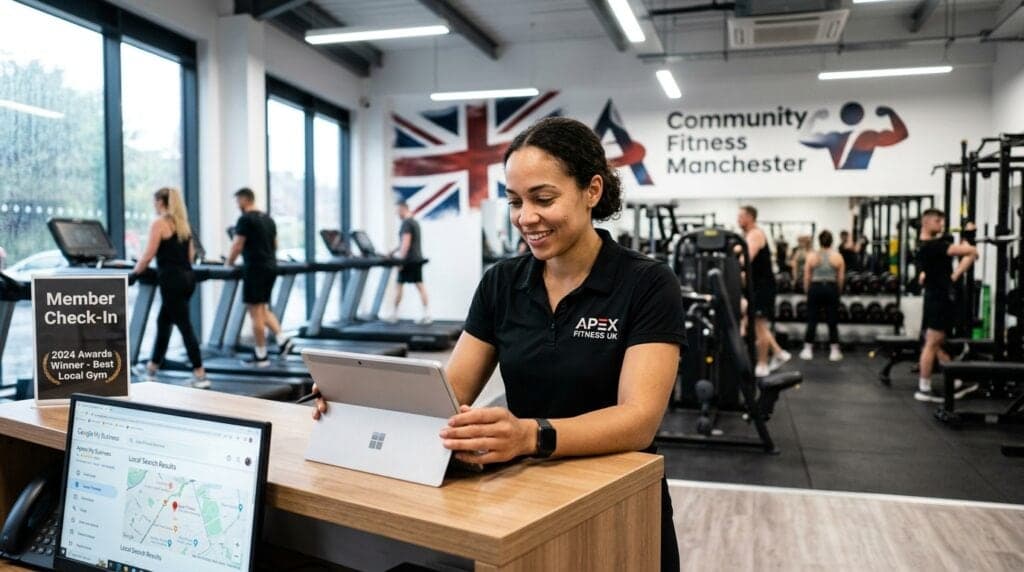
Your Google Business Profile (GBP) is the single most important factor in local rankings. If you have not claimed and optimised yours, do that first. Our full guide covers the details, but here are the key points for SEO:
- Primary category: Set to “Gym” or “Fitness centre”
- Secondary categories: Add “Personal trainer,” “Weight loss centre,” “Yoga studio” as appropriate
- Description: Include your location and key services naturally (e.g. “independent gym in Bristol offering strength training, personal training, and group fitness classes”)
- Photos: Upload at least 15-20 high-quality photos. Google rewards active profiles.
- Posts: Publish weekly updates (offers, events, news)
- Reviews: Actively ask for and respond to reviews
Step 2: Make Sure Your NAP Is Consistent Everywhere
NAP stands for Name, Address, and Phone number. Google uses NAP consistency as a trust signal. If your gym name, address, or phone number is different on your website, Google Business Profile, Facebook page, GymPal listing, and local directories, Google gets confused and may rank you lower.
Audit your NAP across these platforms:
- Google Business Profile
- Your website
- Facebook page
- Instagram profile
- Yelp / Trustpilot
- GymPal listing
- Any local directory listings (Thomson Local, Yell, etc.)
Make sure your name is formatted identically everywhere (e.g. always “Ironhouse Gym Bristol” — not “Ironhouse Gym” on one platform and “Ironhouse Gym, Bristol” on another).
Step 3: Build Location Pages on Your Website
If your website has separate pages for different services or locations, each page should be optimised for local search. Even if you have a single location, your key pages should include:
- Your city or area name in the page title (e.g. “Personal Training in Bristol | Ironhouse Gym”)
- Your full address and a Google Map embed
- Your phone number
- Local keywords naturally woven into the content (e.g. “Our Bristol gym offers…”)
Create dedicated pages for your key services that people search for:
- /personal-training-[your-city]
- /group-classes-[your-city]
- /free-trial-[your-city]
Step 4: Collect and Manage Reviews
Google reviews are a top-three local ranking factor. But they also influence click-through rate — a gym with 4.8 stars and 80 reviews will get significantly more clicks than one with 3.5 stars and 12 reviews, even if ranked lower.
Review strategy:
- Ask every new member for a Google review after their first week
- Ask after positive experiences (hitting a milestone, great class)
- Make it easy with a direct review link sent via text or email
- Respond to every review — positive and negative
Aim for at least 5-10 new reviews per month. Over 6 months, that builds a significant body of social proof.
Step 5: Get Listed on Relevant Directories
Being listed on fitness and local directories provides two benefits: backlinks (which improve your website’s authority) and additional places for potential members to find you.
Priority listings:
- GymPal — UK fitness-specific directory with high intent audience
- Yelp UK
- Trustpilot
- Thomson Local
- Yell.com
- Bark.com (if you offer personal training)
For each listing, use identical NAP information and include a link back to your website where possible.
Step 6: Create Local Content
Content that references your local area signals relevance to Google. Blog posts, pages, and resources that include local keywords help you rank for location-based searches. Ideas include:
- “Best running routes in [your city]”
- “A guide to healthy eating in [your area]”
- “Gym etiquette tips for our [your city] members”
- “Why we opened our gym in [your neighbourhood]”
- “Local fitness events in [your city] this month”
This content does not need to be long or complex. Even 500-800 words per post, published monthly, can make a significant difference over time.
Step 7: Technical SEO Basics for Your Website
You do not need to be a developer to handle the basics:
- Mobile-friendly: Google indexes mobile-first. If your site is not mobile-friendly, it will not rank well.
- Fast loading: Aim for pages to load in under 3 seconds. Compress images and use a fast hosting provider.
- SSL certificate: HTTPS is a ranking signal. Your site should have it (most website builders include it free).
- Schema markup: Add LocalBusiness schema to your site. This helps Google understand your business information. Most website builders have plugins or built-in tools for this.
- Sitemap: Submit an XML sitemap to Google Search Console. This helps Google find and index all your pages.
- Google Search Console: Set this up (it is free) to monitor your indexing, search performance, and any technical issues.
Step 8: Track Your Progress
SEO is a long-term investment. You will not see results overnight, but you should see measurable improvement within 3-6 months. Track these metrics:
| Metric | How to Track | Target |
|---|---|---|
| Google Maps ranking | Search for “gym near me” from different locations | Top 3 local pack |
| Organic website traffic | Google Analytics (free) | Growing month on month |
| Google Business Profile views | GBP Insights dashboard | Growing month on month |
| Phone calls from GBP | GBP Insights dashboard | Growing month on month |
| Direction requests | GBP Insights dashboard | Growing month on month |
| Review count and rating | GBP and manual tracking | 4.5+ stars, 50+ reviews |
| Keyword rankings | Google Search Console or Ubersuggest (free) | Top 10 for target keywords |
How GymPal Supports Your SEO Strategy
Your GymPal listing contributes to your SEO in several ways:
- A backlink to your website (improves domain authority)
- A presence on a domain with existing SEO authority for fitness-related searches
- Additional reviews and social proof that reinforce your reputation
- Visibility to a fitness-specific audience with high purchase intent
Combined with a strong Google Business Profile and well-optimised website, a GymPal listing completes your local search presence.
The Bottom Line
Local SEO is not complicated — but it does require consistency. The gym owners who rank highest in local search are not necessarily the ones with the biggest budgets or the best websites. They are the ones who have claimed their profiles, built consistent citations, collected reviews steadily, and published local content regularly.
Start with the quick wins: claim and optimise your Google Business Profile, audit your NAP consistency, and start asking for reviews. Then build from there. Over 3-6 months, these small, consistent actions will compound into significantly better local visibility and more enquiries through your door.
Boost your local search visibility by claiming your free GymPal listing. It takes minutes, provides a valuable backlink, and puts your gym in front of thousands of UK fitness seekers. One more place for Google to find you — and one more channel for members to discover you.
Is your gym listed on GymPal? Over 10,000 UK fitness businesses are in our directory. Claim your free listing in 5 minutes — and start getting discovered by local fitness seekers today.

I am Adam Hall, a dedicated fitness professional with over ten years of experience in the UK’s fitness industry. I earned my Master’s degree in Sports Science from Loughborough University and have worked with several top fitness studios across the UK. My certifications include a Level 3 Personal Trainer Certificate and a specialised Strength and Conditioning Coach accreditation.
Starting my career as a personal trainer, I quickly moved up to manage multiple gym locations, overseeing their operations and training programs. Beyond managing gyms, I regularly contribute to well-known fitness magazines and have been featured in articles for “Health & Fitness” and “Men’s Health”. My passion also extends online where I run a popular blog on GymPal’s AI-powered directory platform detailing insights into choosing the right fitness venues across the UK. With hundreds of posts reaching thousands of readers monthly, my goal is to influence positive changes in how people approach health and exercise throughout the country.