Pilates for Back Pain: A Desk Worker’s Guide to a Stronger Back (UK)
Click Below To Share & Ask AI to Summarize This Article
If you spend eight hours a day at a desk, you know the feeling. It starts as a faint stiffness around 10am. By mid-afternoon your lower back is grumbling, your shoulders have crept up towards your ears, and by the time you stand up at 5pm you’re moving like someone twice your age. You’re not broken — you’re just a UK desk worker.
Back pain is one of the leading causes of sickness absence in Britain, with millions of working days lost to it every year, and the shift to hybrid working has made many of us more sedentary, not less. The kitchen-table office and the sofa laptop are doing your spine no favours. Yet the most effective fix for most desk-related back pain isn’t a fancy chair, a standing desk, or even a physio appointment. It’s movement — specifically, the right kind of movement, done regularly.
That’s where Pilates comes in. It’s low-impact, it’s built around the exact muscles your desk job switches off, and it was quite literally designed around postural health. In this guide we’ll cover why sitting hurts your back so much, how Pilates targets the problem at the source, five moves you can start today, whether mat or reformer classes suit a sore back best, and how to find a class near you in the UK.
Why Sitting All Day Wrecks Your Back
Your body is brilliantly adaptive — and that’s precisely the problem. When you sit for hours, your hip flexors shorten and tighten, your glutes switch off from lack of use, and your deep core muscles go to sleep because the chair does their job for them. Meanwhile, slumping forward loads your lower back far more than standing does, and your head — which weighs roughly 5kg — drifts forward of your shoulders, forcing your neck and upper back muscles to hold it up like a fishing rod with a heavy weight on the end.
Estimates suggest the average UK office worker racks up nine or more hours of sitting a day, once the commute, the sofa and the scrolling are factored in. Over weeks and months, your body adapts to that shape. Tight hips, sleepy glutes, a weak midsection and a rounded upper back become your default setting — and your lower back gets stuck absorbing forces it was never designed to handle alone.
Worse is the cycle that follows: your back hurts, so you move less, so the supporting muscles get weaker, so your back hurts more. If you’re tempted to answer that cycle with total rest, hold that thought — our guide to rest and recovery explains why, for most stiff, non-specific back pain, gentle structured movement beats the sofa almost every time.
How Pilates Targets Back Pain at the Source
Pilates was developed by Joseph Pilates in the early 20th century, partly to rehabilitate bedridden patients, and its entire philosophy centres on what he called the “powerhouse” — the deep trunk muscles that stabilise your spine. We’re not talking six-pack abs. We’re talking the transverse abdominis (your internal corset), the multifidus (tiny muscles running along your spine), the pelvic floor and the diaphragm. These are the exact muscles that go dormant when you sit all day.
A good Pilates class wakes them up. Every exercise is built around controlled, deliberate movement from a neutral spine position, with breathing patterns that engage the deep core before anything else moves. You’ll also spend real time on spinal mobility — flexing, extending and rotating through each segment of the back — which directly counters the frozen, hunched posture your desk imposes on you. Where most gym training strengthens the big prime movers, Pilates trains the small stabilisers that keep your spine aligned while those big muscles do their work.
Official guidance backs the movement-first approach: the NHS’s advice on back pain puts keeping active — including exercises like Pilates, swimming and walking — right at the top of the list for managing and preventing most lower back pain.
One important caveat: Pilates is brilliant for common, non-specific desk back pain, but it’s not a substitute for medical care. If your pain shoots down your leg, came on after an injury, is getting worse, or comes with numbness, tingling or other worrying symptoms, see your GP or a physiotherapist before starting any new exercise programme.
Five Pilates Moves Every Desk Worker Should Know
You don’t need a studio to start undoing the damage — a patch of living room carpet and ten minutes will do. Here are five foundation moves, in the order most Pilates teachers would introduce them.
- Pelvic tilts. Lie on your back, knees bent, feet flat. Gently flatten your lower back into the floor by tilting your pelvis, then release. Ten slow reps. This is the gentlest possible way to find and switch on your deep core, and it’s ideal if your back is very sensitive.
- Cat-cow. On all fours, arch your spine up towards the ceiling (cat), then let it sink while your chest lifts (cow). Move slowly, one vertebra at a time. Eight to ten rounds mobilises your whole spine and is perfect first thing in the morning or last thing at night.
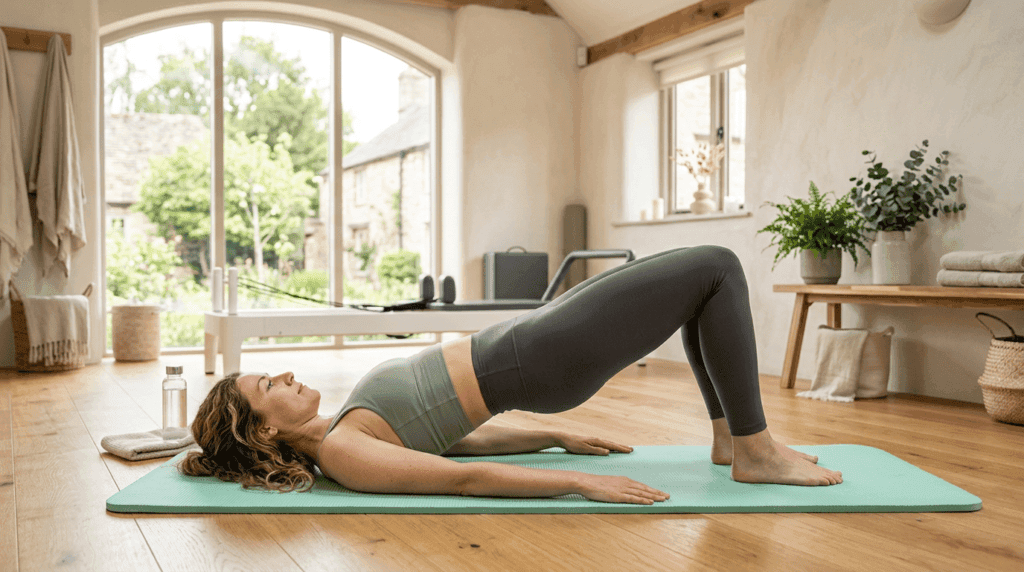
- Bridging. Still on your back, peel your hips up towards the ceiling one segment at a time, then lower with control. Ten reps. This fires up the glutes your office chair switched off, so your lower back stops doing their job.
- Seated spine twist. Sit tall on your chair or on the floor, inhale to lengthen up, exhale and rotate to one side. Five each way. This unlocks the mid-back, which is where most desk hunch lives, and you can do it between meetings without anyone noticing.
- The swan. Lying on your front, hands under your shoulders, gently press up to extend your spine — only as far as feels comfortable — then lower. Five to eight reps. Extension work is the direct antidote to the all-day forward hunch.
A practical tip that beats any single exercise: set a recurring 45-minute reminder to stand up and move for two minutes. Your spine is designed for regular position changes, not heroic weekend workouts after five static days.
Mat or Reformer — Which Is Better for a Sore Back?
Once you start looking at classes, you’ll spot two types: mat Pilates, done on a cushioned mat, and reformer Pilates, done on a bed-like machine with a sliding carriage, springs, ropes and a footbar. Both build the same deep core strength, but they feel very different.
Mat classes are cheaper — typically £6 to £15 for a drop-in at UK leisure centres and community halls, and often less with a block booking — and you can practise anywhere. The catch is that supporting your own body weight from day one can be tough if your core is very deconditioned, though a good teacher will layer in modifications.
Reformer classes tend to suit bad backs beautifully. The carriage supports your body while the springs provide resistance, which lets you move through full ranges of motion without loading your spine — many people with cranky backs find they can do more on a reformer than on a mat. The trade-off is price: expect £20 to £40 per class in London and £18 to £28 elsewhere, though intro offers and class packs soften the blow. If you’re weighing up the machine, our beginner’s guide to reformer Pilates walks through how the springs and carriage actually work, what a first class feels like and what it should cost.
What Your First Class Is Really Like
If you’ve never done a group fitness class before, Pilates is one of the gentlest possible entries. There’s no jumping, no blaring music and no pressure to keep up — most of the class is done lying down or on all fours, moving slowly while the instructor talks you through which muscles should be working. You’ll wear normal comfortable gym kit, and many studios ask for grippy socks.
Do tell the instructor about your back before the class starts. A qualified teacher — look for a minimum of a Level 3 Pilates qualification, or a reputable school such as Body Control Pilates, STOTT or Polestar — will happily modify anything that doesn’t suit you. Small class sizes help here, which is worth checking when you book.
If you’re still building confidence about walking into any class for the first time, our complete beginner’s guide to Pilates covers the kit, the jargon and exactly what to expect, so nothing on the timetable can ambush you.
How to Find Pilates Classes Near You
Pilates is everywhere in the UK right now — council leisure centres, David Lloyd and Nuffield Health clubs, dedicated reformer studios, physiotherapy clinics running clinical Pilates, and independent teachers hiring church halls from Aberdeen to Truro. The hard part isn’t finding a class; it’s finding the right one.
GymPal takes the legwork out of it: we list Pilates studios and classes across the UK, so you can search by postcode, compare prices, check timetables and filter by class type — mat or reformer, beginner or improver — in a few taps rather than a dozen browser tabs.
As a rule of thumb: if your main goal is a nagging desk back, look for a beginner or foundation-level mat class, or a small-group reformer class with a beginner pathway. Clinical Pilates run by physios is worth the premium if your back has a history. And take advantage of intro offers — most studios will let you try a first class at a reduced rate so you can tell whether the teaching style suits you.
Your Back Deserves Better Than Your Desk Chair
Desk-related back pain is rarely about one bad chair or one long week — it’s the accumulated cost of thousands of hours of sitting, and it responds to the same medicine: regular, intelligent movement. Two or three Pilates sessions a week, plus a few pelvic tilts and spine twists at your desk, can genuinely change how your back feels by the end of month one.
You don’t need to be flexible, fit or coordinated to start — you need a mat, an hour a week and a teacher who knows what they’re doing. Search Pilates classes near you on GymPal and book your first session this week. Your spine will thank you by Friday.

I am Adam Hall, a dedicated fitness professional with over ten years of experience in the UK’s fitness industry. I earned my Master’s degree in Sports Science from Loughborough University and have worked with several top fitness studios across the UK. My certifications include a Level 3 Personal Trainer Certificate and a specialised Strength and Conditioning Coach accreditation.
Starting my career as a personal trainer, I quickly moved up to manage multiple gym locations, overseeing their operations and training programs. Beyond managing gyms, I regularly contribute to well-known fitness magazines and have been featured in articles for “Health & Fitness” and “Men’s Health”. My passion also extends online where I run a popular blog on GymPal’s AI-powered directory platform detailing insights into choosing the right fitness venues across the UK. With hundreds of posts reaching thousands of readers monthly, my goal is to influence positive changes in how people approach health and exercise throughout the country.