Pilates for Beginners: Everything You Need to Know Before Your First UK Class
Click Below To Share & Ask AI to Summarize This Article
Pilates has gone from a niche rehabilitation technique to one of the most popular fitness classes in the UK — and for good reason. Whether you’ve spotted a reformer studio popping up on your high street, seen your friends post about it on Instagram, or simply want a workout that builds real strength without wrecking your joints, Pilates deserves your attention.
But if you’ve never set foot on a mat or near a reformer machine, it can feel a little intimidating. What even is Pilates? Is it just posh stretching? How much does it cost? And where do you actually find a class? This guide answers all of those questions so you can walk into your first session with confidence.
Pilates was developed in the early 20th century by Joseph Pilates as a system of controlled movement focused on core stability, posture, alignment, and precise muscle engagement. Today it’s practised by millions of people in the UK — from elite athletes and dancers to complete beginners and those recovering from injury.
Mat Pilates vs Reformer Pilates: What’s the Difference?
The first decision you’ll face as a beginner is choosing between mat and reformer Pilates. They share the same principles but feel quite different in practice.
Mat Pilates is done on the floor using just a mat and your own bodyweight. It’s the most accessible starting point: classes are widely available at gyms, leisure centres, and community halls, and they’re typically the most affordable option. You’ll focus on controlled movements, breathing patterns, and building core awareness.
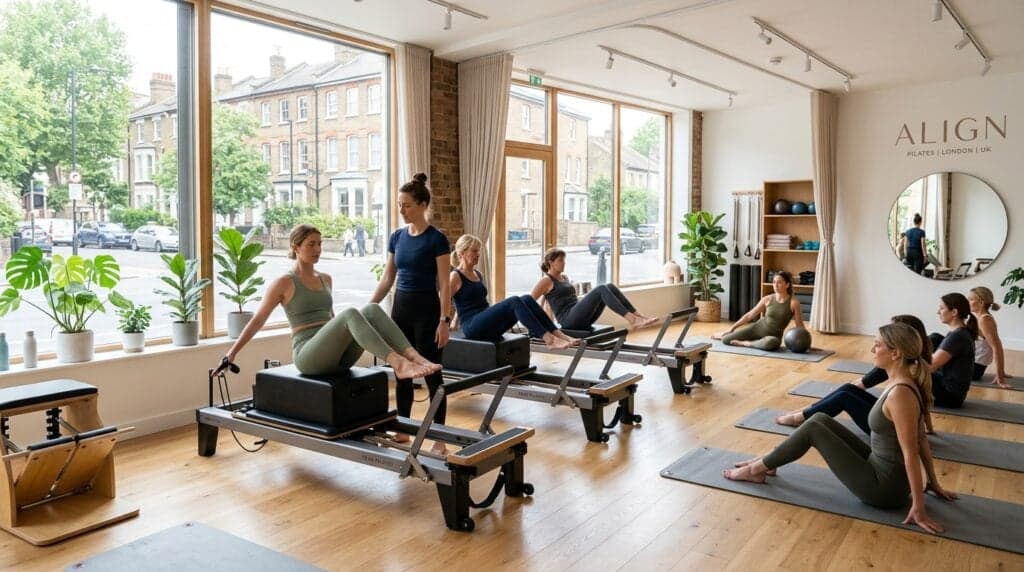
Reformer Pilates uses a sliding carriage, springs, straps, and pulleys to create adjustable resistance. It feels more like using equipment at a gym — you’re working against the spring tension rather than just gravity. Reformer studios offer a more personalised, small-group experience, and many people find reformer movements easier on their joints than mat work. The trade-off is cost: reformer sessions are significantly pricier.
For most beginners, mat Pilates is the natural entry point. It builds the foundational body awareness you need to get more from reformer work later. That said, many studios now run beginner reformer programmes specifically designed for newcomers, so don’t rule it out.
Why Pilates Is Worth Your Time
The benefits of regular Pilates practice go well beyond “stronger core” — though that’s certainly part of it.
Core strength and stability: Pilates is one of the most effective ways to build genuine core strength — not just visible abs, but the deep stabilising muscles around your spine and pelvis. This has knock-on benefits for almost every other physical activity you do.
Posture correction: Most of us spend hours hunched over desks or phones. Pilates counteracts this by strengthening the muscles that hold you upright. Regular practitioners often notice an improvement in how they carry themselves within just a few weeks.
Flexibility and mobility: Pilates lengthens and stretches muscles through controlled range-of-motion work. If you already enjoy [yoga classes across the UK](https://askgympal.co.uk/blog/yoga-classes-uk-find-right-style/), you’ll recognise some of that same emphasis on movement quality and body awareness — though Pilates is more focused on strengthening through length rather than deep passive stretching.
Injury rehabilitation and prevention: Pilates was originally developed as a rehabilitation system, and it’s still widely used by physiotherapists and sports medicine professionals. The low-impact nature makes it ideal for those recovering from back problems, joint pain, or muscle injuries.
Mental focus: Each exercise requires genuine concentration. Pilates is sometimes called “the thinking person’s workout” — you can’t zone out and scroll your phone. Many people find this mental engagement part of what makes it so restorative.
What to Expect at Your First Pilates Class
Knowing what awaits you makes everything less daunting. Here’s a realistic picture of a typical beginner Pilates session in the UK.
Class size: Mat Pilates classes at leisure centres or gyms might have 15–20 people. Boutique studios — particularly reformer studios — tend to keep groups much smaller, often 6–10 people. Smaller classes mean more attention from the instructor, which matters a lot when you’re learning the movement patterns.
What to wear: Fitted, stretchy clothing works best — you don’t want baggy tops falling over your head when you’re upside down. Pilates is usually done barefoot or in grip socks (many reformer studios sell these or require them for hygiene reasons).
The session itself: A standard class runs 45–60 minutes. It will move through a series of exercises — some in lying, some sitting, some standing — with the instructor cueing your breathing and alignment throughout. Don’t worry if you can’t do everything perfectly; correct form matters far more than completing a movement.
After class: You’ll likely feel worked — particularly in your core and inner thighs — without the heavy, depleted sensation that comes from intense cardio or strength training. A good recovery approach, whether that’s stretching, proper sleep, or accessing [gym and spa facilities nearby](https://askgympal.co.uk/blog/gym-spa-facilities-uk-train-recover/), will help you feel the benefits sooner.
How Much Does Pilates Cost in the UK?
Pilates prices vary considerably depending on the format and location.
Mat Pilates at a leisure centre or chain gym: If it’s included with your membership, you’re paying nothing extra. Drop-in community classes typically run £5–£12.
Boutique mat studio: Expect £10–£18 per class, with introductory offers (often three classes for £20–£30) widely available for new clients.
Reformer Pilates: This is where costs rise sharply. Individual reformer sessions in a studio typically run £20–£35. Class packs bring this down — 10 sessions for £180–£250 is common in London and other major cities. Outside London, you’ll often find better value.
Online Pilates: Plenty of subscription platforms offer instructor-led Pilates for £10–£20 per month. It’s not a substitute for in-person feedback when you’re starting out, but useful for supplementary practice between sessions.
The variety of options means there’s a price point for almost everyone. If budget is tight, start with a mat class at a local leisure centre and build from there. If you want a more immersive introduction, look for a beginner reformer course rather than a single drop-in session.
How to Find Pilates Classes Near You in the UK
Finding a good Pilates studio or class shouldn’t be difficult, but the quality varies enormously. Here’s what to look for.
Qualified instructors: Look for instructors trained through recognised bodies such as STOTT Pilates, Body Control Pilates, or the Pilates Foundation. These qualifications indicate proper training in anatomy and safe movement. Don’t be afraid to ask about an instructor’s credentials before you book.
Beginner-specific classes: A general mixed-ability class can be frustrating for newcomers. Look for classes explicitly labelled “beginner,” “foundations,” or “Level 1.” Many studios run short-course programmes for new clients rather than just drop-in sessions.
Trial offers: Most studios offer a first-class discount or an introductory bundle. Take advantage of these to try the instructor and studio before committing to a membership. It also lets you compare a couple of studios in your area before settling on one.
GymPal lists Pilates studios and classes across the UK, with filters for location, type, and price range. Search Pilates classes near you on GymPal to find studios, read listings, and compare what’s available in your area without trawling through Google results.
According to Sport England’s Active Lives survey, flexibility and balance-based activities like Pilates have seen consistent growth among UK adults, with participation rising steadily across all age groups over the past five years.
Tips for Getting the Most from Pilates
A few things make a real difference to how quickly you progress.
Consistency beats intensity: Two or three sessions a week will produce results far faster than one marathon session. Pilates is a cumulative practice — the movement patterns need to become instinctive, and that takes repetition.
Tell your instructor about any injuries: Pilates is often recommended precisely because it’s adaptable, but only if your instructor knows what’s going on. A good teacher will modify exercises for you. Don’t suffer through movements that cause pain.
Focus on quality of movement, not quantity: You might only do 10 repetitions of an exercise, but each one should be precise and controlled. Rushing through Pilates is the fastest way to miss the benefit entirely. The slowness is the point.
Don’t compare yourself to others: Pilates is deeply individual. Your range of motion, your starting strength, your posture — all different from everyone else in the room. The only comparison worth making is with yourself from week to week.
Supplement with other activity: Pilates is excellent but it’s not a complete fitness solution on its own. Combine it with cardiovascular exercise and, if appropriate, some strength training. Many people pair it well with swimming, walking, or cycling.
Ready to Start?
Pilates is one of those rare fitness disciplines that genuinely works for almost everyone — regardless of age, fitness level, or what you’ve tried before. It won’t get your heart pounding like a bootcamp session, but the changes it makes to how you move, stand, and feel in your body are often more lasting than anything you’ll find in a conventional gym class.
The best way to start is simply to find a beginner class near you and show up. Most people who try Pilates once are surprised by how much more difficult — and rewarding — it is than they expected.
Find Pilates studios and classes across the UK on GymPal — search by location, filter by type, and compare options without the usual faff. Your first class might be closer than you think.

I am Adam Hall, a dedicated fitness professional with over ten years of experience in the UK’s fitness industry. I earned my Master’s degree in Sports Science from Loughborough University and have worked with several top fitness studios across the UK. My certifications include a Level 3 Personal Trainer Certificate and a specialised Strength and Conditioning Coach accreditation.
Starting my career as a personal trainer, I quickly moved up to manage multiple gym locations, overseeing their operations and training programs. Beyond managing gyms, I regularly contribute to well-known fitness magazines and have been featured in articles for “Health & Fitness” and “Men’s Health”. My passion also extends online where I run a popular blog on GymPal’s AI-powered directory platform detailing insights into choosing the right fitness venues across the UK. With hundreds of posts reaching thousands of readers monthly, my goal is to influence positive changes in how people approach health and exercise throughout the country.