Disability Access in UK Gyms: What Independent Gym Owners Must Provide
Click Below To Share & Ask AI to Summarize This Article
A wheelchair user arrives at your gym for the first time. The entrance has a step. The changing rooms are too narrow. There is no accessible toilet. That person leaves and tells their network — a community of disabled gym-goers and their families — never to visit.:
- Remove physical barriers where reasonably practicable — this includes providing ramps, widening doorways, and ensuring at least one accessible changing area
- Make reasonable adjustments to how you deliver services — allowing support workers free entry, providing visual fire alarms for deaf members, offering alternative communication methods
- Have an accessibility policy and make it available to members
- Not refuse service or membership to someone because they are disabled
Should do (best practice that sets you apart):
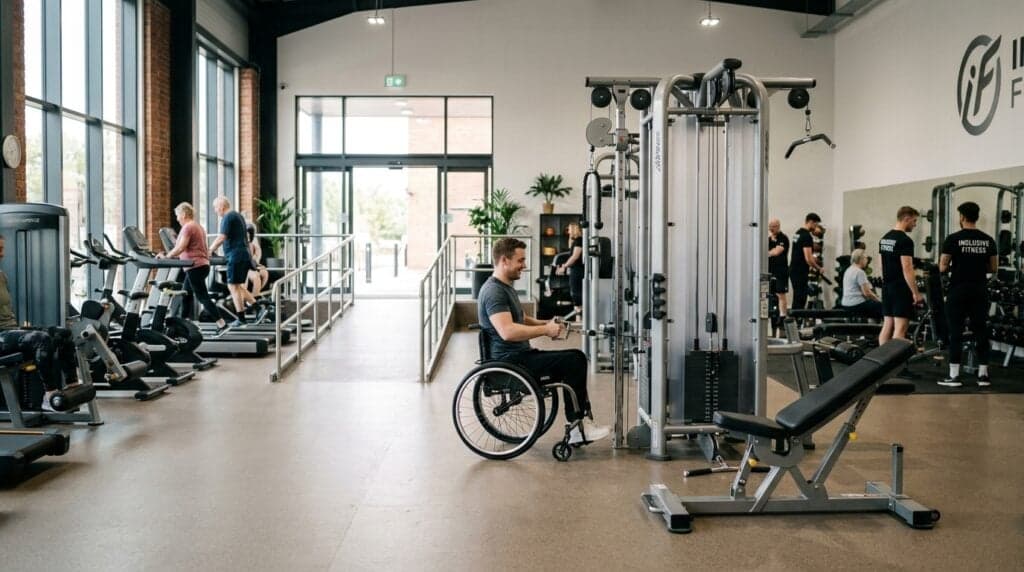
- Install accessible equipment — adaptive machines, chest-height cable machines, benches with grab rails
- Train all staff in disability awareness, not just front desk
- Offer trial sessions specifically for disabled people
- Work with local disability sports organisations
- Pursue Inclusive Fitness Initiative (IFI) accreditation
Physical Access Requirements
The most visible aspect of disability access is your building. These are the areas where most independent gyms fall short.
Entrances and circulation. Step-free access is non-negotiable. If your entrance has a step, you need a ramp with appropriate gradient and handrails. Doorways should be at least 800mm wide — ideally 900mm. Corridors and internal routes need to accommodate wheelchairs and mobility aids.
Changing rooms and showers. At least one changing room should be large enough for a wheelchair user and a carer. An accessible shower with a seat, grab rails, and a handheld showerhead is expected. A changing bench and a hoist are strongly recommended but not legally required in all cases.
Toilets. An accessible toilet meeting Document M of the Building Regulations is a must for most premises. This means a wider cubicle, grab rails, an accessible wash basin, and an emergency pull cord.
Parking. If you have a car park, disabled bays close to the entrance are required under the Equality Act. Blue Badge holders must be able to access your gym without crossing significant distances or obstacles.
Equipment Adaptations
Access is not just about getting through the door. It is about being able to use the gym once inside.
Cardio equipment. Many standard treadmills, bikes, and rowers are difficult or impossible for people with limited mobility. Look for machines with step-through designs, adjustable seats, and hand crank options. Even small changes — adding a seat to a standard upright bike — can open up access.
Strength equipment. Cable machines with height-adjustable pulleys are more accessible than fixed-path machines. Benches with grab rails and adjustable heights help users with mobility limitations. Resistance bands and free weights offer the most flexibility.
Floor space. Clear floor space around equipment matters. A wheelchair user needs room to approach, transfer, and manoeuvre. Cluttered gym floors are a barrier even before you consider the equipment itself.
Staff Training Requirements
Your building can be perfectly accessible, but if your staff are not trained, the experience falls apart. Disability awareness training should cover:
- How to greet and assist disabled members without making assumptions about what they can or cannot do
- How to operate accessible equipment
- Emergency evacuation procedures for disabled members
- Communication basics — speaking clearly, facing the person, not shouting at deaf members
- When to help and when to step back
This training should be part of induction for all staff, not a one-off session for selected employees. Refresh it annually.
The Business Case for Disability Access
Beyond compliance, there is a strong commercial argument. Disabled people in the UK have a combined spending power estimated at over £274 billion per year — the “purple pound.” Carers and family members of disabled people also factor into purchasing decisions. A gym that is genuinely accessible attracts not just disabled members but their entire household.
Accessibility also opens referral pathways. Disability sports charities, local authority directories, and NHS social prescribing schemes all refer patients to accessible facilities. If your gym is on those lists, you gain a steady stream of members who are motivated, loyal, and likely to stay.
Marketing to Disabled Gym-Goers Responsibly
When you do become more accessible, tell people about it — but do it right.
Avoid inspiration porn. Do not frame disabled members as objects of pity or motivation for non-disabled people. Do not use language like “overcoming their disability” or “despite their condition.” Instead, show disabled people using your gym as normal customers. Use inclusive imagery that reflects the diversity of your actual membership.
Be specific about your access features. List your facilities clearly on your website and your GymPal listing: step-free access, accessible changing rooms, accessible toilet, disabled parking, staff trained in disability awareness. This is what disabled people actually look for when choosing a gym.
Working with Disability Sports Charities and IFI Accreditation
Organisations like Activity Alliance, WheelPower, and LimbPower offer guidance, training, and connections to disabled gym-goers. Partnering with them signals genuine commitment and brings practical benefits — event hosting opportunities, staff training resources, and direct referrals.
The Inclusive Fitness Initiative (IFI) is the UK’s accreditation standard for accessible gyms. IFI accreditation requires an accessibility audit, staff training, and ongoing compliance. It is not a quick process, but it provides a recognisable mark that disabled gym-users trust. Many local authorities and NHS referral schemes specifically direct people to IFI-accredited facilities.
Getting Started Today
You do not need to do everything at once. Start with an accessibility audit — walk through your gym as if you were a wheelchair user, a visually impaired person, or someone with limited grip strength. Note every barrier. Then prioritise the changes that will have the biggest impact for the least cost.
Most independent gym owners find that the quick wins — a portable ramp, clear signage, staff training, and an updated GymPal listing — can be done within weeks and at low cost. The bigger investments follow once the business case is proven.
Ready to make your gym visible to disabled gym-goers searching for accessible facilities? Claim your free GymPal listing and add your accessibility features to your profile — it takes minutes and puts you in front of people actively looking for gyms like yours.
Already listed? Make sure your access details are up to date. Over 10,000 UK gyms are on GymPal — but only the ones with complete profiles win those searches.
Not listed yet? Join the UK’s fastest-growing fitness directory today. Create your free GymPal profile and reach more members, including disabled gym-goers and their families.

I am Adam Hall, a dedicated fitness professional with over ten years of experience in the UK’s fitness industry. I earned my Master’s degree in Sports Science from Loughborough University and have worked with several top fitness studios across the UK. My certifications include a Level 3 Personal Trainer Certificate and a specialised Strength and Conditioning Coach accreditation.
Starting my career as a personal trainer, I quickly moved up to manage multiple gym locations, overseeing their operations and training programs. Beyond managing gyms, I regularly contribute to well-known fitness magazines and have been featured in articles for “Health & Fitness” and “Men’s Health”. My passion also extends online where I run a popular blog on GymPal’s AI-powered directory platform detailing insights into choosing the right fitness venues across the UK. With hundreds of posts reaching thousands of readers monthly, my goal is to influence positive changes in how people approach health and exercise throughout the country.