How to Avoid Common Gym Injuries: A Prevention Guide for Beginners
Click Below To Share & Ask AI to Summarize This Article
Nothing Derails Progress Faster Than an Injury
You have been training consistently for six weeks. The weights are going up, you are feeling good, and then — a sharp pain in your shoulder during a bench press. Two weeks later, you are still not back to full training. Worse, you have lost motivation and are questioning whether the gym is worth it.
What it is: A muscle strain or ligament sprain in the lower back, caused by excessive loading with poor form.
How it happens: Deadlifting, squatting, or rowing with a rounded lower back; using too much weight before mastering technique; sitting for long periods then immediately loading the spine.
Prevention:
- Learn and maintain a neutral spine position for every lift
- Warm up your back with cat-cow stretches and bird-dog exercises before deadlifts or squats
- Strengthen your core — planks, dead bugs, and hollow body holds support your spine under load
- Start light and progress gradually — ego lifting is the number one cause of back injuries
2. Shoulder Impingement
What it is: Pain in the front or side of the shoulder when raising the arm, caused by inflammation of the rotator cuff tendons.
How it happens: Overhead pressing with poor scapular positioning; bench pressing too frequently without balancing pulling movements; behind-the-neck lat pulldowns; inadequate warm-up.
Prevention:
- Pull as much as you push — for every pressing exercise, include a pulling exercise
- Warm up shoulders with arm circles, band pull-aparts, and face pulls
- Avoid behind-the-neck pulldowns — use front pulldowns instead
- Do not bench press heavy every session — vary your exercises
- Strengthen the rotator cuff with external rotations using a light band
3. Knee Injuries (Patellar Tendinitis / Meniscus)
What they are: Pain at the front of the knee (patellar tendinitis) or a sharp pain with twisting (meniscus tear).
How they happen: Squatting with knees caving inward (valgus collapse); landing hard from box jumps; running on treadmills at high speeds with poor form; sudden changes in training volume.
Prevention:
- Learn proper squat mechanics — push your knees out over your toes, track them in line with your feet
- Strengthen the VMO (vastus medialis oblique) with leg extensions, split squats, and lunges
- Warm up knees with bodyweight squats and hip circles
- Land softly and softly from jumps — never lock your knees on landing
- Do not increase running speed or distance by more than 10% per week
4. Rotator Cuff Tear
What it is: A partial or full tear of one of the four muscles that stabilise the shoulder joint.
How it happens: Sudden heavy loading on an unprepared shoulder; chronic impingement that weakens the tendon until it tears; bench pressing or overhead pressing with excessive range of motion.
Prevention:
- Strengthen the rotator cuff with light band work (external and internal rotations)
- Progress pressing movements slowly — do not jump to heavy weights
- Warm up shoulders thoroughly before any overhead or pressing work
- If you feel shoulder pain during pressing, stop immediately and assess
5. Neck Strain
What it is: A muscle strain in the cervical spine, causing pain, stiffness, and limited range of motion.
How it happens: Straining the neck during heavy lifts (squats, overhead press) by craning to look at the mirror or at the weight; poor bench press setup with excessive neck arch; poor posture during seated exercises.
Prevention:
- Keep a neutral neck position during all exercises — your head should be in line with your spine
- Do not look up or around during heavy lifts — focus your eyes straight ahead
- Strengthen your neck with isometric holds (push your head into your hand in each direction and hold)
- Set up bench press properly with shoulder blades retracted and feet on the floor
6. Muscle Strains (Hamstrings, Groin, Calf)
What they are: Tears in the muscle fibres, typically caused by sudden stretching under load.
How they happen: Sprinting without warming up; deadlifting with rounded back (hamstring); deep lunges or squats with insufficient mobility (groin); jumping without warm-up (calf/Achilles).
Prevention:
- Dynamic stretching before any explosive or high-speed work
- Progressive loading — do not suddenly attempt a weight significantly heavier than your usual
- Build mobility gradually — do not force your body into positions it is not ready for
- Strengthen muscles eccentrically (slow lowering phase) to build resilience
7. Wrist Strain
What it is: Pain and inflammation in the wrist, common in pressing movements and exercises like cleans and snatches.
How it happens: Excessive wrist extension under load (bench press, overhead press); heavy barbell movements without wrist wraps; poor grip technique.
Prevention:
- Keep your wrists neutral (straight, not bent backwards) during pressing movements
- Use wrist wraps for heavy pressing or overhead work
- Strengthen your forearms with wrist curls and reverse wrist curls
- Take breaks from heavy pressing if you feel wrist discomfort
Universal Injury Prevention Rules
Beyond specific exercises, these principles apply to every gym session:
1. Warm Up Properly (5-10 Minutes)
Never skip this. A proper warm-up increases blood flow, raises tissue temperature, and prepares your joints for the work ahead. Use the dynamic stretching routine from our stretching guide before every session.
2. Master Form Before Adding Weight
Ego is the enemy of longevity. If you cannot perform an exercise with good form using just the bar or light dumbbells, you have no business adding weight. Film yourself from the side to check your form.
3. Progress Gradually
The general rule: increase weight by no more than 2.5-5% per week. Increase volume (sets/reps) by no more than 10% per week. Sudden jumps in training load are the number one predictor of injury.
4. Balance Your Training
- Push and pull in equal volume
- Train upper and lower body
- Include horizontal and vertical pulling movements
- Include core work in every programme
Imbalances create weak points that are more susceptible to injury.
5. Listen to Your Body
There is a difference between productive discomfort (muscle burn, fatigue) and pain (sharp, shooting, joint-related). If something feels wrong, stop. Pushing through joint pain is how small injuries become big ones.
6. Get Enough Rest and Recovery
Muscles do not grow during training — they grow during rest. If you are training the same muscle group hard every day, you are accumulating damage without allowing repair. Allow 48-72 hours between sessions for the same muscle group.
7. Deload Regularly
Every 4-8 weeks, take a deload week: reduce your volume and/or intensity by 40-50%. This allows your body to fully recover and adapt, reducing your long-term injury risk while actually improving performance.
What to Do If You Get Injured
- Stop the exercise immediately. Do not push through sharp or joint pain.
- Assess the severity. If it is mild discomfort, modify the exercise. If it is sharp or shooting pain, stop training that area entirely.
- Apply RICE for the first 48 hours: Rest, Ice, Compression, Elevation. This reduces inflammation and promotes healing.
- See a professional if: Pain persists beyond a week, you heard a pop during the injury, or you cannot move the joint through its normal range.
- Do not rush back. Returning to training before an injury has fully healed is the most common cause of recurring injuries.
Choosing a Gym That Supports Injury Prevention
The right gym environment helps you train safely:
- Well-maintained equipment that functions correctly
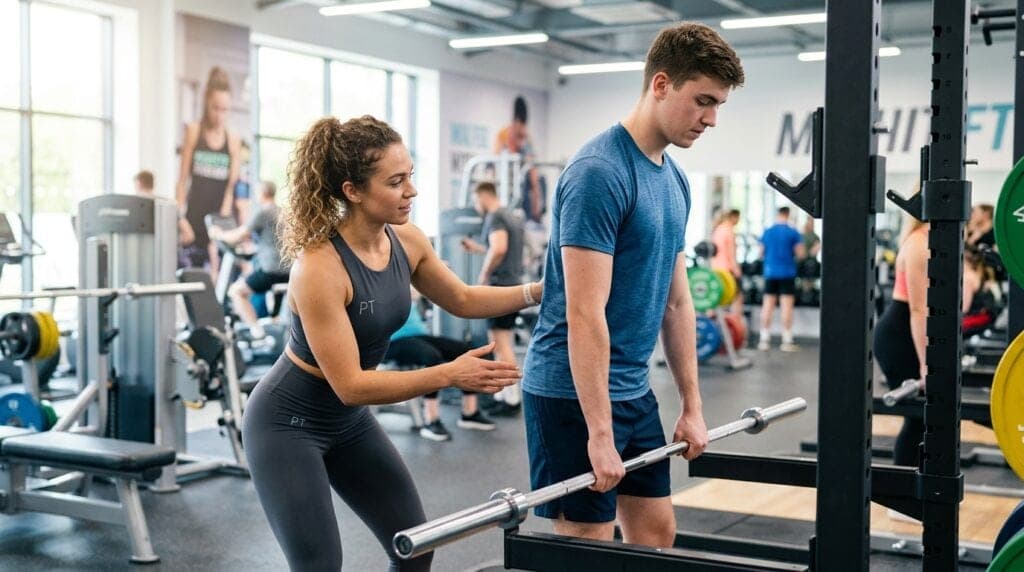
- Floor coaches who can check your form
- Space to move without colliding with other members
- Warm-up and stretching areas
- Recovery facilities (sauna, ice bath)
When you are choosing a gym, these factors matter more than the number of machines or the price. GymPal helps you find UK gyms with the facilities and atmosphere that support safe, long-term training.
The Bottom Line
Gym injuries are frustrating, painful, and demotivating — but they are almost entirely preventable. The vast majority of injuries come down to three things: poor form, too much weight too soon, and inadequate recovery.
Warm up properly, master your technique before loading up, progress gradually, balance your training, and rest when your body tells you to. Do these things consistently and you will train injury-free for years.
Ready to start training safely? Search GymPal to find UK gyms with well-maintained equipment, floor coaches, warm-up areas, and recovery facilities. Train smart, train safe, and train long.

I am Adam Hall, a dedicated fitness professional with over ten years of experience in the UK’s fitness industry. I earned my Master’s degree in Sports Science from Loughborough University and have worked with several top fitness studios across the UK. My certifications include a Level 3 Personal Trainer Certificate and a specialised Strength and Conditioning Coach accreditation.
Starting my career as a personal trainer, I quickly moved up to manage multiple gym locations, overseeing their operations and training programs. Beyond managing gyms, I regularly contribute to well-known fitness magazines and have been featured in articles for “Health & Fitness” and “Men’s Health”. My passion also extends online where I run a popular blog on GymPal’s AI-powered directory platform detailing insights into choosing the right fitness venues across the UK. With hundreds of posts reaching thousands of readers monthly, my goal is to influence positive changes in how people approach health and exercise throughout the country.