Stretching for Beginners: The Only Stretches You Need Before and After the Gym
Click Below To Share & Ask AI to Summarize This Article
Stretching Is the Most Skipped Part of Working Out
Walk into any commercial gym and you will see the same pattern: people rush in, spend 30 seconds doing a half-hearted arm swing, jump straight into their workout, and leave as soon as they finish their last set. No warm-up. No cool-down. No stretching.
Before Your Workout: Dynamic Stretches (5 Minutes)
Before training, you should do dynamic stretches — movements that take your joints through their full range of motion while increasing blood flow. Static stretching (holding a stretch in place) before training can actually reduce power output. Save that for afterwards.
1. Arm Circles (30 seconds)
Stand tall and make large forward circles with both arms for 15 seconds, then reverse direction for 15 seconds. Loosens the shoulder joints and warms up the rotator cuff muscles.
2. Leg Swings (30 seconds each leg)
Hold onto a wall or rack for balance. Swing one leg forward and backward in a controlled motion, gradually increasing the range. Switch legs. Warms up the hip flexors, glutes, and hamstrings.
3. Hip Circles (30 seconds)
Stand with feet shoulder-width apart. Place your hands on your hips and make large circles with your hips, 15 seconds clockwise and 15 seconds anti-clockwise. Mobilises the hip joints, which are involved in almost every lower body exercise.
4. Bodyweight Squats (10 reps)
Perform 10 slow, controlled bodyweight squats, going as deep as your mobility allows. This activates your quads, glutes, and hips while warming up the pattern you will use under load.
5. Inchworms (5 reps)
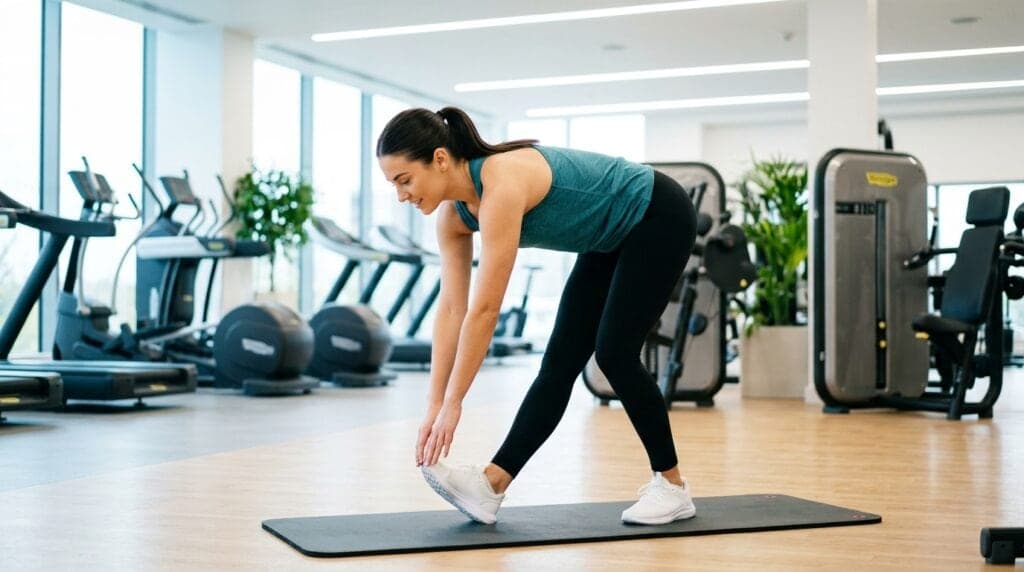
Stand tall, bend forward and touch your toes (or shins), walk your hands out to a plank position, hold for a moment, then walk your feet to your hands and stand up. Stretches the hamstrings, calves, and shoulders while activating the core.
6. Torso Twists (30 seconds)
Stand with arms extended to the sides. Rotate your torso left and right in a controlled motion. Mobilises the thoracic spine, which is important for overhead movements and squats.
After Your Workout: Static Stretches (5-10 Minutes)
After training, your muscles are warm and pliable — the ideal time for static stretching. Hold each stretch for 20-30 seconds, breathing deeply. Never bounce or force a stretch beyond mild discomfort.
1. Chest Stretch (20-30 seconds each side)
Stand in a doorway and place your forearm against the door frame with your elbow at shoulder height. Gently lean forward until you feel a stretch across your chest. This counteracts the hunched posture from desk work and pressing movements.
2. Lat Stretch (20-30 seconds each side)
Kneel in front of a bench or place your hands on a wall. Reach forward with both arms and let your chest drop toward the floor. You should feel a stretch along the sides of your back. Important for anyone doing pull-ups, rows, or lat pulldowns.
3. Standing Quad Stretch (20-30 seconds each leg)
Stand on one leg (hold a wall for balance). Grab your other ankle behind you and pull your heel towards your glutes. Keep your knees close together and push your hips slightly forward. Targets the quadriceps and hip flexors.
4. Seated Hamstring Stretch (20-30 seconds each leg)
Sit on the floor with one leg extended and the other foot against your inner thigh. Reach towards your toes of the extended leg until you feel a stretch in the back of your thigh. Keep your back straight. Targets the hamstrings.
5. Figure-Four Glute Stretch (20-30 seconds each side)
Lie on your back with knees bent. Place one ankle on the opposite knee, then pull the bottom knee towards your chest. You should feel a deep stretch in your glute. Essential for anyone who squats, deadlifts, or sits for long periods.
6. Shoulder Cross-Body Stretch (20-30 seconds each side)
Bring one arm across your body and use your other hand to gently pull it closer to your chest. Keep the stretched arm straight. Targets the rear deltoid and upper back.
7. Calf Stretch (20-30 seconds each side)
Stand facing a wall with one foot forward. Press your heel into the floor and lean towards the wall until you feel a stretch in your calf. Keep the back leg straight. Targets the gastrocnemius (calf muscle).
8. Cat-Cow (10 slow reps)
Start on your hands and knees. Alternate between arching your back (cow) and rounding it (cat) in a slow, controlled motion. Mobilises the entire spine and releases tension in the lower back after heavy lifting.
Common Stretching Mistakes
- Static stretching before training. This can reduce power output. Do dynamic stretches before and static stretches after.
- Bouncing while stretching. This triggers a protective muscle contraction (the stretch reflex) and can cause micro-tears. Hold steady.
- Stretching to the point of pain. Mild discomfort is normal. Sharp pain means you are going too far. Back off slightly.
- Holding your breath. Breathe deeply and slowly during each stretch. Exhale as you deepen the stretch.
- Rushing through stretches. Hold each for 20-30 seconds minimum. It takes time for the muscle to relax and lengthen.
- Only stretching the muscles you trained. Your whole body benefits from regular stretching, even on rest days.
When to Stretch on Rest Days
Dedicated stretching or mobility sessions on rest days can accelerate your progress. Consider:
- A 15-20 minute full-body stretching routine
- A yoga or mobility class at your gym
- Using a foam roller on tight areas (quads, IT band, upper back)
Many UK gyms now offer dedicated mobility or yoga classes as part of their membership. If yours does, it is worth trying. If you are looking for a gym with recovery and mobility facilities, GymPal lets you filter by class types and amenities.
The Bottom Line
Stretching is not glamorous, but it is one of the most impactful habits you can build as a beginner. Five minutes of dynamic stretching before training prepares your body for the work ahead. Five to ten minutes of static stretching afterwards aids recovery and improves long-term mobility.
The routines above cover every major muscle group and take less than 15 minutes total. That is a small investment for significantly better performance, fewer injuries, and a body that moves better both inside and outside the gym.
Need a gym with the space and facilities to stretch properly? Search GymPal to find UK gyms with dedicated stretching areas, yoga classes, mobility zones, and recovery facilities. Compare options and claim a free trial.

I am Adam Hall, a dedicated fitness professional with over ten years of experience in the UK’s fitness industry. I earned my Master’s degree in Sports Science from Loughborough University and have worked with several top fitness studios across the UK. My certifications include a Level 3 Personal Trainer Certificate and a specialised Strength and Conditioning Coach accreditation.
Starting my career as a personal trainer, I quickly moved up to manage multiple gym locations, overseeing their operations and training programs. Beyond managing gyms, I regularly contribute to well-known fitness magazines and have been featured in articles for “Health & Fitness” and “Men’s Health”. My passion also extends online where I run a popular blog on GymPal’s AI-powered directory platform detailing insights into choosing the right fitness venues across the UK. With hundreds of posts reaching thousands of readers monthly, my goal is to influence positive changes in how people approach health and exercise throughout the country.