How to Create a Profitable Personal Training Programme at Your UK Gym
Click Below To Share & Ask AI to Summarize This Article
Personal Training Is a Revenue Goldmine Most Gyms Ignore
If your gym only generates revenue from memberships, you are leaving money on the table. Personal training (PT) is one of the highest-margin services a gym can offer, with typical session rates of £30–75 per hour and profit margins of 60–80% after trainer costs. According to NHS exercise guidelines
Yet many independent UK gyms treat PT as an afterthought — a service that exists in the corner if anyone asks about it. The gyms that treat PT as a core business pillar generate significantly more revenue per square foot, have higher member retention, and create a coaching culture that sets them apart from budget chains. According to CIMSPA professional standards for fitness professionals
Here is how to build a personal training programme that generates real revenue for your gym.
Step 1: Decide on Your PT Business Model
There are three main ways to structure personal training at your gym. Each has different revenue implications:
| Model | How It Works | Your Revenue | Best For |
|---|---|---|---|
| In-house employed PTs | You hire trainers as employees, set rates, and manage bookings | Full session revenue minus wages and NI | Gyms that want full control over quality and customer experience |
| Licensee/rental model | PTs pay you a weekly or monthly fee to train clients at your gym | Fixed rental income regardless of how many sessions they do | Gyms that want predictable income with minimal management |
| Revenue share | PTs keep a percentage of each session (typically 50-70%) | Percentage of each session sold | Gyms that want to incentivise PTs to sell while sharing risk |
The right model depends on your gym size, management capacity, and goals. Many gyms start with the licensee model for simplicity, then move to revenue share or employed PTs as the programme grows.
Step 2: Recruit and Vet Quality Trainers
Your PT programme is only as good as your trainers. A bad PT damages your gym’s reputation. Here is how to find and keep good ones:
Minimum Requirements
- Level 3 Personal Trainer qualification (recognised by CIMSPA or REPs)
- Public liability insurance
- First aid certificate
- Professional, approachable demeanour
Where to Find PTs
- Post on your social media and website
- Contact local personal training course providers — newly qualified PTs are often looking for gym bases
- Ask your existing members — some may be qualified or studying towards their PT qualification
- LinkedIn and fitness industry job boards
Vetting Process
- Check their qualifications and insurance certificates
- Observe them deliver a sample session (either with you or a willing member)
- Ask about their specialisms, target client base, and availability
- Get references from previous gyms or clients
Step 3: Price Your PT Services Competitively
UK PT session rates vary significantly by location and trainer experience:
| Session Type | Typical Price Range |
|---|---|
| Single 1-to-1 session (60 min) | £30–75 |
| Single 1-to-1 session (45 min) | £25–55 |
| Block of 5 sessions | £135–335 (5-10% discount) |
| Block of 10 sessions | £250–650 (10-15% discount) |
| Small group training (2-4 people) | £15–25 per person per session |
| Group class (6-12 people) | £8–15 per person per session |
London and the South East command the highest rates. Northern England, Scotland, and Wales tend to be at the lower end. Research what other gyms in your area charge and position yourself competitively.
Step 4: Create a Sales Funnel for PT
PT will not sell itself. You need a system to convert interested members into paying clients:
The Free Taster Session
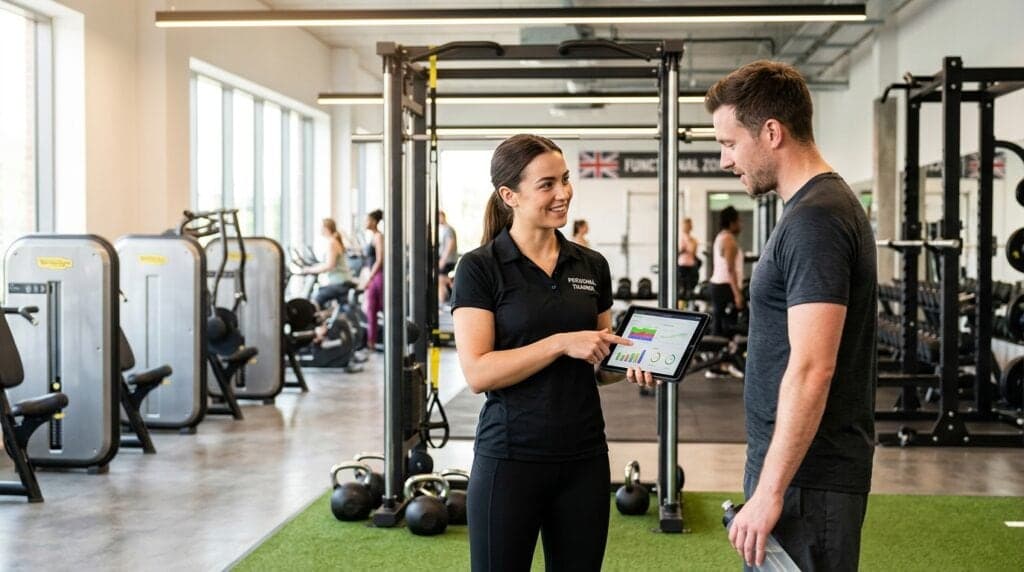
The single most effective PT sales tool is a complimentary 30-minute taster session. Offer this to every new member during their induction. The format is simple:
- Assessment (10 min): Understand their goals, fitness history, and any injuries or limitations
- Mini-workout (15 min): Put them through 3-4 exercises relevant to their goals
- Recommendation (5 min): Explain how PT can help them achieve their goals faster, share success stories, and present your packages
The taster session is not a hard sell. It is a value-first approach that demonstrates your PT’s expertise. Conversion rates for well-delivered taster sessions typically range from 30-50%.
Visibility and Promotion
- Introduce your PTs in new member welcome packs
- Feature PTs and client success stories on your social media
- Display PT availability and pricing on a noticeboard in the gym
- Include PT information in your email newsletter
- Offer PT as an add-on during membership sign-up conversations
Step 5: Offer Packages, Not Just Single Sessions
Single sessions have high drop-off rates. Packages create commitment and generate upfront cash flow. Offer tiered packages:
| Package | What It Includes | Price Point |
|---|---|---|
| Starter | 3 sessions + basic programme | £90–180 |
| Transformation | 10 sessions + nutrition guidance + progress tracking | £280–650 |
| 12-Week Programme | 24 sessions + full programme + nutrition plan + weekly check-ins | £600–1,400 |
| Group Training | 8 small-group sessions (2-4 people) | £100–200 per person |
The 12-week programme is the most profitable option. It creates a structured journey, locks in revenue, and delivers measurable results that generate testimonials and referrals.
Step 6: Track Performance and Hold PTs Accountable
Without tracking, you have no idea whether your PT programme is profitable. Monitor these metrics monthly:
| Metric | Why It Matters |
|---|---|
| Total PT sessions delivered | Overall programme volume |
| Revenue per PT per month | Individual trainer performance |
| Client retention rate | Are clients staying beyond the first block? |
| New client acquisition | How many new clients each PT is bringing in |
| Client results and testimonials | Social proof for marketing and referrals |
| PT utilisation rate | Hours booked vs hours available |
Share these metrics with your PTs. Trainers who understand their numbers are more motivated to improve them.
Step 7: Create a Referral Culture
PT clients who get results become your best advocates. Build referral incentives into your PT programme:
- Offer existing clients a free session for every new client they refer who signs up for a package
- Ask successful clients for written or video testimonials (with their permission)
- Feature client transformations on social media (with before/after photos where appropriate)
A single client transformation story shared on Instagram can generate more PT enquiries than any paid advertisement.
How This Ties Into Your Wider Gym Strategy
A strong PT programme benefits your entire gym:
- Members with PTs retain at significantly higher rates (80%+ vs 50-70% for non-PT members)
- PTs act as floor coaches, improving the experience for all members
- Client success stories provide marketing content for your gym
- PT revenue can offset the cost of additional staff or facility improvements
Combined with a strong online presence — including your GymPal listing, Google reviews, and social media — a PT programme transforms your gym from a facility into a service business with multiple revenue streams.
The Bottom Line
Personal training is not an optional extra for independent gyms — it is a core revenue stream that can add thousands of pounds per month to your bottom line. The investment required is minimal: recruit qualified trainers, create a simple sales funnel, offer structured packages, and track your numbers.
Start with one good trainer and a free taster session offer. Prove the concept, measure the results, and scale from there. Within three to six months, a well-run PT programme can be generating more profit per hour than any other aspect of your gym business.
Want to attract more members who are interested in personal training? Claim your free GymPal listing and highlight your PT services, trainer profiles, and client success stories. Reach thousands of UK fitness seekers who are ready to invest in expert guidance.
Is your gym listed on GymPal? Over 10,000 UK fitness businesses are in our directory. Claim your free listing in 5 minutes — and start getting discovered by local fitness seekers today.

I am Adam Hall, a dedicated fitness professional with over ten years of experience in the UK’s fitness industry. I earned my Master’s degree in Sports Science from Loughborough University and have worked with several top fitness studios across the UK. My certifications include a Level 3 Personal Trainer Certificate and a specialised Strength and Conditioning Coach accreditation.
Starting my career as a personal trainer, I quickly moved up to manage multiple gym locations, overseeing their operations and training programs. Beyond managing gyms, I regularly contribute to well-known fitness magazines and have been featured in articles for “Health & Fitness” and “Men’s Health”. My passion also extends online where I run a popular blog on GymPal’s AI-powered directory platform detailing insights into choosing the right fitness venues across the UK. With hundreds of posts reaching thousands of readers monthly, my goal is to influence positive changes in how people approach health and exercise throughout the country.