How to Overcome Gym Anxiety: A Practical Guide for Beginners
Click Below To Share & Ask AI to Summarize This Article
Gym Anxiety Is Completely Normal
You are not alone. Studies suggest that up to 50% of people experience some form of gym anxiety, and for many, it is the single biggest barrier to starting an exercise routine. The feeling has a name — gymtimidation — and it is more common than you might think.
Knowing where everything is and how it works removes a major source of anxiety.
3. Have a Plan Before You Arrive
Walking into a gym without a plan is a recipe for anxiety. You end up wandering around, feeling lost, and eventually leaving early. Write your workout down before you go — even if it is just three exercises. When you know exactly what you are doing, you can walk in with purpose and get straight to work.
Need a starting programme? Our beginner workout programme guide includes two complete workouts you can take straight to the gym floor.
4. Wear What Makes You Comfortable
There is no dress code for the gym. Wear whatever makes you feel comfortable and confident. If that means a baggy t-shirt and tracksuit bottoms, wear that. If you prefer shorts and a vest, go for it. No one is judging your outfit — they are too busy worrying about their own.
5. Use Headphones
A simple pair of headphones is one of the most effective anxiety-reduction tools available. Music or a podcast creates a personal bubble that reduces self-consciousness and makes you feel less exposed. It also signals to others that you are focused on your workout, which reduces unwanted interaction.
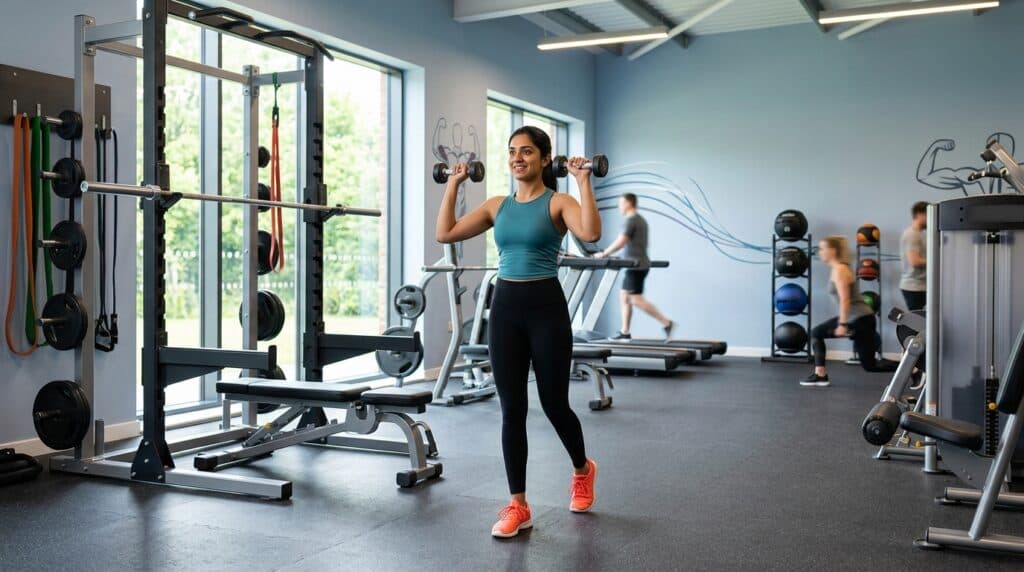
6. Start With Machines, Not Free Weights
Resistance machines have clear instructions, fixed movement paths, and adjustable seats. They are designed to be beginner-friendly and are much less intimidating than the free weight area. Start here for your first few sessions. As your confidence grows, you can gradually introduce free weights.
7. Focus on Your Own Workout
This is easier said than done, but it gets easier with practice. Before each session, remind yourself: everyone here is focused on their own goals. No one is analysing your form, counting your reps, or judging your body. The occasional glance is normal — it is not judgement. People look around gyms. It means nothing.
8. Bring a Friend
If possible, go with someone who already goes to the gym. A friend provides emotional support, practical guidance, and a distraction from anxious thoughts. If you do not have a gym-going friend, many gyms run buddy-matching programmes or group classes where you can meet people in a structured, low-pressure environment.
9. Consider Group Classes
Classes are surprisingly effective for reducing anxiety. In a class, everyone is following the same instructions, which means you are not standing out by doing your own thing. The instructor provides structure and guidance, and the group setting creates a sense of shared purpose. Start with beginner-friendly classes like body conditioning, yoga, or a gentle circuit.
10. Celebrate Small Wins
Overcoming gym anxiety is not a one-time event — it is a process. Celebrate the small victories: walking through the door, completing your first workout, trying a new machine, going during a busier time. Each one is progress, and each one deserves recognition.
What to Do When Anxiety Hits Mid-Workout
Sometimes anxiety shows up even when you have prepared. Here is what to do when it happens:
- Pause. Stop what you are doing. Take five slow, deep breaths. Focus on the physical sensation of breathing.
- Ground yourself. Look around and name five things you can see, four things you can hear, three things you can feel. This interrupts the anxiety spiral.
- Move to a quieter area. If the main gym floor feels overwhelming, move to a stretching area, the changing room, or grab some water.
- Remind yourself why you are here. You came to the gym to improve your health. That takes courage. You have already done the hardest part by showing up.
- It is okay to leave early. If the anxiety is overwhelming, leaving after 10 minutes is still better than not going at all. You can build up gradually.
Choosing the Right Gym for Anxiety
The gym you choose makes a big difference. Some environments are more anxiety-friendly than others:
- Smaller, independent gyms often have a more personal, less intimidating atmosphere than large chain gyms
- Women-only gyms provide a comfortable environment for women who feel self-conscious in mixed gyms
- Gyms with clear equipment labels and beginner-friendly layouts reduce the fear of looking lost
- Gyms with good off-peak hours give you the option to train when it is quieter
- Gyms with welcoming staff who greet you and are available to help make a huge difference
When you are researching gyms, look for these qualities. GymPal lets you filter UK gyms by type, read member reviews that often mention atmosphere and friendliness, and compare options before you visit. Finding the right gym environment can make overcoming anxiety significantly easier.
How Long Does It Take to Feel Comfortable?
Most people report that gym anxiety reduces significantly after 3-5 consistent visits. By week three or four, the gym starts to feel familiar rather than intimidating. By month two, many people wonder what they were worried about.
The key is consistency. Going once every two weeks keeps the gym feeling new and unfamiliar. Going three times a week accelerates the adaptation process dramatically.
The Bottom Line
Gym anxiety is real, common, and completely manageable. It is not a sign of weakness or a reason to avoid exercise. It is simply your brain responding to a new, unfamiliar environment — and like any new environment, it becomes familiar with exposure and practice.
You do not need to feel confident before you go to the gym. You just need to go. Confidence builds from the inside out, one session at a time. Start small, be kind to yourself, and remember: every single person in that gym was a beginner once.
Ready to take the first step? Search GymPal to find a welcoming gym near you. Filter by type, read member reviews about atmosphere and friendliness, and claim a free trial to visit without commitment. Your future self will thank you.

I am Adam Hall, a dedicated fitness professional with over ten years of experience in the UK’s fitness industry. I earned my Master’s degree in Sports Science from Loughborough University and have worked with several top fitness studios across the UK. My certifications include a Level 3 Personal Trainer Certificate and a specialised Strength and Conditioning Coach accreditation.
Starting my career as a personal trainer, I quickly moved up to manage multiple gym locations, overseeing their operations and training programs. Beyond managing gyms, I regularly contribute to well-known fitness magazines and have been featured in articles for “Health & Fitness” and “Men’s Health”. My passion also extends online where I run a popular blog on GymPal’s AI-powered directory platform detailing insights into choosing the right fitness venues across the UK. With hundreds of posts reaching thousands of readers monthly, my goal is to influence positive changes in how people approach health and exercise throughout the country.