Reformer Pilates UK: What It Is, What It Costs, and Where to Find a Studio
Click Below To Share & Ask AI to Summarize This Article
There’s a new machine taking over UK fitness studios — and it’s not a treadmill. The Pilates reformer, a sliding carriage mounted on a spring-loaded frame, has gone from niche physiotherapy equipment to the workout of the moment. Boutique reformer studios are popping up in every major UK city, classes book out within minutes, and your social media feed is probably already full of clips of people gliding gracefully across those sleek wooden beds.
But what actually is reformer Pilates? Is it worth the premium price tag? And how does it differ from a regular Pilates class? Whether you’re completely new to the world of Pilates or you’ve been doing mat classes for years, this guide covers everything you need to know before booking your first reformer session.
Spoiler: it’s harder than it looks — and that’s exactly why people are obsessed with it.
What Is a Pilates Reformer?
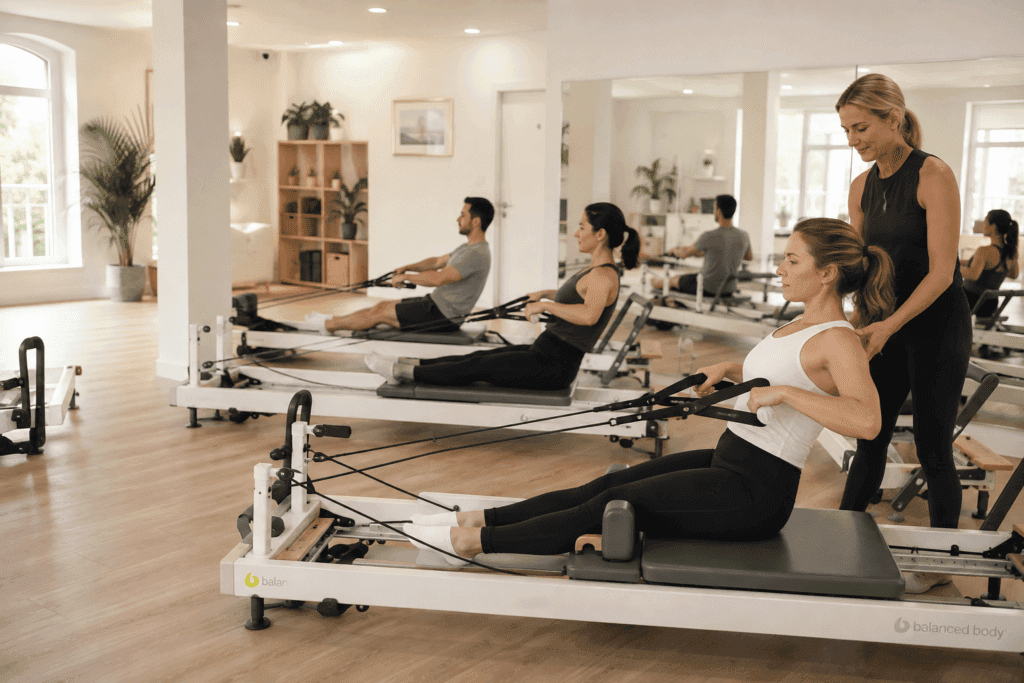
The reformer is a piece of apparatus developed by Joseph Pilates himself in the early twentieth century. It consists of a padded carriage that slides along a track, connected to a set of springs that provide variable resistance. You push or pull the carriage using your feet, hands, or body weight while performing controlled movements — and the springs make the machine either assist or resist your effort depending on how they’re set up.
This spring tension is what makes reformer Pilates unique. Unlike free weights or bodyweight exercises, the resistance is consistent throughout the entire range of motion. Your muscles work on both the push and the return, which means more time under tension and a genuinely different stimulus to anything you’ll find in a conventional gym.
Modern reformers come in two main types: the traditional wooden Pilates reformer, associated with classical Pilates studios, and contemporary aluminium models — brands like Balanced Body, Stott, and Peak Pilates dominate the boutique market. The fundamentals are the same; the finish differs.
Reformer Pilates vs Mat Pilates: What’s the Difference?
Mat Pilates is done on the floor using your bodyweight, sometimes with small props like resistance bands or magic circles. It’s a brilliant starting point — accessible, affordable, and available in almost every leisure centre and gym in the country. But the reformer adds a new dimension.
For anyone already familiar with what Pilates involves as a beginner, stepping onto the reformer is a logical next progression. The spring resistance allows the instructor to modify exercises so they’re actually easier in some cases (useful for rehabilitation or those with limited strength) and significantly harder in others. You can also access a far wider range of exercise positions — standing, kneeling, lying on your back or side, seated — which challenges balance and coordination in ways that mat work simply can’t replicate.
That said, mat Pilates isn’t inferior. Many classical instructors argue it’s the foundation you need before touching a reformer. Most reformer studios in the UK will take complete beginners, but having some mat experience does help you understand cues like “neutral spine” and “ribcage placement” before you’re also navigating a moving carriage.
Benefits of Reformer Pilates
The reformer delivers results across a surprisingly wide range of fitness goals. Here’s what consistent practice tends to produce:
Core strength — Every exercise on the reformer requires active stabilisation of the pelvis and spine. Unlike crunches or sit-ups, the movements are functional and integrated, meaning the strength you build translates directly to how you move in daily life.
Improved posture — The reformer has a particular reputation for addressing the rounded shoulders and forward head posture that come from desk work. Sessions consistently target the posterior chain — glutes, hamstrings, mid-back — which helps counteract the effects of long hours sitting.
Flexibility and mobility — The spring-assisted stretches on the reformer allow you to move into ranges you’d struggle to access independently. Regular practitioners typically notice significant improvements in hip mobility, spinal rotation, and hamstring length within a few months.
Injury rehabilitation and prevention — Physiotherapists and sports medicine practitioners across the UK regularly use reformer Pilates as a rehabilitation tool for back pain, knee injuries, hip problems, and post-surgical recovery. The low-impact nature and variable resistance make it ideal for people who can’t do high-intensity exercise.
Lean muscle tone — The slower, controlled movements under sustained spring tension create genuine muscular endurance. Regular reformer practitioners tend to develop long, defined muscles rather than bulk.
According to research published via ukactive, mind-body disciplines like Pilates have seen some of the fastest participation growth in the UK fitness sector over the past five years — driven largely by the rise of boutique studio culture.
How Much Does Reformer Pilates Cost in the UK?
Here’s the honest answer: reformer Pilates isn’t cheap. But the price varies quite a bit depending on where you are and what format you choose.
Group classes (typically 4–8 people per reformer) are the most accessible entry point. In London, expect to pay £25–£40 per class, with introductory offers often bringing this down to £10–£20 for your first few sessions. Outside London — in cities like Manchester, Leeds, Edinburgh, Bristol, and Birmingham — prices typically run £18–£30 per class.
Semi-private classes (2–3 people sharing an instructor) sit at £40–£70 per session and allow for more personalised attention and faster progression.
Private sessions (one-to-one) cost £60–£120 in London and £45–£90 elsewhere. These are especially valuable if you’re using reformer Pilates for injury rehabilitation or want to progress quickly.
Membership packages are where the value lies. Most studios offer monthly memberships with a set number of classes included — four sessions a month for around £80–£120, or unlimited for £150–£250 depending on the studio. If you’re planning to go regularly, class packages (typically 10 or 20 sessions bought upfront at a discount) usually offer the best per-session rate.
If you’re weighing up reformer Pilates against other fitness options, it helps to have a clear picture of what different types of UK gym memberships actually cost — some premium gyms now include reformer Pilates classes as part of an all-in membership, which can make the economics look very different.
Is Reformer Pilates Right for You?
Reformer Pilates suits a remarkably wide range of people — but it’s not for everyone in every context. Here’s a rough guide:
You’ll love it if you:
- Want a low-impact workout that genuinely builds strength and flexibility
- Are recovering from an injury or managing chronic pain
- Already do yoga, barre, or mat Pilates and want a new challenge
- Find conventional gyms uninspiring or intimidating
- Train for sport and want improved movement quality and injury resilience
- Are postpartum and looking for a safe way to rebuild core strength
It might not be your primary workout if you:
- Want rapid cardiovascular fitness gains — reformer Pilates will raise your heart rate, but it’s not a cardio session
- Are primarily focused on building maximal strength or muscle mass
- Have a tight budget — at £20–£35 a class, it’s a significant commitment
Many people find reformer Pilates works best as part of a balanced programme — two reformer sessions per week alongside running, swimming, or gym training covers both the strength-and-mobility base and the cardiovascular side.
Reformer Pilates vs Barre: Which Is Right for You?
This comparison comes up constantly in boutique fitness circles. Both are low-impact, both attract a similar demographic, and both are having a moment in UK cities. But they deliver quite different things.
Barre classes use ballet-inspired movements at a rail (the barre) to target the thighs, glutes, and core through small, high-repetition movements. They’re typically more cardio-intensive and more music-driven — the class atmosphere tends to feel more like a group workout than a mindful practice. If you’ve been curious about whether barre classes are worth it, the answer largely depends on what you want from a session.
Reformer Pilates, by contrast, is slower, more technical, and more individually tailored — even in a group setting. The instructor pays more attention to your alignment and can adjust spring resistance for your specific level. If your goal is injury recovery, postural work, or deep core strength, reformer wins. If you want something higher-energy with a strong cardio element, barre has the edge.
The good news: you don’t have to choose. Many boutique studios now offer both, and alternating between the two is a genuinely excellent approach to balanced fitness.
What to Expect at Your First Reformer Pilates Class
If you’ve never been on a reformer before, the machine can look a bit intimidating. Here’s what a typical first session looks like:
You’ll arrive to find your reformer already set up (most studios adjust spring tension for you as a beginner). The instructor will walk you through basic carriage mechanics before the class begins, so you understand how to get on and off safely and what “pushing through the footbar” means.
Most beginner and introductory classes move at a measured pace with lots of verbal cues. Expect to work through exercises lying on your back (supine), on your side, and in kneeling positions. The class will target the whole body — typically starting with footwork to warm up the legs, moving through core and glute work, then finishing with upper body and stretching.
You’ll be sore the next day — possibly in muscles you didn’t know existed. The adductors (inner thighs), obliques, and serratus anterior (that muscle under your armpit) are common surprise casualties of a first reformer session. This is normal and eases significantly by your second or third class.
Wear: fitted, stretchy clothing that won’t ride up when your legs are in the air. Grip socks are compulsory at almost every studio — most will sell pairs at reception if you forget.
How to Find a Reformer Pilates Studio Near You
Reformer studios are now available across the UK — not just in London. Major cities like Manchester, Edinburgh, Bristol, Leeds, Birmingham, and Cardiff all have well-established studios, and smaller towns are rapidly catching up.
When choosing a studio, look for instructors with a full Pilates diploma (BASI, STOTT, Body Control Pilates, or similar) rather than a short reformer-only course. Good studios will also offer proper introductory sessions rather than throwing you straight into an all-levels class.
GymPal lists Pilates studios across the UK, including reformer-specific venues — you can search by postcode or area to find what’s available near you, compare what each studio offers, and often find introductory deals in one place.
Many leisure centres and council-run gyms are also beginning to invest in reformer equipment, which means sessions at a significantly lower price point than boutique studios. If budget is a factor, it’s worth searching specifically for council or leisure trust studios in your area before assuming reformer Pilates is out of reach financially.
Final Thoughts
Reformer Pilates has earned its moment. The combination of genuine results — strength, flexibility, posture, injury prevention — delivered in a low-impact, adaptable format puts it in rare company in the fitness world. Whether you’re a complete beginner, a regular gym-goer looking for something different, or someone coming back from injury, the reformer is worth your serious consideration.
Yes, it costs more than a budget gym membership. Yes, you’ll feel completely baffled during your first class. But for most people who try it consistently, reformer Pilates becomes the workout they actually look forward to — and that, ultimately, is what sustainable fitness looks like.
Find your nearest reformer Pilates studio on GymPal and filter by location to see introductory deals, class timetables, and studio details all in one place.

I am Adam Hall, a dedicated fitness professional with over ten years of experience in the UK’s fitness industry. I earned my Master’s degree in Sports Science from Loughborough University and have worked with several top fitness studios across the UK. My certifications include a Level 3 Personal Trainer Certificate and a specialised Strength and Conditioning Coach accreditation.
Starting my career as a personal trainer, I quickly moved up to manage multiple gym locations, overseeing their operations and training programs. Beyond managing gyms, I regularly contribute to well-known fitness magazines and have been featured in articles for “Health & Fitness” and “Men’s Health”. My passion also extends online where I run a popular blog on GymPal’s AI-powered directory platform detailing insights into choosing the right fitness venues across the UK. With hundreds of posts reaching thousands of readers monthly, my goal is to influence positive changes in how people approach health and exercise throughout the country.