Sauna and Cold Plunge: Is the Recovery Hype Worth It?
Click Below To Share & Ask AI to Summarize This Article
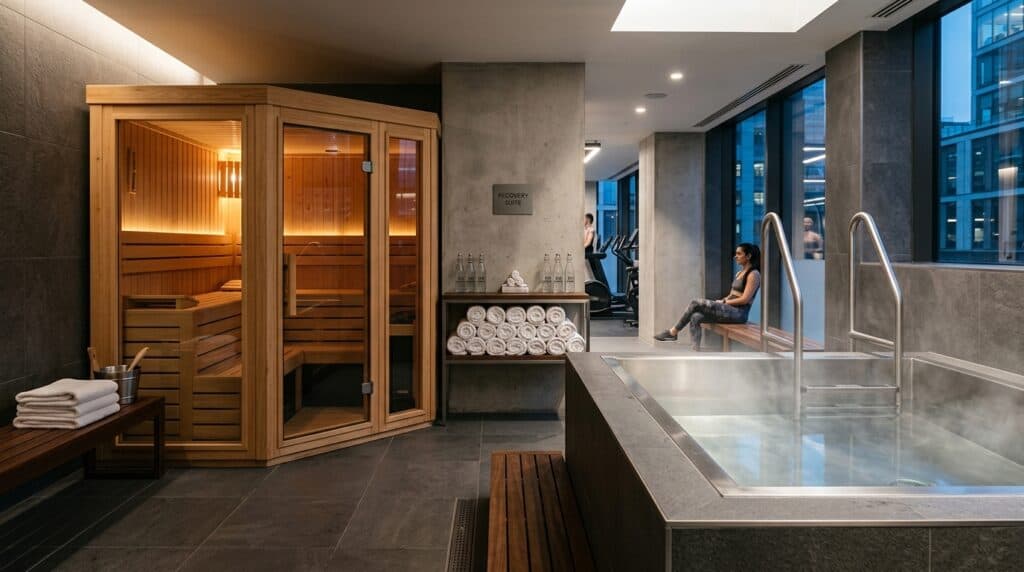
Walk into almost any newly refurbished UK gym these days and you’ll spot it: a sauna cabin tucked behind the changing rooms, or a cold plunge pool with a queue of members steeling themselves for 90 seconds of misery. What used to be a spa-day treat is now marketed as a serious part of training — and gyms from boutique studios in Shoreditch to budget chains in Leeds are adding “recovery suites” to justify higher membership tiers.
But is any of it actually doing what the Instagram reels claim? Before you start queuing for the ice bath every Tuesday, it’s worth separating the genuine physiology from the wellness marketing — because the honest answer is “it depends on what you’re training for,” and that nuance rarely survives a 15-second video.
This guide breaks down what sauna and cold water immersion can realistically do for your recovery, where the evidence runs thin, and how to decide whether it’s worth seeking out a gym with these facilities or just booking an occasional spa day instead.
It matters because the stakes are real money, not just wasted time. A premium membership tier with recovery suite access can add several hundred pounds a year to your gym bill, and if you’re training for a specific goal — strength, a marathon, simply showing up consistently — that money might be far better spent elsewhere. So let’s work through what the research actually supports.
What’s Actually Behind the Sauna and Cold Plunge Craze
The current wave owes a lot to endurance and strength sport, where athletes have used contrast therapy for decades, and to a steady stream of podcasts promising that fifteen minutes in freezing water will fix your sleep, your mood and your metabolism in one go. UK gym operators have noticed: PureGym, Third Space and a growing number of independent studios have added sauna cabins, steam rooms or plunge pools as a differentiator in a crowded market, often bundling access into a premium membership tier costing an extra £15–£30 a month.
That commercial push is exactly why it’s worth being sceptical. A facility can be genuinely useful and still be oversold. The honest picture sits somewhere between “miracle recovery tool” and “overpriced novelty” — closer to the latter for some goals, closer to the former for others.
It’s also worth noting this isn’t entirely new in Britain — working men’s clubs and Victorian bathhouses had steam rooms and cold plunges a century before anyone filmed themselves doing it for social media. What’s changed is the framing: it used to be relaxation, now it’s sold as performance. Separating those two purposes is the key to deciding whether it’s worth your money.
The Science: What Cold Water Immersion Really Does
Cold water immersion has the most research behind it, and the findings are genuinely mixed rather than simply positive. A Cochrane systematic review on cold-water immersion for muscle soreness found it can modestly reduce delayed-onset muscle soreness after hard sessions, particularly following competition or back-to-back training days. That’s useful if you’ve got a 10K on Saturday and a long run again on Monday.
The catch is that the same cooling effect which eases soreness also appears to blunt some of the adaptations you’re training for in the first place. Several studies suggest that routinely plunging straight after resistance sessions can dampen gains in muscle size and strength, likely by dulling the inflammatory signalling your body uses to repair and build tissue. So if your main goal is getting stronger or building muscle, jumping in the plunge pool immediately after every leg day may be working against you, not for you. Save it for the weeks you’re managing fatigue around a race or a heavy competition schedule, rather than making it a daily habit.
Sauna Recovery: Relaxation Dividends More Than Muscle Repair
Sauna use tells a different story. Regular sauna bathing is associated with better cardiovascular markers and lower all-cause mortality in long-term population studies, and the heat exposure does trigger some genuinely useful cellular repair processes. But when it comes to measurable, next-session performance recovery, the effect is modest at best — the standout benefit is how it makes you feel rather than how fast your muscles repair.
That’s not nothing. Fifteen to twenty minutes of heat after a tough session lowers perceived stress, loosens tight shoulders and hips, and makes training feel sustainable rather than punishing. For anyone building a long-term exercise habit, “enjoyable enough to keep doing” counts for a great deal more than a marginal physiological edge — consistency beats optimisation almost every time.
Finding a UK Gym With Recovery Facilities
If you’ve decided the relaxation and occasional soreness relief are worth paying for, the next question is where to find it without overpaying. Facilities vary wildly — some gyms have a single cramped sauna cabin that’s always fully booked, others have proper recovery suites with plunge pools, steam rooms and even compression boots. Working through a proper gym choice checklist before you sign a contract will save you discovering the sauna is “temporarily out of service” three months into a 12-month agreement.
This is exactly the kind of detail that’s easy to miss on a quick tour but obvious once you search properly, filtering gyms near you by the amenities that matter — sauna, steam room, pool, recovery suite — rather than relying on a sales rep’s enthusiasm during a walkthrough.
Building a Sensible Recovery Routine
Recovery is about far more than hot and cold rooms, and it’s worth putting sauna and plunge pools in that wider context rather than treating them as a shortcut. Sleep, protein intake, and simply programming enough rest days do more heavy lifting for how you feel week to week than any single recovery gadget. If you haven’t got the basics nailed down, our guide to rest and recovery for UK gym-goers is a better starting point than a £30-a-month sauna add-on.
A sensible routine for most people training three to five times a week looks like: sauna or warm bath after a hard session for relaxation, the odd cold plunge after a genuinely brutal week or before a competition, and otherwise just making sure you’re sleeping seven-plus hours and eating enough. Layer the fancy stuff on top of that foundation, not instead of it.
A realistic weekly pattern might be two strength sessions with no cold exposure afterwards (so you don’t blunt those adaptations), one cardio-heavy session followed by 15 minutes in the sauna purely to unwind, and a cold plunge reserved for the odd week where you’ve got a race, a tough work deadline, or simply feel like you’re carrying more fatigue than usual. There’s no need to ritualise it into every single session — that’s exactly the trap the marketing wants you to fall into, because more frequent “need” sells more premium memberships.
Price-wise, if you’re paying for standalone sessions rather than a bundled membership, expect to pay roughly £15–£25 for a one-off sauna and plunge pool session at a dedicated recovery studio in most UK cities, with London naturally sitting at the higher end. That’s a useful benchmark for working out whether your gym’s premium tier markup is actually good value or not.
When to Skip It: Risks and Contraindications
Cold water immersion isn’t risk-free. The initial cold shock response spikes heart rate and blood pressure sharply, which matters if you have any cardiovascular condition, and it’s genuinely unsuitable if you’re pregnant, have Raynaud’s syndrome, or are managing certain circulatory issues — check with a GP first if any of that applies to you. Saunas carry similar cautions around blood pressure and dehydration, and neither should be attempted after drinking alcohol, which sadly rules out the “sauna and a pint” combination some gyms seem to be leaning into as a social offer.
The simple rule: if you feel dizzy, nauseous, or unusually breathless in either a sauna or a cold plunge, get out immediately. No recovery benefit is worth pushing through genuine warning signs.
It’s also worth flagging that children, older adults, and anyone unfamiliar with cold exposure should ease in gradually rather than diving straight into a full plunge pool — a cold shower finishing thirty seconds colder than usual is a far more sensible starting point than copying an elite athlete’s ice bath routine on day one. Build tolerance over weeks, not in a single enthusiastic session.
Spa Days vs Gym Recovery Suites
For a lot of people, the better value move is skipping the premium gym membership tier entirely and booking an occasional proper spa day instead. A good day spa gives you longer, less rushed access to sauna, steam and pool facilities than a gym changing room ever will, usually for less than three months of a premium add-on fee. If that sounds more appealing than squeezing into a gym sauna cabin with four strangers, our UK spa day guide covers what to expect and roughly what you’ll pay.
Treat the two as complementary rather than competing: regular, free sauna access if your gym happens to have it and you enjoy it, plus the occasional proper spa day as a reset when you want more than fifteen rushed minutes.
The Bottom Line
Sauna and cold plunge facilities aren’t a scam, but they’re also not the recovery shortcut the marketing suggests. Cold water immersion has a real, narrow use case around soreness relief during heavy competition periods, and a real downside if you’re using it after every strength session while trying to build muscle. Sauna’s biggest benefit is how good it makes you feel, which is a legitimate reason to use it but not a reason to pay a premium if your budget’s tight.
If recovery facilities genuinely matter to you, don’t just take a gym’s word for what’s on offer — search for gyms with the exact amenities you want on GymPal and compare before you commit to a contract. Your recovery routine should be built around sleep, food and sensible programming first, with the sauna as a very pleasant bonus.

I am Adam Hall, a dedicated fitness professional with over ten years of experience in the UK’s fitness industry. I earned my Master’s degree in Sports Science from Loughborough University and have worked with several top fitness studios across the UK. My certifications include a Level 3 Personal Trainer Certificate and a specialised Strength and Conditioning Coach accreditation.
Starting my career as a personal trainer, I quickly moved up to manage multiple gym locations, overseeing their operations and training programs. Beyond managing gyms, I regularly contribute to well-known fitness magazines and have been featured in articles for “Health & Fitness” and “Men’s Health”. My passion also extends online where I run a popular blog on GymPal’s AI-powered directory platform detailing insights into choosing the right fitness venues across the UK. With hundreds of posts reaching thousands of readers monthly, my goal is to influence positive changes in how people approach health and exercise throughout the country.