Creatine for Beginners: The UK Gym-Goer’s Guide
Click Below To Share & Ask AI to Summarize This Article
Walk past the supplements shelf in any Boots, Holland & Barrett or independent gym shop and you’ll see it: creatine monohydrate, usually in a plain white tub, usually one of the cheapest things on the shelf. It’s also, according to decades of research, one of the only supplements that reliably does what it says on the label. And yet plenty of UK gym-goers still steer clear of it, put off by old myths about kidney damage, bloating, or the vague sense that it’s “for bodybuilders.”
That’s a shame, because creatine is one of the simplest, cheapest and best-studied ways to get more out of your training, whether you’re lifting weights three times a week, doing HYROX training, or just trying to hold onto muscle as you get older. It’s not magic, and it won’t fix a poor diet or inconsistent training, but used properly it gives you a genuine, measurable edge.
This guide covers what creatine actually does, how much to take, which product to buy, and the myths worth ignoring — all with UK prices, UK products, and no nonsense.
What Creatine Actually Does
Creatine is a compound your body already makes, mostly stored in your muscles, where it helps regenerate ATP — the energy your muscles burn through fastest during short, intense efforts like a heavy squat, a sprint finish, or the last few reps of a set. Your body produces some naturally (around 1g a day) and you get a bit more from red meat and fish, but most people’s muscle stores sit well below saturation.
Supplementing with creatine tops up those stores, meaning you can produce energy for high-intensity efforts slightly faster and for slightly longer. In practice, that usually shows up as being able to squeeze out one or two extra reps, recover a little quicker between sets, and — over weeks and months — build strength and muscle faster than training alone.
It’s worth being clear about what it isn’t. Creatine isn’t a stimulant, it won’t help your 5k time much, and it isn’t a fat burner. It’s a strength and power tool, first and foremost.
Vegetarians and vegans tend to see the biggest jump in benefit, simply because their baseline muscle creatine stores are usually lower — most dietary creatine comes from meat and fish, so anyone who’s cut those out has more “headroom” to fill. The supplement itself is lab-made rather than animal-derived, so it’s suitable regardless of diet.
Who Actually Benefits Most?
Creatine’s biggest wins are for anyone doing repeated short, intense efforts: weightlifting, sprinting, HYROX-style hybrid events, rugby, football, or CrossFit-style circuits. If your training involves heavy sets of 1-12 reps, sprint intervals, or explosive movements, you’re squarely in the group most likely to notice a difference.
It’s also one of the better-studied supplements for older adults. Combined with resistance training, creatine has been shown to help preserve muscle mass and strength as part of healthy ageing — useful to know if you’re training to stay strong and independent rather than chasing a personal best. Endurance athletes running long, steady-state sessions will notice far less benefit, since that kind of effort relies on a different energy system entirely.
Does It Actually Work? What the Research Says
Creatine monohydrate is, by a wide margin, the most heavily researched sports supplement in existence, with hundreds of controlled trials behind it. The International Society of Sports Nutrition’s position stand on creatine supplementation concludes it’s not only effective for increasing high-intensity exercise capacity and lean body mass, but also one of the safest supplements currently available, including for long-term use in healthy people.
That’s a stronger evidence base than almost anything else sold as a “fitness supplement” — most fat burners, BCAAs and pre-workout blends don’t come close. If you’re going to spend money on one supplement this year, the research says creatine is the one that’s actually worth it.
How Much Should You Take?
You’ve got two options, and neither is complicated.
Straight to maintenance: Take 3-5g of creatine monohydrate every day, with no loading phase. Your muscle stores build up gradually over three to four weeks until they’re saturated. This is the approach most people should use — it’s simpler, gentler on the stomach, and gets you to the same place.
Loading phase: Take 20g a day (split into 4 doses of 5g) for five to seven days, then drop to a 3-5g daily maintenance dose. This saturates your muscles faster — useful if you’ve got an event or a training block starting in a couple of weeks — but it’s more likely to cause mild bloating in the loading week.
Timing matters less than people think. Taking it before or after training, with a meal, or on rest days all work — consistency is what matters, not the exact hour on the clock. There’s no need to cycle off it either; the “you need breaks or your body stops producing its own” idea isn’t supported by the evidence.
Which Product to Actually Buy in the UK
Stick to plain creatine monohydrate — ideally Creapure-certified, which is a German-manufactured, independently tested form that guarantees purity. You do not need “advanced” formulas like creatine HCL, buffered creatine (Kre-Alkalyn), or creatine ethyl ester — none of them have been shown to outperform monohydrate despite costing two or three times as much.
On UK prices, a 250g tub of plain creatine monohydrate (enough for roughly 80-100 days at a 3g dose) typically costs £8-£15 from retailers like MyProtein, Bulk, or Holland & Barrett. That works out to roughly 10-15p a day — genuinely one of the cheapest things you can do for your training. Avoid flavoured or “pre-mixed” creatine drinks and pricier proprietary blends; you’re paying extra for marketing, not results.
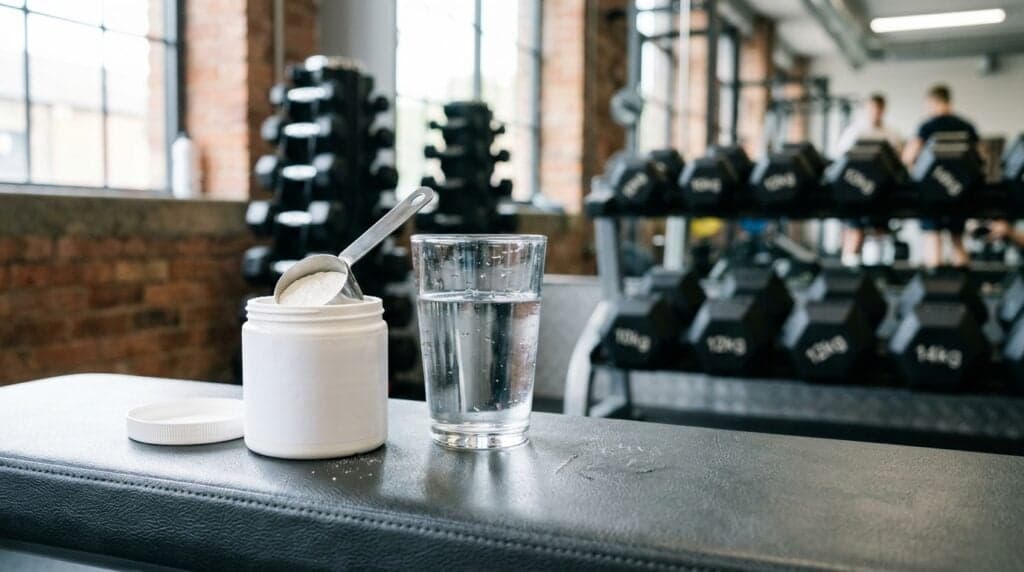
It mixes into water, juice or a protein shake without much fuss — it doesn’t dissolve perfectly, so a bit of settling at the bottom of the glass is normal, not a sign anything’s wrong.
A Few Quick Questions People Always Ask
Do I need to cycle off it? No — there’s no evidence that continuous, long-term use causes your body to stop producing its own creatine or reduces the supplement’s effectiveness over time.
Can I take it with a pre-workout or caffeine? Yes, there’s no meaningful interaction. Some older studies suggested caffeine might blunt creatine’s effects slightly, but more recent, better-designed research hasn’t backed that up.
Does it cause hair loss? This one traces back to a single small study that found a rise in a hormone loosely linked to hair loss, with no study since actually confirming creatine causes hair loss in practice. If you’re already prone to male pattern baldness it’s a reasonable thing to keep an eye on, but it’s far from settled science.
Will it make me bulky if I don’t want that? No — creatine on its own doesn’t build noticeable muscle. Any size change comes from the training you do alongside it, and strength training tends to build visible muscle far more slowly than people expect.
Common Myths, Sorted From Real Concerns
The kidney damage myth is the big one, and it’s largely traced back to studies involving people who already had pre-existing kidney disease, not healthy adults. For people with normal kidney function, long-term creatine use at standard doses hasn’t been shown to cause harm. If you do have a diagnosed kidney condition, or you’re on medication that affects kidney function, it’s worth a quick chat with your GP before starting, same as with any supplement.
Water retention is real but misunderstood — creatine draws water into your muscle cells (not under your skin), which can add a small amount to the number on the scale but isn’t the “puffy” bloating people imagine. Digestive discomfort is the most common actual side effect, usually from taking too much in one go during a loading phase; splitting doses or skipping loading altogether sorts it out for most people.
If you’re also weighing up other supplements, it’s worth knowing which supplements are actually worth your money as a beginner — creatine and a decent protein intake will get you further than most of what’s on that shelf.
Get the Bigger Lever Right First
Creatine works best as a small edge on top of solid fundamentals, not a substitute for them. If your training is inconsistent or your diet’s a mess, no supplement is going to compensate for that. It’s worth checking you’re already covering the basics: eating enough protein across the day is the bigger lever for most beginners, and if you’re unsure where you stand, it’s worth working out how much protein you actually need before you start layering supplements on top.
Don’t Skip Recovery
Recovery matters just as much. Creatine helps you train harder and recover slightly faster between sets, but it doesn’t replace sleep or rest days — getting those right is what actually lets the extra training capacity translate into real strength gains, and it’s worth reading up on rest and recovery for UK gym-goers if that side of your routine needs work.
Who Should Be Cautious
Creatine is well-tolerated by most healthy adults, but a few groups should think twice or check with a doctor first: anyone with existing kidney or liver conditions, pregnant or breastfeeding women (simply due to a lack of research in this group, not evidence of harm), and under-18s, where research is more limited. If you’re on any regular medication and unsure, a quick word with a pharmacist or GP costs nothing and settles any doubt.
The Bottom Line
Creatine monohydrate is cheap, well-researched, and does what it claims for most people who lift weights, do HIIT, or train for strength and power. Start with 3-5g a day, stick to plain Creapure monohydrate, don’t overthink the timing, and give it a month before judging results. It’s one of the few supplement aisles where the science backs up the hype.
Of course, no supplement makes up for training in the wrong environment — if your current gym doesn’t have the free weights, coaching or atmosphere to back up your new routine, it might be worth a change. You can search hundreds of UK gyms, from budget chains to independent strength-focused studios, on GymPal to find one that actually fits how you train.

I am Adam Hall, a dedicated fitness professional with over ten years of experience in the UK’s fitness industry. I earned my Master’s degree in Sports Science from Loughborough University and have worked with several top fitness studios across the UK. My certifications include a Level 3 Personal Trainer Certificate and a specialised Strength and Conditioning Coach accreditation.
Starting my career as a personal trainer, I quickly moved up to manage multiple gym locations, overseeing their operations and training programs. Beyond managing gyms, I regularly contribute to well-known fitness magazines and have been featured in articles for “Health & Fitness” and “Men’s Health”. My passion also extends online where I run a popular blog on GymPal’s AI-powered directory platform detailing insights into choosing the right fitness venues across the UK. With hundreds of posts reaching thousands of readers monthly, my goal is to influence positive changes in how people approach health and exercise throughout the country.