VO2 Max Training: The UK Gym-Goer’s Guide

Click Below To Share & Ask AI to Summarize This Article
Scroll through any fitness forum or chat to a mate who’s just bought a smartwatch, and you’ll hear the same two letters and a number: VO2 max. It’s gone from a sports science lab metric to the thing everyone from marathon runners to your uncle on his new Garmin is suddenly obsessed with. But what does it actually mean, is it worth your time, and — crucially — how do you improve it at your local UK gym?
VO2 max is simply a measure of how much oxygen your body can use during intense exercise. The higher it is, the more efficiently your heart, lungs and muscles work together, and the research linking it to long-term health is genuinely compelling rather than just wellness-trend noise.
Here’s what it is, why it matters more than you might think, and exactly how to start training for it without needing a lab, a mask, or a four-figure membership.
What VO2 Max Actually Measures
VO2 max stands for “volume of oxygen maximum” — the maximum amount of oxygen your body can take in and use during exercise, measured in millilitres per kilogram of body weight per minute. Think of it as the size of your engine: a bigger number means your cardiovascular system can deliver more fuel to your working muscles before you hit your limit.
Elite endurance athletes can sit above 70 ml/kg/min, while the average UK adult in their 40s typically falls somewhere between 30 and 40, depending on sex, age and training history. The exact number matters far less than the trend — and the good news is that it’s one of the most trainable fitness metrics there is, improving by 10-20% in as little as two to three months of consistent work.
Why It’s Become Such a Big Deal
VO2 max has jumped out of exercise physiology textbooks because of a growing body of research tying it to how long — and how well — we live. Large population studies have repeatedly found that low cardiorespiratory fitness is one of the strongest predictors of early death from any cause, stronger even than smoking or diabetes status in some analyses. A higher VO2 max is linked to lower rates of heart disease, better blood sugar control, and sharper cognitive function into older age.
That’s a different proposition to chasing a six-pack or a heavier deadlift. It’s a genuine longevity lever, which is exactly why it’s resonating with people who’ve never set foot in a gym before as much as it is with seasoned lifters. If you’re already building general strength and movement quality, pairing it with routines like kettlebell training for beginners gives you both the cardio and strength ends of the fitness picture covered.
How to Actually Train It (No Lab Required)
You don’t need a VO2 max test to improve your VO2 max — you need consistent, well-structured cardio. Two approaches do most of the heavy lifting:
Zone 2 training is low-to-moderate intensity cardio — a pace where you can hold a conversation but not comfortably sing — done for 30-60 minutes, several times a week. This builds the aerobic base (more capillaries, more mitochondria) that everything else sits on top of. A brisk treadmill walk, a steady bike ride, or a gentle jog all count.
High-intensity intervals push the ceiling up faster. The classic format is 4 minutes hard (around 90% effort) followed by 3-4 minutes easy, repeated four times, two or three times a week. It’s uncomfortable but short, which makes it realistic to fit around work and family life. Many gyms now run dedicated interval sessions — if yours doesn’t, structured HIIT classes are an easy way to get the format right without having to programme it yourself.
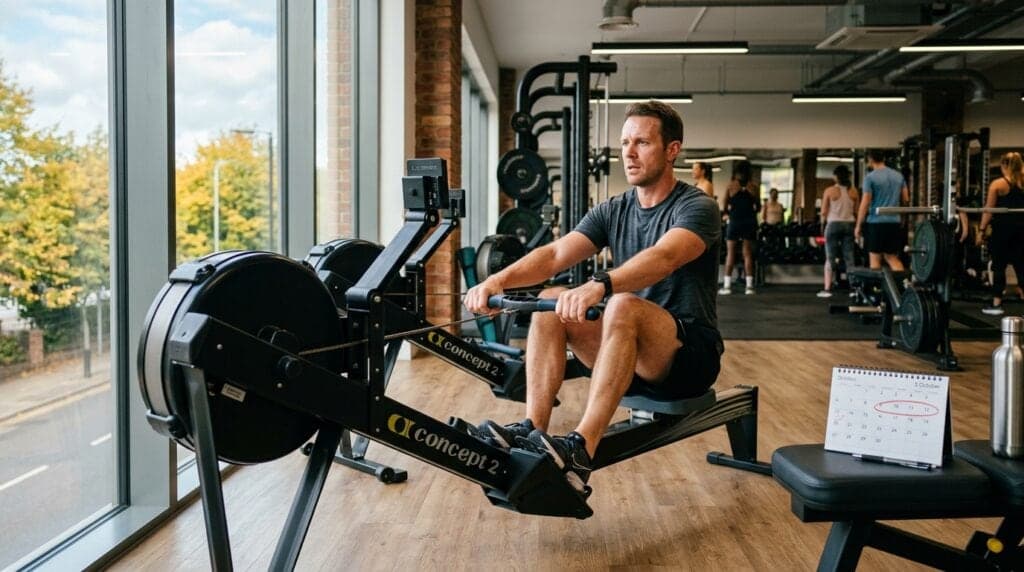
Rowing machines, assault bikes and the stair climber are particularly effective for intervals because they load the whole body and are low-impact on the joints — handy if running isn’t your thing or your knees have opinions about it.
A Simple Weekly Structure to Follow
If you’re starting from scratch, you don’t need a complicated spreadsheet. A sensible week looks something like this: two zone 2 sessions of 30-45 minutes (a steady bike ride or brisk walk/jog), one interval session (4 x 4 minutes hard with 3-4 minutes easy recovery), and one or two strength sessions to keep everything else ticking along. That’s a realistic four to five training days, which leaves room for rest days and the rest of your life.
The order matters less than the consistency. Some weeks you’ll manage three cardio sessions, other weeks just one — that’s fine. VO2 max responds to the average effort over months, not to any single “perfect” week. What tends to derail people is going too hard too often: cramming in intervals four times a week with no easy days leads to burnout and plateaus, not faster gains. The zone 2 work is what builds the engine; the intervals just add the top end on top of it.
If you’re newer to structured training altogether, it’s worth starting with just the zone 2 sessions for the first two to three weeks before layering in intervals. Your joints, tendons and motivation will thank you, and you’ll have a base to build on rather than burning out in week two.
Common Mistakes That Stall Progress
The biggest one by far is intensity confusion — treating every session as an all-out effort. Zone 2 training only works if it stays genuinely easy; if you’re gasping for air on what’s meant to be a recovery-paced ride, you’re just doing a watered-down interval session and getting neither the aerobic base benefit nor the proper high-intensity stimulus. Slow down more than feels natural; it’s usually still not slow enough.
The second is skipping the warm-up before intervals. Jumping straight into a maximal effort from cold is both a good way to pick up a strain and a poor way to hit the heart rate zones you’re actually aiming for. Five to ten minutes of easy movement first makes the hard efforts noticeably more effective.
The third is expecting fast results. Unlike strength training, where you can sometimes feel stronger within a couple of sessions, cardiovascular adaptations take weeks to show up in how you feel and months to show up clearly in the numbers. Track trend, not day-to-day fluctuation, and don’t abandon the plan after a flat first fortnight.
Getting Your VO2 Max Actually Measured
If you want a number rather than just a feeling of “I’m fitter than I was,” a few options exist without booking into a sports science lab. Many mid-range and premium smartwatches (Garmin, Apple Watch, Polar) now estimate VO2 max reasonably well from heart rate and pace data during runs — not lab-accurate, but good enough to track trend over time, which is what actually matters.
For a proper lab test, university sports science departments and some private performance clinics in bigger UK cities offer treadmill or bike VO2 max assessments with a breathing mask, typically costing £80-£150. It’s a nice-to-have rather than a necessity — most people are better served putting that money towards consistent training than a one-off number.
Fuelling the Work
Interval sessions and longer steady cardio both draw heavily on carbohydrate and protein stores, and recovery between sessions is where the actual fitness adaptation happens. If you’re increasing your cardio volume, it’s worth checking you’re eating enough to support it — our guide on how much protein you really need is a good starting point for making sure recovery isn’t the thing holding your progress back.
Sleep matters just as much here as diet. Cardiovascular adaptations — the new blood vessels, the more efficient heart — largely happen while you’re resting, not while you’re training, so cramming in sessions without recovery tends to backfire.
Who Should Prioritise This
Genuinely, almost everyone benefits, but it’s worth flagging for two groups specifically. If you’re over 40 and haven’t done structured cardio in years, building your aerobic base gradually with walking, swimming or cycling before adding intervals is the sensible, joint-friendly route. And if you’re already strength-focused and cardio has fallen off your radar entirely, even two sessions a week will move the needle more than you’d expect, without undoing your strength gains.
The NHS’s physical activity guidelines for adults recommend at least 150 minutes of moderate activity or 75 minutes of vigorous activity a week — VO2 max training fits neatly inside that framework rather than requiring you to reinvent your routine.
Finding the Right Setup Near You
Not every gym is set up the same way for this kind of training. Some have a bank of rowers and bikes and run regular interval classes; others are better suited to steady-state cardio on treadmills with a good view of the TV. If you’re not sure what’s available locally, you can search gyms near you on GymPal to compare facilities, class timetables and equipment before committing to a membership.
VO2 max isn’t a fad metric to obsess over daily — it’s a slow-moving number that rewards boring consistency. Pick a format you’ll actually stick with, give it a few months, and the number (and how you feel climbing stairs) will take care of itself.

I am Adam Hall, a dedicated fitness professional with over ten years of experience in the UK’s fitness industry. I earned my Master’s degree in Sports Science from Loughborough University and have worked with several top fitness studios across the UK. My certifications include a Level 3 Personal Trainer Certificate and a specialised Strength and Conditioning Coach accreditation.
Starting my career as a personal trainer, I quickly moved up to manage multiple gym locations, overseeing their operations and training programs. Beyond managing gyms, I regularly contribute to well-known fitness magazines and have been featured in articles for “Health & Fitness” and “Men’s Health”. My passion also extends online where I run a popular blog on GymPal’s AI-powered directory platform detailing insights into choosing the right fitness venues across the UK. With hundreds of posts reaching thousands of readers monthly, my goal is to influence positive changes in how people approach health and exercise throughout the country.