Spin Classes UK: What to Expect at Your First Indoor Cycling Session
Click Below To Share & Ask AI to Summarize This Article
Indoor cycling is everywhere. Walk through any mid-to-large gym in the UK and you’ll likely spot the spin studio — a darkened room of stationary bikes, bass-heavy playlists thumping through the walls, and a class of red-faced cyclists pushing hard. From council leisure centres in Sheffield to boutique studios in Shoreditch, spin has embedded itself firmly into UK fitness culture.
But if you’ve never clipped in before, the whole thing can feel a bit intimidating. What do you wear? How do you set the bike up? Will the instructor humiliate you for not keeping up?
The good news: spin is one of the most beginner-friendly group fitness formats going. Here’s everything you need to know before you ride.
What Is a Spin Class?
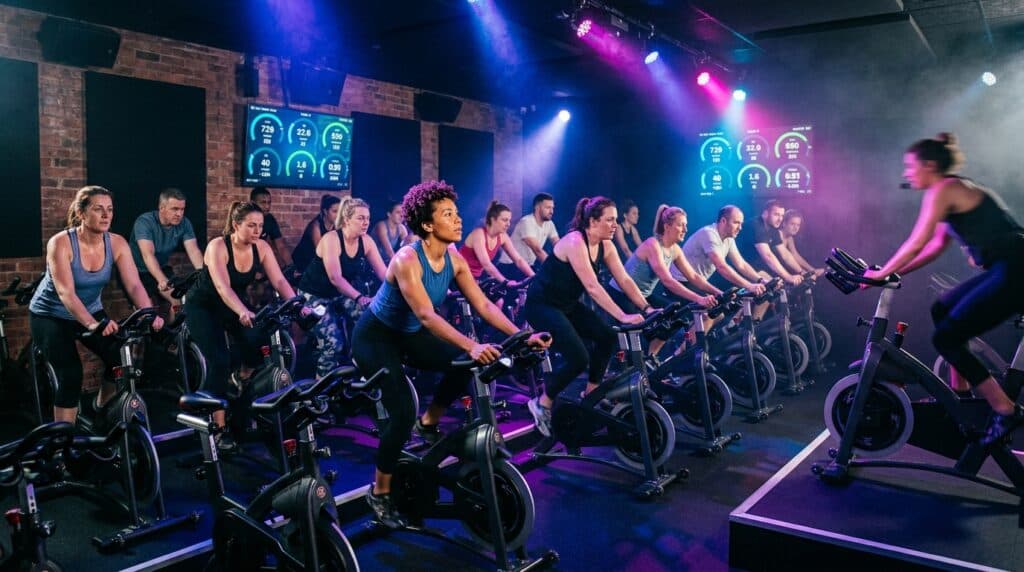
Spin — also called indoor cycling or studio cycling — is a group workout on stationary bikes, led by an instructor who guides you through intervals of varying intensity, all set to music. The instructor sits on a bike at the front and calls out changes: “turn it up two clicks,” “out of the saddle,” “ease off and recover.” You follow their lead, adjusting your own resistance.
The beauty of it is that no one can see what resistance you’ve got dialled in. If you need to ease off, you ease off. It’s one of the only group fitness formats where you’re genuinely competing only with yourself.
A standard class runs 45–60 minutes. Some gyms offer express 30-minute formats too. Most follow a rough structure:
- Warm-up (5 minutes): low resistance, steady cadence, settling onto the saddle and loosening up your legs
- Main set (30–40 minutes): alternating between hard efforts — sprints, climbs, out-of-saddle intervals — and recovery phases
- Cool-down (5 minutes): low resistance, bring your heart rate down, light stretch
Why Spin? The Benefits Are Genuinely Impressive
Spin delivers serious cardiovascular fitness in a time-efficient package. A 45-minute session can burn anywhere between 400 and 600 calories depending on your body weight and how hard you push — comparable to a full outdoor cycling session without the hills, punctures, or lorries.
But spin isn’t just a calorie-burner. The varied intensity builds genuine aerobic and anaerobic fitness, which pays dividends across every other workout you do. Standing intervals and hill climbs build quad, hamstring, and glute strength. And because it’s a low-impact format — your weight is supported by the saddle and pedals rather than your knees and ankles — it’s accessible to people returning from injury, those with joint problems, or anyone who finds running hard on their body.
There’s also the communal energy. There’s something about a darkened room, loud music, and twenty people all grinding through the same effort that pushes you harder than you’d go alone. Research consistently shows that people work harder in group exercise settings — spin takes full advantage of that effect.
Setting Up Your Bike: Get This Right Before the Class Starts
Arrive 10–15 minutes before your first class. Book your spot in advance — most gym spin studios fill up fast, particularly the early morning and lunchtime slots.
When you arrive, tell the instructor it’s your first time. They’ll walk you through the setup, but knowing the basics helps:
- Seat height: Stand next to the bike. Set the saddle level with your hip bone. When pedalling, your leg should have a slight bend at the bottom of the stroke — not fully straight, not excessively bent.
- Seat position (fore/aft): Slide the saddle forward or back so that when the pedal is at the 3 o’clock position, your knee sits directly over the pedal axle.
- Handlebar height: Higher handlebars are more comfortable for beginners. As you get more confident, you can lower them for a more aggressive position. Start at seat height or just above.
Most studio bikes in the UK use SPD-compatible clip-in pedals or cage pedals (flat platforms with a strap). Some boutique studios rent cycling shoes — worth asking when you book.
What Happens During the Class
The first five minutes feel slightly awkward. Your legs won’t feel quite right, the saddle will seem odd, and you’ll probably wonder what you’re doing. Push through it. By the ten-minute mark you’ll have found your rhythm.
The instructor will call out resistance levels and cadence targets throughout the class. These are guides, not instructions. If they say “add four turns of resistance” and you can only manage two, that’s completely fine. The most important thing in your first session is staying in control and not burning out in the first fifteen minutes.
Out-of-saddle work — standing climbs where you rise off the bike and pedal upright — is a staple of spin. They’re harder than they look for beginners. If you find them tough, simply stay seated and reduce the resistance slightly. No one will notice. The experienced riders in the room were beginners once too.
Many people who get hooked on spin also incorporate other high-intensity group formats into their week. HIIT classes pair brilliantly with spin — HIIT delivers upper body and full-body conditioning while spin handles the pure cardiovascular work, so the two complement each other without much overlap.
What Will Hurt (and How Long It Lasts)
Your backside will ache. This is the universal spin beginner experience. The sit bones simply aren’t used to saddle pressure, and no amount of being warned about it fully prepares you. The soreness typically peaks 24–48 hours after your first session and fades significantly after three or four rides. Padded cycling shorts help enormously — they’re available from £15–£40 at Decathlon, Wiggle, or most sports retailers.
Quad and glute DOMS. Expect delayed onset muscle soreness in your quads and glutes after your first session. Light movement the following day — a walk, a gentle swim — helps flush it through faster than complete rest.
What won’t hurt: your joints. One of the reasons spin has such broad appeal across different age groups in the UK is that it doesn’t load your knees, hips, or ankles the way running and high-impact formats do. If you’re managing a joint issue or returning from injury, indoor cycling is one of the safest cardiovascular options available.
What to Wear and Bring
Keep it simple for your first session:
- Fitted, moisture-wicking leggings or cycling shorts (avoid very loose shorts — fabric can catch on the saddle)
- Lightweight T-shirt or vest
- Trainers with a firm sole, or cycling shoes if you have them
- A large water bottle — you’ll sweat more than you expect
- A small towel
Where to Find Spin Classes Near You in the UK
Spin is available at every level of the UK gym market:
Budget gyms: PureGym, The Gym Group, and Anytime Fitness all run regular studio cycling classes included in membership at no extra cost. A solid starting point if you want to try before committing to anything more expensive.
Mid-range clubs: David Lloyd, Nuffield Health, and Bannatyne clubs typically run branded formats like Les Mills RPM. Good production quality, experienced instructors, and a solid regular class schedule.
Boutique studios: Cities like London, Manchester, Edinburgh, and Birmingham have dedicated spin studios — think Psycle, 1Rebel, or local independents — where the entire offering centres on indoor cycling. Classes typically cost £15–£25, but the lighting rigs, sound systems, and specialist instructors are a level above the standard gym format.
Council leisure centres: Often the most affordable option, with spin classes from as little as £5–£7 per session or included in leisure membership. Worth checking your local council’s active leisure website.
Use GymPal to search for gyms near you with studio cycling — filter by location and group fitness to see what’s available in your area.
How Spin Compares to Other Popular UK Group Fitness Classes
Spin is cardiovascular-first, lower body-focused, and low-impact. Here’s how it stacks up against formats you might be weighing it up against:
- vs HIIT: HIIT classes are typically more full-body and include bodyweight strength work. Spin is purer cardio and easier on your joints. Many regulars do both through the week.
- vs boxing: Boxing fitness classes in the UK build upper body conditioning and coordination that spin simply doesn’t — combine the two for a well-rounded training week.
- vs yoga/Pilates: These are complementary, not competitive. The flexibility and core strength from yoga or Pilates actually improves your spin form, especially on longer sessions.
Your Most Common Spin Questions Answered
Do I need to be fit to start? No. Resistance is fully in your control — dial it down and the class still works. Most UK spin instructors are experienced at welcoming complete beginners.
How often should I go? Once a week is a great starting point. Many regulars build to two or three sessions per week once the saddle soreness has resolved and they’ve found their rhythm.
Is spin good for weight loss? Combined with a balanced diet, yes — the calorie burn is substantial and the format is sustainable long-term because it’s low-impact and enjoyable. NHS physical activity guidelines recommend 150 minutes of moderate aerobic activity per week for adults — a couple of spin sessions covers this comfortably.
I’m nervous about walking into a spin class for the first time. Completely normal. The gym anxiety that many UK gym-goers feel in group fitness settings is real — but spin’s dim lighting and individual resistance control make it one of the least intimidating formats available. Tell the instructor it’s your first time and they’ll look after you.
Ready to Ride?
Spin is one of those formats where the barrier to entry — that first slightly awkward class — gives way very quickly to a genuinely addictive workout. The calorie burn is real, the fitness gains stack fast, and the format suits almost every fitness level.
Find a gym with studio cycling near you on GymPal — search by location, check the class timetable, and book that first ride. The saddle soreness is temporary. The fitness gains are not.

I am Adam Hall, a dedicated fitness professional with over ten years of experience in the UK’s fitness industry. I earned my Master’s degree in Sports Science from Loughborough University and have worked with several top fitness studios across the UK. My certifications include a Level 3 Personal Trainer Certificate and a specialised Strength and Conditioning Coach accreditation.
Starting my career as a personal trainer, I quickly moved up to manage multiple gym locations, overseeing their operations and training programs. Beyond managing gyms, I regularly contribute to well-known fitness magazines and have been featured in articles for “Health & Fitness” and “Men’s Health”. My passion also extends online where I run a popular blog on GymPal’s AI-powered directory platform detailing insights into choosing the right fitness venues across the UK. With hundreds of posts reaching thousands of readers monthly, my goal is to influence positive changes in how people approach health and exercise throughout the country.