Boxing Classes UK: A Beginner’s Guide to Getting Started in the Ring
Click Below To Share & Ask AI to Summarize This Article
Boxing has never been more popular in the UK. Whether it is the explosive cardio, the stress-relief of hitting a bag, or the camaraderie of a proper boxing club, more people than ever are lacing up gloves for the first time. Around 1.2 million people in the UK now take part in some form of boxing fitness each year — and the numbers keep climbing.
But if you have never set foot in a boxing gym, it can feel like a world unto itself. Different gyms cater to wildly different crowds, from elite fighters in training to office workers wanting to blow off steam on a Tuesday evening. The kit, the lingo, the unwritten rules — it is enough to make even a confident gym-goer pause at the door.
This guide cuts through all of that. Here is exactly what to expect from boxing classes in the UK, what you will pay, and how to find a gym that suits you — whether you want to get fitter, learn a skill, or step into the ring yourself one day.
Why Boxing Has Exploded as a Fitness Choice
A decade ago, boxing as a fitness pursuit was still fairly niche. Today it is everywhere — from boutique boxing studios in Manchester and London to community boxing clubs in rural market towns across Yorkshire, the Midlands, and the South West.
The reasons are not hard to understand. An hour of boxing burns somewhere between 500 and 700 calories, putting it up there with running and cycling for cardiovascular output. But unlike a treadmill session, boxing demands full mental engagement. You cannot zone out when you are trying to remember a jab-cross-hook combination while keeping your guard up and your feet moving.
There is also a compelling mental health angle. The focused, repetitive nature of bag work is one of the best stress-busters going, and the discipline of learning a technical skill builds confidence that carries over into everyday life. NHS mental health services and community programmes have increasingly turned to boxing as a therapeutic tool — and for good reason.
Types of Boxing Classes You Will Find in the UK
One of the things that confuses newcomers is that “boxing class” can mean very different things depending on the gym. Here is a quick breakdown of what is out there:
Fitness Boxing and Boxercise
Non-contact boxing for fitness. No sparring, no partner drills where anyone actually gets hit — just pads, bags, and combinations either choreographed to music or called out by an instructor. These sessions are brilliant for cardio and coordination, and they are run by mainstream gym chains like PureGym and Virgin Active as well as specialist studios. If you are coming to boxing primarily for the workout and have zero interest in ever sparring, this is your entry point.
Technical Boxing Classes
Offered by dedicated boxing clubs, technical classes teach you the actual sport: footwork, stance, guard, punch technique, head movement. These classes might eventually progress to controlled pad work with a partner, but there is no contact at beginner level. Choose these if you genuinely want to learn to box, not just get sweaty punching a bag.
White Collar Boxing
White collar boxing has grown massively over the last decade. It is a structured programme — usually 8 to 12 weeks — where complete beginners train towards an organised charity fight event. It is hugely popular with professionals who want a clear goal to work towards, and the events themselves are well-managed with proper safety protocols.
Women’s Boxing Classes
Women’s boxing has surged in popularity since Britain’s Nicola Adams became a household name. Many clubs now run women-only sessions, and some boxing gyms are almost entirely female in membership. The community at these clubs tends to be extraordinarily welcoming, making them a great option if the idea of a male-dominated gym environment puts you off.
What Happens in Your First Boxing Class
Most beginner boxing classes follow a similar structure, which is reassuring to know before you turn up.
You will start with a warmup — typically skipping, some light shadow boxing in the mirror, and mobility work. Do not stress if you cannot skip to save your life; most instructors have seen every level of beginner and will not bat an eyelid.
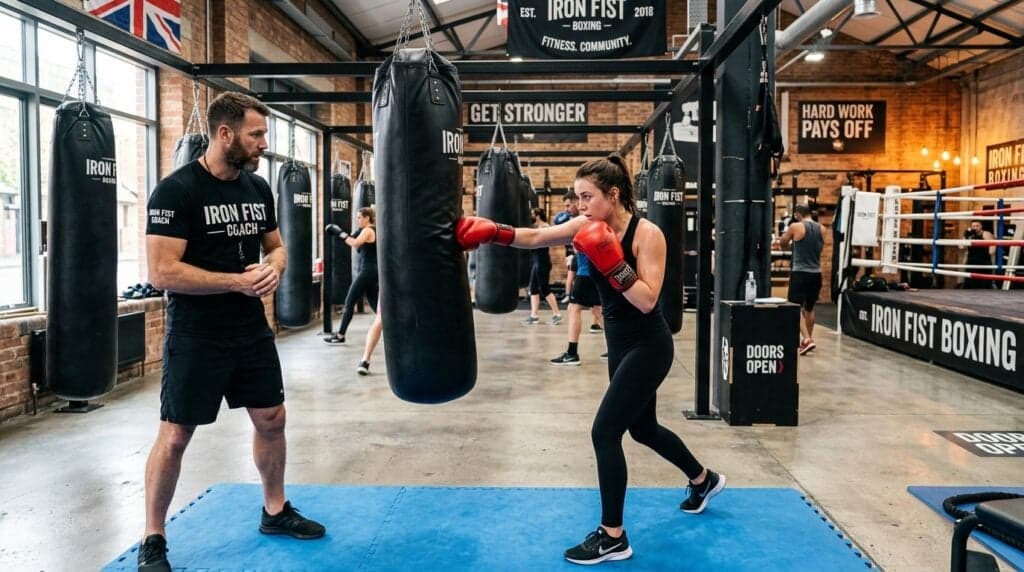
From there you will move into technique work: learning your stance, your guard, and the basic punches — the jab, cross, hook, and uppercut. The instructor demonstrates, then you practise, either on the bag or in front of a mirror.
Bag rounds follow, where you string the combinations together. You will hear the timer go off in 2- or 3-minute intervals — the same format as actual boxing rounds. Work hard, then rest. Repeat. It sounds simple, and it is — until your lungs start burning at round three.
Many classes end with conditioning work (press-ups, burpees, core exercises) before a cooldown and stretch. The whole thing is usually 45 to 60 minutes. You will be tired. You will also feel brilliant.
If nerves are a factor — and for many people they are, stepping into any new gym environment — the gymtimidation that stops people walking through the door is something boxing clubs actually handle well. The sport has a mutual respect built into its culture that most clubs carry into how they treat newcomers. You are not an intrusion; you are exactly who the session is designed for.
How Much Do Boxing Classes Cost in the UK?
Costs vary significantly by location and gym type, but here is a realistic overview for 2026:
- Fitness boxing and boxercise at mainstream gyms: Usually covered by your existing gym membership. If you are already paying £25–£45 per month at a budget gym, boxing classes are likely included at no extra cost.
- Dedicated boxing gym membership: Expect £40–£80 per month for unlimited access, which typically includes coached sessions. Community boxing clubs — often affiliated with England Boxing — can be considerably cheaper.
- Drop-in sessions: £10–£25 at most clubs. Boutique fitness boxing studios in London can charge £25–£35 per session.
- White collar boxing programmes: £200–£400 for the full 8-to-12-week package. Some clubs offer it free in exchange for raising charity sponsorship.
- One-to-one boxing coaching: £40–£80 per hour outside London; £70–£120 per hour in the capital.
Regional variation matters too. You will pay notably more in London and the South East than in the Midlands or the North of England, where excellent community clubs often charge under £30 per month.
What Kit Do You Actually Need?
For your first session at most gyms, the list is short:
- Trainers: Cross-trainers or running shoes are fine to start. Proper boxing boots are great eventually but entirely optional for beginners.
- Comfortable workout clothes: Nothing specialist needed. A t-shirt and shorts or leggings work perfectly.
- Hand wraps: Most gyms will lend a pair for your first session. They cost around £5–£10 to buy your own, and they protect your knuckles and wrists — worth buying once you know you enjoy it.
- Boxing gloves: Again, most gyms lend these initially. When ready to buy, budget £30–£60 for a decent pair. Do not go cheap; gloves are there to protect your hands.
- Gum shield: Only required once you start any contact work. Not needed for bag classes.
Resist the urge to panic-buy expensive kit before your first session. Show up, try it, invest once you know you love it.
Boxing vs. Other High-Intensity Fitness Classes
A common question is how boxing stacks up against other cardio-heavy options. Boxing — done properly, in rounds — is among the most demanding cardiovascular formats you can choose. The constant movement, the upper body effort, the mental engagement: all of it drives your heart rate high and keeps it there.
The high-intensity interval training scene in the UK achieves similar metabolic demands through structured work-rest intervals. Boxing achieves it almost by default — rounds are natural intervals. Many fitness boxing studios blend both approaches, using boxing formats to structure the session. Either way, your cardiovascular system will have to work hard. Boxing just tends to feel less like exercise while you are doing it.
How to Find the Right Boxing Gym Near You
The UK has no shortage of boxing gyms — from amateur clubs affiliated with England Boxing in every major town to high-end boutique studios in city centres. The challenge is finding one that suits your goals.
Think about what you actually want. If you are after high-energy cardio with great music and no contact, a boutique fitness boxing studio is probably the right fit. If you genuinely want to learn the sport, look for a gym that trains fighters at some level — even if you never plan to spar yourself, the quality of technical coaching in these clubs is usually higher.
According to England Boxing, the sport’s national governing body, affiliated clubs must meet structured safeguarding and coaching standards — a good indicator to look for when vetting a gym.
If you are also weighing boxing against other combat sports, the guide to martial arts gyms across the UK covers Muay Thai, Brazilian jiu-jitsu, judo, and MMA alongside boxing — useful if you are not sure yet which discipline appeals most.
GymPal makes it easy to search for boxing gyms and martial arts clubs near you across the UK. Filter by location, browse the listings, and get in touch with a club that sounds right. Most gyms are happy to answer questions over the phone or let you watch a session before committing.
Is Boxing Safe for Beginners?
For non-contact fitness boxing, absolutely — the risk profile is similar to any other gym class. For technical boxing with bags and pads, the main injury risks are to the hands, wrists, and shoulders, all of which are mitigated by proper technique and good equipment.
Sparring is a different conversation. Reputable gyms will not put beginners into contact work until they have the technical foundations and, more importantly, the confidence and readiness to do so safely. Any club that pressures newcomers into sparring before they are ready is one to avoid.
As with any new high-intensity exercise, a quick word with your GP first is sensible if you have existing health conditions. For most people, though, boxing is a safe and enormously rewarding addition to a fitness routine.
Making the Most of Your First Month
The biggest mistake new boxers make is rushing. Boxing is a technical sport, and the early weeks are about building movement patterns — how you stand, how you move, how you throw punches without injuring yourself. Resist the temptation to go harder before you have nailed the basics.
Commit to two or three sessions per week in your first month. Your forearms and wrists will be tired in ways you did not expect — bag work is genuinely demanding on the hands — so give yourself recovery time between sessions. Most newcomers find that their cardiovascular fitness improves quickly; boxing is efficient. The technique takes longer to feel natural, and that is completely normal.
Find a training partner if you can. Whether it is a mate who starts with you or someone you meet at the club, having someone at a similar level keeps you both accountable and makes the sessions more enjoyable. Boxing is a solo sport in the ring; in the gym, it is very much a team effort.
Ready to Find Your Club?
Boxing is one of those activities that people try once, are not sure about, and then find themselves completely hooked a month later. The combination of physical challenge, skill development, and genuine community is hard to replicate in other workout formats.
Whether you are after a boxercise session to supplement your regular gym routine or you want to learn the sport properly, the UK has options at every level and price point. Use GymPal to find boxing gyms and martial arts clubs near you — browse by location, check the listings, and find a club that feels right.
The first session is always the hardest. After that, most people cannot wait to go back.

I am Adam Hall, a dedicated fitness professional with over ten years of experience in the UK’s fitness industry. I earned my Master’s degree in Sports Science from Loughborough University and have worked with several top fitness studios across the UK. My certifications include a Level 3 Personal Trainer Certificate and a specialised Strength and Conditioning Coach accreditation.
Starting my career as a personal trainer, I quickly moved up to manage multiple gym locations, overseeing their operations and training programs. Beyond managing gyms, I regularly contribute to well-known fitness magazines and have been featured in articles for “Health & Fitness” and “Men’s Health”. My passion also extends online where I run a popular blog on GymPal’s AI-powered directory platform detailing insights into choosing the right fitness venues across the UK. With hundreds of posts reaching thousands of readers monthly, my goal is to influence positive changes in how people approach health and exercise throughout the country.