Adult Swimming Lessons UK: Learn to Swim at Any Age
Click Below To Share & Ask AI to Summarize This Article
There are roughly 14 million adults in the UK who can’t swim — or who swim so poorly that they avoid the pool entirely. If you’re one of them, you’re not alone, and you’re certainly not too old to change that. Whether you never quite got the hang of it as a kid, moved away from a pool town, or just haven’t been near water since a disastrous school trip to Weston-super-Mare, learning to swim as an adult is completely achievable.
Adult swimming lessons are offered at leisure centres, private pools, and independent swim schools right across the country. Most are friendly, patient, and specifically designed for grown-ups who didn’t grow up with fins. This guide covers what you’ll actually find when you book your first session, how much it’ll cost, and how to track down the best options near you.
Spoiler: it’s far less intimidating than you’re imagining. Most adult swimming classes are full of people in exactly the same position as you.
Why So Many Adults in the UK Don’t Swim
It’s worth acknowledging upfront that non-swimming adults aren’t rare. Research from Swim England — the national governing body for swimming in England — consistently shows that a significant chunk of the adult population either can’t swim at all or lacks the confidence to swim without support.
The reasons vary. Some adults never had proper access to a pool growing up. Others had bad experiences with cold, crowded lessons at school. A decent number learned the basics as children but gradually stopped and lost their confidence over the years. Anxiety about being seen in swimwear, fear of putting their face in the water, or worrying about looking foolish are all real barriers that keep adults away from the pool.
Good adult swimming instructors know all of this. The best programmes are structured around common adult anxieties, not child-focused curricula that assume you’ve got rubber armbands and no self-consciousness.
What to Expect From Your First Adult Swimming Lesson
Most adult lessons start with an informal assessment of your current ability. You don’t need to be able to do anything — instructors have seen every level, including complete beginners who have never been in a pool deeper than their knees. They just want to know where you’re starting from.
From there, typical beginner sessions focus on:
- Water confidence — getting comfortable being in the water, submerging your face, controlling your breathing
- Floating — the basic skill that underpins everything else, and often the bit that surprises people the most
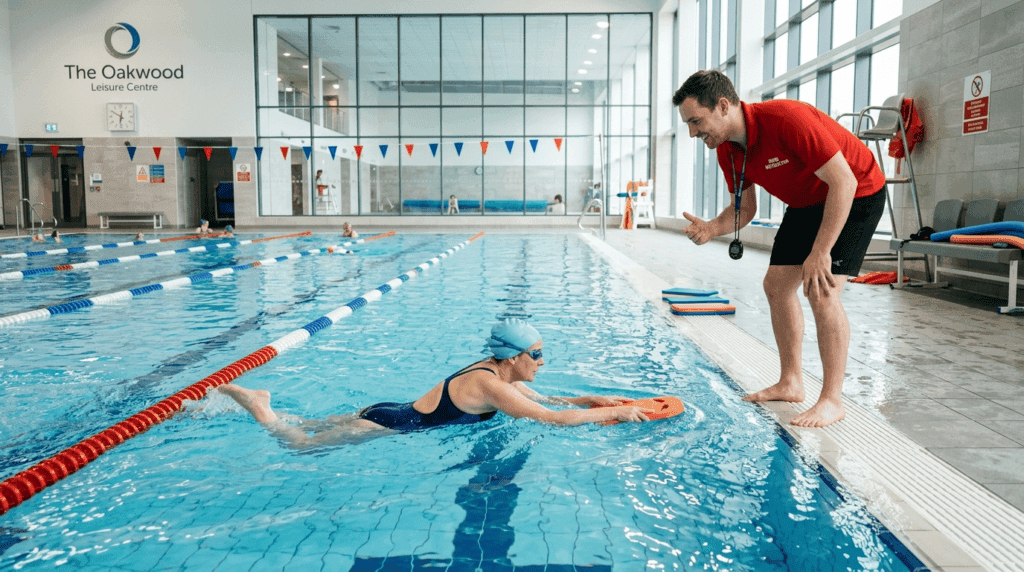
- Kicking technique — usually practised holding a float before adding arm movements
- Breaststroke or front crawl basics — most beginner programmes start with breaststroke because the timing is more intuitive
Lessons run either one-to-one (just you and the instructor) or in small groups, typically 4–8 people. Group lessons are more affordable and many adults find them less pressure — everyone’s learning together, nobody’s watching you, and there’s often a surprisingly good atmosphere. One-to-one lessons move faster and are ideal if you have specific anxieties or want to progress quickly.
Sessions are usually 30–45 minutes. Pools that run adult-specific sessions typically schedule them at times that avoid the after-school rush — mid-morning, early evening weekdays, or dedicated adult-only weekend slots.
How Much Do Adult Swimming Lessons Cost in the UK?
Prices vary depending on whether you’re booking through a local authority leisure centre or a private swim school.
Council-run leisure centres are the most affordable option. Adult group swimming lessons typically run between £6–£12 per session, often sold as a block of 10 weeks. If you’re already a gym member at the same centre, you may get a discounted rate. Some councils offer subsidised lessons for residents on low incomes or certain benefits — worth asking when you enquire.
Private swim schools and clubs charge more but often offer higher instructor-to-swimmer ratios and more flexible scheduling. Group classes at private providers usually sit at £12–£20 per session; one-to-one lessons at a private pool can range from £30–£60 per hour depending on location and the instructor’s qualifications.
Health club chains with pools — Virgin Active, David Lloyd, Nuffield Health, and similar — typically include swimming access with membership and sometimes offer in-house adult lessons as a paid add-on. If you’re already a member, this can be excellent value. If you’re swimming-specific and not using the rest of the gym, the membership cost needs factoring in. Plenty of [health clubs with pools across the UK](https://askgympal.co.uk/blog/gyms-with-spas-uk-health-clubs-pools-saunas/) combine swimming with wider wellness facilities like saunas, steam rooms and spa areas — useful context if you’re weighing up where to join.
Private one-to-one lessons at public pools are a middle ground — an independent instructor who hires lane time at a local pool. You’ll often find these advertised locally or through platforms like Bark.com. They tend to cost £25–£45 per session and give you the benefits of personal instruction without the full private club cost.
Where to Find Adult Swimming Lessons Near You
The easiest place to start is your nearest council leisure centre. Almost all local authority pools in England, Wales, and Scotland run some form of adult swimming programme. Search “[your town] leisure centre swimming lessons” and you’ll usually land on a timetable within two clicks.
For a broader search, Swim England’s Find a Learn to Swim provider tool lets you search by postcode for accredited swimming lesson providers near you — useful for finding quality-assured options if you’re not sure where to start.
GymPal also lists swimming venues across the UK, so you can use it to find pools and leisure centres near you and check what facilities they offer before you commit to travelling across town.
When choosing a provider, look for:
- Swim England–affiliated instructors (ASA-qualified)
- Classes grouped by ability level, not just “adult”
- Small class sizes (the smaller the better for beginners)
- A clear pathway from beginner to independent swimmer
- A timetable that actually works for your schedule
What to Bring and How to Prepare
You don’t need much for your first lesson. A well-fitted swimsuit or trunks, a towel, and a pair of goggles are enough. Goggles genuinely change how comfortable swimming feels — putting your face in the water without them is unpleasant for most adults, and instructors typically encourage you to use them from the start.
Some beginners find a swimming cap helpful, but it’s not mandatory unless the pool specifically requires it. A kick float will usually be provided by the pool or instructor.
If you’re nervous, arrive a few minutes early and introduce yourself to the instructor before the session. Most are used to anxious beginners and will quietly reassure you about what the session involves. You don’t need to be able to do anything before you get in — that’s the whole point of the lesson.
On the topic of anxiety: it’s completely normal to feel self-conscious about swimwear, about being seen struggling, or about being the least capable person in a group. The reality of adult swimming classes is that everyone is dealing with the same stuff. A surprising number of people in beginner sessions are returning swimmers who’ve lost confidence rather than true beginners — there’s no shame in either position.
Progression: What Comes After Beginners?
Most adult swimming programmes use a structured pathway. You’ll typically move through beginner (water confidence, floating, basic kicking) into improver (full stroke technique, building distance) and then into independent or fitness swimmer stages where the focus shifts to stamina and efficiency.
Swim England’s National Plan for Teaching Swimming provides the standard framework most UK providers follow. It breaks adult ability into clear stages and ensures instructors teach in a consistent, progressive way — so if you move house and join a new pool, your new instructor has a shared reference point for where you are.
Once you’re swimming independently, the world opens up considerably. Many people find that once they can swim comfortably, they want to explore further — [aqua fitness classes](https://askgympal.co.uk/blog/aqua-fitness-uk-pool-workouts-guide/), for example, are one of the best low-impact full-body workouts available and open up as soon as you’re comfortable in the water.
Can You Learn to Swim as an Adult if You’re Scared of Water?
Yes — though it requires a patient instructor and usually more time than someone with no fear. Aquaphobia (a genuine fear of water) is more common than most people realise, and many swim schools have instructors trained in managing it.
One-to-one lessons are almost always the better option here. A dedicated session with an instructor who understands aquaphobia lets you work at your own pace without the social pressure of a group setting. Progress might be slow at first — even getting comfortable standing in shoulder-deep water might be a whole session’s work — but that’s completely fine.
Some people work with a specialist fear-of-water programme before joining mainstream lessons. Organisations like the Fear-Free Swimming group run courses specifically designed for adults with water phobia, with small session sizes and a trauma-informed approach.
If the idea of open water is what ultimately appeals — summer lidos, lake swims, sea swimming — then building pool confidence first is the natural path. Once you’ve got reliable technique in a controlled environment, moving outdoors becomes far more manageable. The [UK’s wild swimming and open water scene](https://askgympal.co.uk/blog/wild-swimming-uk-open-water-fitness-guide/) has grown enormously over the past decade, and most wild swimmers started exactly where you are now.
Adult Swimming Lessons in Different UK Regions
Coverage varies by region but is generally good across England, Wales, and Scotland. Most cities and large towns have multiple options; rural areas can be patchier but usually have at least one council pool within reasonable distance.
London has an unusually wide spread of options including a growing number of private swim schools, lidos (Parliament Hill, Brockwell, and London Fields all run adult programmes), and chains like Everyone Active and Better, which run adult lessons across their pool sites.
Manchester and Birmingham both have large council pool networks with regular adult programmes. The better-quality private options tend to cluster around the suburbs of both cities.
Scotland has a strong leisure trust infrastructure — trusts like Leisure and Culture Dundee, Live Borders, and Edinburgh Leisure all offer adult swim lessons through their council pool estates. Glasgow Life runs a particularly well-regarded adult beginner programme across its pools.
Wales is served largely by local authority leisure centres; most have adult provision, though scheduling can be limited outside of larger towns like Cardiff, Swansea, and Newport.
Wherever you are, GymPal is a useful first stop to browse swimming venues in your area and compare what’s available before making any enquiries.
The First Step Is Just Finding Out What’s Near You
If you’ve been putting off learning to swim — or getting back to it — there’s a very good chance there’s a class running near you within the next fortnight. Adult swimming lessons are genuinely one of the more accessible fitness starting points in the UK: they’re widely available, relatively affordable, and run by instructors who understand adult learners rather than assuming you’ve got the mindset of an eight-year-old.
The actual hardest part is usually just making the enquiry. After that, most people find it significantly less terrifying than they imagined. The water’s warm(ish), the instructors are patient, and the other beginners are all in the same boat — or, more accurately, the same pool.

I am Adam Hall, a dedicated fitness professional with over ten years of experience in the UK’s fitness industry. I earned my Master’s degree in Sports Science from Loughborough University and have worked with several top fitness studios across the UK. My certifications include a Level 3 Personal Trainer Certificate and a specialised Strength and Conditioning Coach accreditation.
Starting my career as a personal trainer, I quickly moved up to manage multiple gym locations, overseeing their operations and training programs. Beyond managing gyms, I regularly contribute to well-known fitness magazines and have been featured in articles for “Health & Fitness” and “Men’s Health”. My passion also extends online where I run a popular blog on GymPal’s AI-powered directory platform detailing insights into choosing the right fitness venues across the UK. With hundreds of posts reaching thousands of readers monthly, my goal is to influence positive changes in how people approach health and exercise throughout the country.