The Complete Beginner’s Guide to Stretching and Mobility
Click Below To Share & Ask AI to Summarize This Article
Why Stretching and Mobility Deserve More Than Five Minutes
Walk into any UK gym and you’ll see the same pattern: people rush through a quick quad stretch, maybe touch their toes once, then load up a barbell. Meanwhile, the physiotherapists and sports therapists are busier than ever. There’s a direct connection. According to Sport England Active Lives survey
Stretching and mobility work aren’t glamorous. They won’t get you a personal best on your deadlift or make for an impressive Instagram story. But they might be the single most important thing you can do to train consistently, stay injury-free, and actually enjoy going to the gym.
Whether you’re a complete beginner or someone who’s been training for years but never quite got around to a proper mobility routine, this guide will walk you through everything you need to know. According to NHS physical activity guidelines
Stretching vs Mobility: What’s the Difference?
People often use these terms interchangeably, but they’re not the same thing:
- Stretching is about lengthening muscles. Think of reaching for your toes or pulling your heel to your glute. It targets the muscle tissue itself.
- Mobility is about how well a joint moves through its full range of motion. It involves muscles, tendons, ligaments, and the joint capsule working together. Think of hip circles, shoulder dislocates with a band, or deep squat holds.
You need both. Stretching a muscle that’s tight might help temporarily, but if the underlying joint has limited range of motion, that tightness will keep coming back. A good routine includes elements of both.
Why It Matters for Gym-Goers
Injury Prevention
Research published in the British Journal of Sports Medicine consistently shows that regular stretching and mobility work reduce the risk of muscle strains and joint injuries. If you’ve ever pulled a hamstring doing deadlifts or felt your shoulder pinch during an overhead press, limited mobility was likely a contributing factor.
Better Performance
A joint that moves through its full range produces more force. If your hips are tight, your squat depth suffers. If your thoracic spine is stiff, your overhead pressing power is limited. Mobility work isn’t supplementary — it’s foundational to getting stronger.
Faster Recovery
Targeted stretching after training helps reduce muscle soreness and promotes blood flow to worked areas. It’s not a magic cure for DOMS, but it genuinely helps you feel less like a robot the morning after leg day. See also: Gym Design and Fit-Out: How to Create a Space That Members L. See also: Women-Only Gyms in the UK: Why They Are Growing in Popularit.
Long-Term Joint Health
The “use it or lose it” principle applies to joint range of motion. As we age — and as we spend more time sitting at desks — our joints naturally stiffen. Regular mobility work counteracts this and keeps you moving well into your 40s, 50s, and beyond.
Before Your Workout: Dynamic Warm-Up (5-10 Minutes)
Static stretching (holding a stretch for 30+ seconds) before exercise has been shown to temporarily reduce power output. Instead, use dynamic movements that take your joints through their full range while increasing blood flow:
Lower Body Focus
- Leg swings: 10 per side, forward and back, then side to side. Hold onto a wall for balance.
- Walking lunges with a twist: 8-10 steps, rotating your torso toward your front leg. Opens hips and thoracic spine simultaneously.
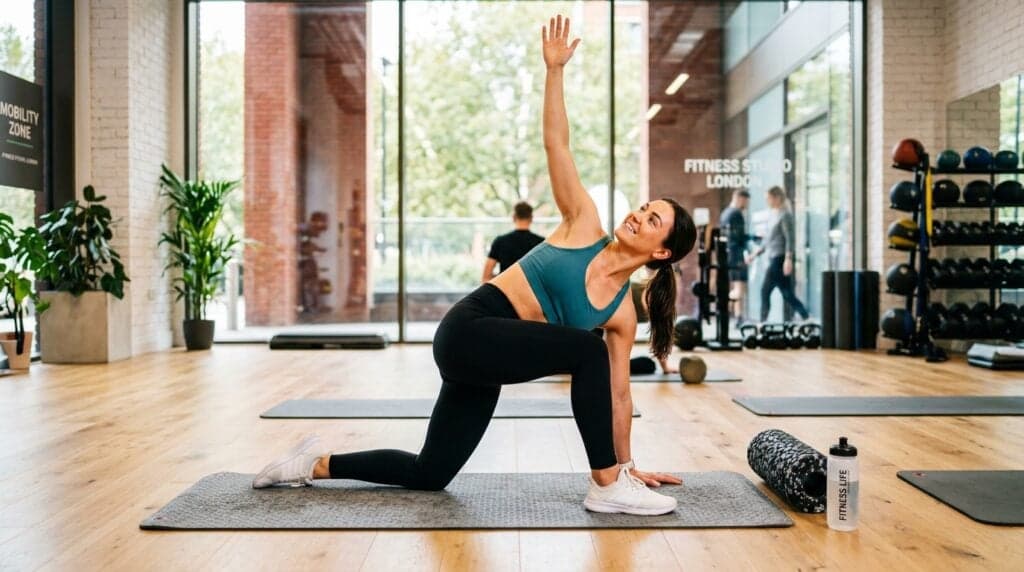
- World’s greatest stretch: 5 per side. Lunge forward, place your elbow on the ground, rotate your arm to the sky. A full-body opener in one movement.
- Bodyweight squats: 10 reps, focusing on depth and pushing knees out. If your heels lift, place a small plate under them.
- Ankle circles: 10 per direction per ankle. Often overlooked but critical for squat depth.
Upper Body Focus
- Arm circles: 15 forward, 15 backward. Gradually increase the size.
- Band pull-aparts: 15 reps with a light resistance band. Great for posture and shoulder health.
- Cat-cow stretches: 10 reps on all fours. Mobilises the entire spine.
- Thread the needle: 8 per side. From all fours, reach one arm under your body and rotate your torso. Excellent for thoracic rotation.
After Your Workout: Static Stretching Routine (10-15 Minutes)
Post-workout is when static stretching shines. Your muscles are warm, making them more receptive to lengthening. Hold each stretch for 30-60 seconds, breathing deeply:
Essential Stretches for Gym-Goers
- Standing hamstring stretch: Place one foot on a bench, hinge at the hips with a flat back. Feel the stretch in the back of your thigh, not your lower back.
- Pigeon stretch: From all fours, bring one knee forward to the same-side wrist and extend the other leg back. Opens the hip flexors and glutes — essential for anyone who sits at a desk.
- Wall pec stretch: Place your forearm on a wall at 90 degrees and turn your body away. Targets the chest and anterior shoulder, counteracting the hunched posture from desk work and bench pressing.
- Couch stretch: Kneel with one knee on the floor against a wall, other foot forward in a lunge position. The single best stretch for hip flexors. Hold for 60 seconds — it’s uncomfortable, but that means it’s working.
- Lat stretch: Grab a bar or doorframe with one hand, lean back and let your shoulder drop. Opens the lats and side of your torso.
- Figure-four glute stretch: Lie on your back, cross one ankle over the opposite knee, and pull the bottom leg toward you. Targets the glutes and piriformis.
Mobility Work You Can Do at Home
You don’t need to be at the gym to improve your mobility. Here’s a simple 15-minute routine you can do in your living room, ideally on rest days or in the evening:
- Deep squat hold: 60 seconds. Use a doorframe for balance if needed. Push your knees out and keep your chest up.
- 90/90 hip switches: 10 switches. Sit with both knees bent at 90 degrees, then switch sides by lifting your legs and rotating.
- Thoracic spine foam rolling: 2 minutes. Lie on a foam roller across your mid-back, support your head, and extend over the roller.
- Shoulder dislocates: 15 reps with a broomstick or resistance band. Hold it wide, slowly bring it from in front of your body to behind and back.
- Ankle dorsiflexion stretch: 60 seconds per side. Kneel with one foot flat against a wall, knee touching the wall, and lean forward.
Common Mistakes to Avoid
- Bouncing during stretches: This triggers the stretch reflex, which actually makes the muscle tighter. Hold still and breathe.
- Stretching cold muscles: Always do some light movement (even a brisk walk) before static stretching.
- Ignoring pain: Stretching should feel like mild discomfort, not pain. Sharp or shooting pain means you’re going too far or there’s an existing issue that needs attention.
- Only stretching the muscles you trained: If you sit at a desk all day, your hip flexors, chest, and hamstrings are probably tight regardless of what you trained. Address your posture-related tightness every session.
- Doing it once and giving up: Like strength training, mobility requires consistency. Five minutes daily is far better than 30 minutes once a week.
How Long Until You Notice a Difference?
Most people notice improved range of motion within 2-3 weeks of consistent daily stretching. Significant mobility improvements typically take 4-8 weeks. The key word is consistent. Ten minutes every day will get you further than an hour once a fortnight.
Find a Gym That Supports Your Goals
The best gym for you is one that fits your lifestyle, goals, and location. Whether you’re looking for a facility with dedicated stretching zones, recovery equipment, or classes that incorporate mobility work, you can find it on GymPal. Browse thousands of UK gyms, read real reviews, and compare facilities to find the right fit for your training journey.

I am Adam Hall, a dedicated fitness professional with over ten years of experience in the UK’s fitness industry. I earned my Master’s degree in Sports Science from Loughborough University and have worked with several top fitness studios across the UK. My certifications include a Level 3 Personal Trainer Certificate and a specialised Strength and Conditioning Coach accreditation.
Starting my career as a personal trainer, I quickly moved up to manage multiple gym locations, overseeing their operations and training programs. Beyond managing gyms, I regularly contribute to well-known fitness magazines and have been featured in articles for “Health & Fitness” and “Men’s Health”. My passion also extends online where I run a popular blog on GymPal’s AI-powered directory platform detailing insights into choosing the right fitness venues across the UK. With hundreds of posts reaching thousands of readers monthly, my goal is to influence positive changes in how people approach health and exercise throughout the country.