Calisthenics UK: Build Strength With Just Your Body Weight
Click Below To Share & Ask AI to Summarize This Article
There’s a fitness movement quietly taking over parks, playgrounds, and warehouse gyms across Britain — and it doesn’t involve a single dumbbell or cable machine. Calisthenics, the art of using your own bodyweight as resistance, has exploded in popularity across the UK. From outdoor rigs in London’s Victoria Park to dedicated calisthenics studios in Manchester and Glasgow, more and more people are discovering that the best gym equipment they’ll ever use is the one they were born with.
But calisthenics is more than a budget alternative to the gym. It’s a complete training system that builds functional strength, flexibility, and body control in ways that traditional weightlifting often can’t match. The movements — pull-ups, dips, handstands, muscle-ups, levers — are visually impressive, deeply satisfying to master, and enormously effective at building muscle and athletic performance.
This guide covers everything you need to know about getting started with calisthenics in the UK: what it is, why it’s worth doing, the best exercises to begin with, how to progress, and where to find calisthenics-friendly spaces near you.
What Is Calisthenics?
Calisthenics (pronounced “cal-is-then-ics”) comes from the Greek words for “beauty” and “strength.” At its core, it’s physical training that uses your bodyweight instead of external weights. Think of it as the opposite of going to a weights room — there’s no barbell to load, no machine to adjust. Just you, gravity, and a bar to hang from.
The range of exercises is enormous. At the beginner end, you’ve got push-ups, squats, and lunges — movements most people are familiar with. As you progress, you unlock more demanding skills: dips, pull-ups, pistol squats, and handstand push-ups. At the elite end sits the stuff that makes gym-goers stop and stare: the human flag, the planche, the front lever, and the muscle-up.
What makes calisthenics different from simply “doing press-ups in your living room” is the structured skill progression. You’re always working toward the next level — adding reps, increasing difficulty, or mastering a new movement. That progression keeps training engaging in a way that mindlessly adding weight to a barbell often doesn’t. You’re not just getting stronger; you’re genuinely developing new physical skills.
Why Calisthenics Is Booming in the UK
A decade ago, calisthenics in the UK was a niche pursuit — the domain of gymnastics coaches and people who trained in parks because they couldn’t afford a gym. Today, it’s mainstream. Search for calisthenics on YouTube and you’ll find British content creators with millions of followers. Dedicated calisthenics parks have sprung up in cities from Bristol to Edinburgh. And specialist calisthenics gyms — often called “street workout gyms” or “movement gyms” — are opening across the country.
Several factors are driving this. First, cost. A calisthenics workout requires nothing more than a bar — and many parks have them for free. In a period when gym memberships, personal training sessions, and group classes have all risen in price, zero-cost outdoor training has real appeal.
Second, accessibility. You can train alone, in silence, with no membership card, no locker, and no induction session. For the growing number of people who find traditional gym environments uncomfortable — the kind of anxiety that can stop someone from ever walking through the door — training outside with your own bodyweight is often the gateway back into fitness. The feeling of gymtimidation is very real, and calisthenics removes that barrier entirely by shifting training to an environment where the rules are entirely your own.
Third, and perhaps most importantly: results. Despite carrying none of the prestige of heavy barbell training, calisthenics builds serious muscle. A well-executed pull-up recruits the same latissimus dorsi, biceps, and rear deltoids as a cable row. Dips load the triceps and pectorals effectively. Ring push-ups create chest muscle activation that flat bench press often can’t match. The science is clear: bodyweight resistance training produces comparable hypertrophy to free weight training when progressive overload is applied systematically.
The Best Calisthenics Exercises for Beginners
If you’re new to calisthenics, resist the urge to attempt a muscle-up in the first week. The foundation is a small set of compound movements that build the strength and body awareness you’ll need for more advanced skills later.
Push-ups — The foundational pushing movement. Start with regular push-ups; if those are too hard, use an elevated surface. Once you can do 3 sets of 20 with good form, progress to diamond push-ups or archer push-ups.
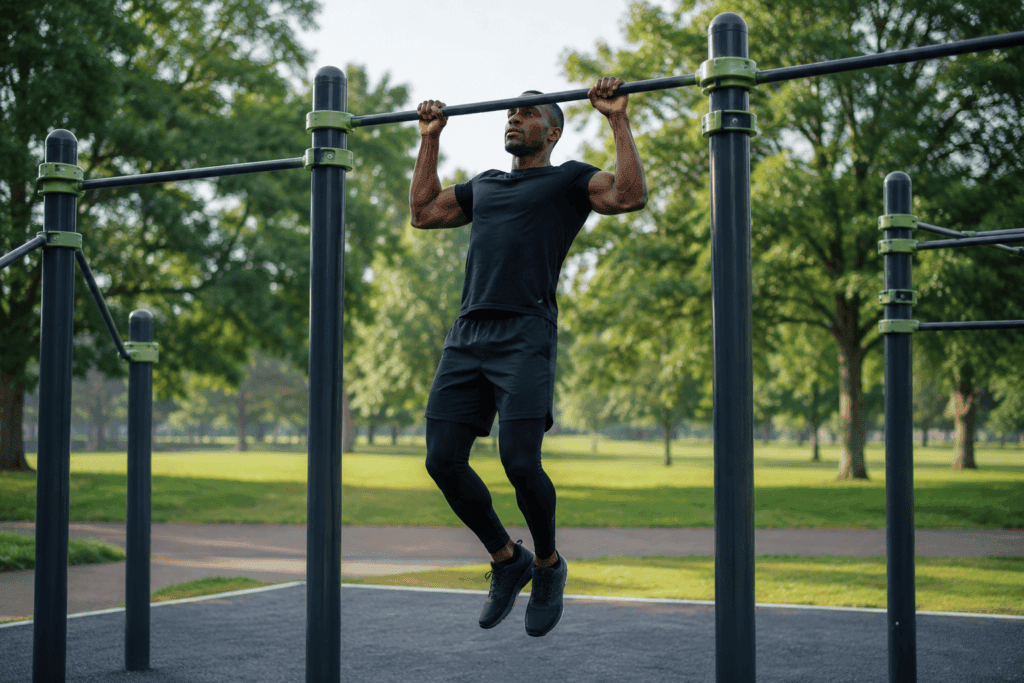
Dead hangs and scapular pulls — Before you attempt a pull-up, spend time simply hanging from a bar and learning to control your shoulder blades. Scapular pulls — depressing your shoulder blades while hanging, without bending your elbows — are the single most important precursor to a proper pull-up. They also protect your shoulders.
Bodyweight rows — If pull-ups aren’t possible yet, horizontal rows under a low bar or using gymnastics rings are the best way to build pulling strength. They train the same muscles in a less demanding position and progress quickly.
Squats and split squats — Lower body strength tends to advance faster in calisthenics. Standard bodyweight squats progress to Bulgarian split squats, then eventually to pistol squats — single-leg squats that test strength, balance, and mobility simultaneously.
Dips — On parallel bars, dips are one of the most effective upper body pushing exercises in all of calisthenics. Keep your torso upright to bias the triceps, or lean forward slightly for more chest involvement. If full dips aren’t possible yet, bench dips let you build the required strength.
Hollow body hold — This is the core of calisthenics, literally and figuratively. The slightly curved, arms-extended body position is the foundation of skills like the front lever, planche, and muscle-up. Spend a few minutes every session working this hold and you’re building the right movement patterns from the very start.
How to Progress: The First Six Months
The most common mistake beginners make is trying to skip ahead. Calisthenics rewards patience and systematic progression above almost everything else. Here’s a simple framework for your first six months:
Months 1–2: Build a foundation. Three sessions per week, roughly 45 minutes each. Focus entirely on push-up progressions, scapular work, bodyweight rows, and squats. Aim for 3–4 sets of each exercise, pushing close to failure. Add a hollow body hold at the end of each session.
Months 3–4: Begin pull-up work. If you can do 5 or more pull-ups, move them to a central part of your programme. If not, continue with negatives (jumping to the bar and lowering yourself slowly over 3–5 seconds) and assisted variations. Introduce dips once your push-up foundation is solid.
Months 5–6: Begin skill work alongside strength training. The L-sit — a controlled static hold with legs parallel to the ground — is an excellent first skill that develops hip flexors and triceps simultaneously. Handstand work against a wall can also begin here, starting with face-to-wall holds to develop shoulder stability and body alignment.
By the end of six months of consistent training, most people are genuinely surprised by how much their physique has changed — and how much stronger they feel in everyday activities like carrying shopping, climbing stairs, or picking things up. Calisthenics develops real-world strength in a way that machine-based gym training often doesn’t.
Calisthenics Parks, Gyms, and Outdoor Rigs in the UK
One of the best things about calisthenics is that you can do it almost anywhere. But having access to quality equipment genuinely accelerates progress — and the UK now has more options than ever.
Outdoor calisthenics parks: These have proliferated across UK cities over the past five years. Look for parks with outdoor fitness equipment — pull-up bars, dip bars, and sometimes more advanced structures like monkey bars and parallel bars. London has excellent provision, with permanent rigs at Clapham Common, Hackney Marshes, and several parks in East London. Birmingham’s Cannon Hill Park, Leeds’ Woodhouse Moor, Manchester’s Platt Fields Park, and Glasgow’s Kelvingrove Park all have usable setups. Many councils have added these facilities following Sport England’s investment in outdoor physical activity infrastructure.
Dedicated calisthenics gyms: A new breed of gym has emerged specifically for bodyweight and calisthenics training. These spaces typically feature high-quality gymnastics rings, wall bars, parallettes, and coaching from experienced practitioners. They’re small, focused, and usually very welcoming to beginners. Cities including London, Manchester, Bristol, Leeds, and Glasgow now have at least one dedicated calisthenics gym. Monthly membership typically runs between £40 and £80, which compares favourably with larger chain gyms.
Standard gyms with functional training areas: Many traditional gyms have added functional training zones in recent years — spaces with pull-up rigs, dip stations, and gymnastics rings that work perfectly for calisthenics training. Functional fitness gyms across the UK tend to be particularly well-equipped for bodyweight work, often offering rig space, rings, and open floor alongside the usual barbell setup.
Outdoor bootcamp and movement classes: If you want some structure and coaching to kickstart your calisthenics journey, many outdoor bootcamp classes in the UK incorporate substantial bodyweight work — push-ups, burpees, dips on benches, and squat variations — and provide a community-based entry point while you build your solo practice.
GymPal lets you search for gyms and fitness spaces near you across the UK, including functional training centres and specialist movement gyms that cater to calisthenics enthusiasts.
Calisthenics and Weight Loss: What to Expect
A question that comes up constantly: is calisthenics effective for weight loss? The honest answer is yes — but the mechanism might be different from what you expect.
Calisthenics isn’t primarily a calorie-burning activity the way a long run or spin session might be. But it builds lean muscle mass, and muscle mass raises your resting metabolic rate. A person carrying more muscle burns more calories at rest, throughout the day, even when sitting at a desk. Over months and years, that compounds significantly.
The more immediate effect is compositional. People who do calisthenics consistently tend to lose body fat and gain muscle simultaneously, particularly in the first year. The lean, defined look that many gym-goers chase is essentially this combination — and calisthenics is remarkably effective at producing it without the need for extensive cardio or restrictive dieting.
The NHS recommends at least 150 minutes of moderate-intensity activity per week for adults, alongside muscle-strengthening activities on two or more days. A well-structured calisthenics programme covers both elements — the movement builds cardiovascular endurance and the resistance elements strengthen muscles — which is one reason it’s increasingly recommended by health professionals.
Is Calisthenics Right for You?
Calisthenics works for almost anyone — but it’s particularly well-suited to certain kinds of people.
If you’re someone who’s been put off joining a traditional gym — whether that’s anxiety about using equipment correctly, uncertainty about what to do, or simply finding the environment uncomfortable — then training outside with your bodyweight, or in a small specialist calisthenics gym with a welcoming community, can be a genuine turning point.
If you already train but feel stuck or bored with the same machines and routines, calisthenics provides an entirely new category of challenges and skills to pursue. The planche, the human flag, the muscle-up — these are goals that can sustain motivation for years without requiring any additional kit or gym upgrades.
If you’re time-pressed or travel frequently for work, calisthenics is the most portable form of strength training that exists. All you need is a bar — and in most UK towns, there’s one in the local park.
And if you’re starting completely from scratch, calisthenics offers one of the most accessible and lowest-cost ways to begin building strength, coordination, and physical confidence. It scales from absolute beginner to elite athlete without ever requiring you to change gyms or buy new equipment.
Your First Steps This Week
Here’s what to do to get started right now:
- Find a local bar. Walk to your nearest park and see if there’s a pull-up bar or outdoor fitness rig. Most towns and cities now have at least one. GymPal can help you find gyms and outdoor fitness spaces near you.
- Test your baseline. How many push-ups can you do with good form? Can you hang from a bar for 30 seconds? Can you do a deep bodyweight squat with your heels flat? These are your starting points — and they’ll look very different in six months.
- Follow a structured programme. Apps like Calisthenics Ally and coaches on YouTube such as Tom Merrick provide free, well-structured beginner programmes. Don’t improvise from day one — a programme keeps you progressing efficiently.
- Be patient with skills. The advanced movements take months or years to develop. That’s not a warning; it’s part of the appeal. You’re building something real and lasting.
- Consider an introductory session. Many calisthenics gyms offer one-off coaching sessions or beginner workshops. An hour with an experienced coach can save you months of inefficient practice and ingrained bad habits.
The Bottom Line
Calisthenics is one of the most complete, sustainable, and accessible forms of strength training available to UK gym-goers. It doesn’t require expensive equipment, a monthly membership, or any prior experience. Done consistently, it produces real muscle, genuine athleticism, and a set of physical skills that are deeply satisfying to develop over time.
Whether you start in your local park, in a dedicated movement gym, or simply on your living room floor, the key is consistency and progressive challenge. Start where you are, build systematically, and trust the process — because in six months, you’ll barely recognise what your body is capable of.
GymPal lists gyms, functional fitness centres, and outdoor spaces right across the UK. Search your area on GymPal to find a calisthenics-friendly spot near you and get started today.

I am Adam Hall, a dedicated fitness professional with over ten years of experience in the UK’s fitness industry. I earned my Master’s degree in Sports Science from Loughborough University and have worked with several top fitness studios across the UK. My certifications include a Level 3 Personal Trainer Certificate and a specialised Strength and Conditioning Coach accreditation.
Starting my career as a personal trainer, I quickly moved up to manage multiple gym locations, overseeing their operations and training programs. Beyond managing gyms, I regularly contribute to well-known fitness magazines and have been featured in articles for “Health & Fitness” and “Men’s Health”. My passion also extends online where I run a popular blog on GymPal’s AI-powered directory platform detailing insights into choosing the right fitness venues across the UK. With hundreds of posts reaching thousands of readers monthly, my goal is to influence positive changes in how people approach health and exercise throughout the country.