CrossFit Gyms UK: What to Expect Before Your First WOD

Click Below To Share & Ask AI to Summarize This Article
Walk past most CrossFit boxes in the UK and you’ll hear it before you see it: clanging barbells, someone counting down the last ten seconds of a workout, and a group of people cheering on whoever’s still going. It looks intense from the car park, which puts plenty of people off ever booking that first intro session — which is a shame, because CrossFit is built specifically for people who’ve never done it before, not just the people already shouting encouragement.
If you’ve been curious but intimidated, here’s exactly what to expect before you turn up, so the only surprise on day one is how much you enjoy it.
None of this requires any prior experience with weightlifting or gymnastics. The whole format is designed around measuring your own progress against your own previous scores, not comparing yourself to the person next to you — the leaderboard culture you see online is almost always optional and specific to competitive boxes, not a universal part of the experience.
Adam Hall here. Let’s get you ready for your first WOD.
What “CrossFit” Actually Means
CrossFit is a style of training that mixes weightlifting, gymnastics-based bodyweight movements, and cardio into varied daily workouts, known as the WOD (Workout of the Day). No two days look quite the same — one session might pair squats with rowing, the next might combine pull-ups with kettlebell swings. The variety is intentional: rather than specialising in one thing, you’re training general fitness across strength, stamina, and mobility all at once.
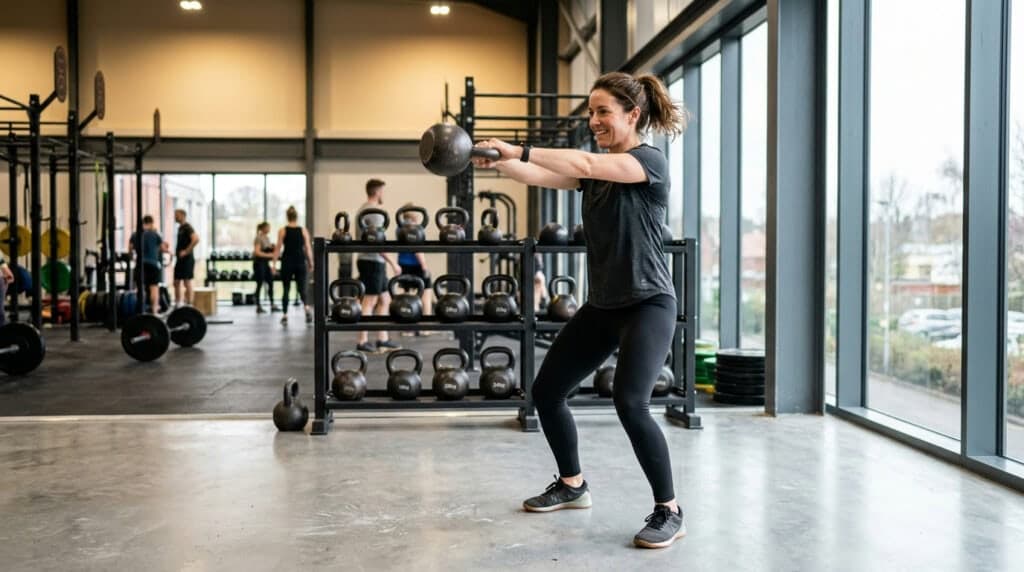
Boxes” (CrossFit gyms are almost never called gyms by regulars) tend to be stripped-back spaces — exposed brick, rigs, barbells, and open floor space rather than rows of cardio machines and mirrors. It’s a different atmosphere to a typical commercial gym, and that’s usually exactly what draws people in once they get past the intimidation factor.
Why Your First Session Won’t Look Like the Instagram Videos
The videos that make CrossFit look terrifying are almost always competitive athletes doing the “Rx” (as prescribed) version of a workout. Every reputable box scales every single workout for beginners — lighter weights, modified movements, fewer reps — and a good coach will scale your very first class without you even having to ask. If a box doesn’t scale workouts for newcomers, that’s a red flag about the coaching, not a sign CrossFit itself isn’t for you.
Most boxes also run a dedicated “On-Ramp” or foundations course for new members, typically 3-6 sessions over a couple of weeks, covering the core lifts and movements before you join a regular class. Ask about this specifically when you enquire — a box that skips straight to throwing beginners into a full class with no introduction isn’t setting you up well.
During On-Ramp, expect to spend most of the time on the air squat, the deadlift, the push press, and basic gymnastics positions like the hollow hold, well before anyone hands you a barbell loaded with real weight. Coaches use this period to spot and correct technique issues early, which matters more in CrossFit than in a typical gym because the workouts move quickly and often combine several movements under fatigue.
What an Actual Session Looks Like
A typical hour runs: a group warm-up (10 minutes), a skill or strength component where the coach walks through technique for that day’s main lift (15-20 minutes), the WOD itself (anywhere from 5 to 25 minutes depending on the workout), and a cool-down. Classes are small by design, usually 8-15 people, which means the coach can actually watch your form rather than just supervising from a distance.
The community element is real and not just marketing — most boxes have people cheering on whoever finishes last, and that’s considered completely normal rather than patronising. It’s one of the more consistently cited reasons people stick with CrossFit longer than a standard gym membership.
Classes typically run on a fixed timetable throughout the day, often starting as early as 6am and running through until 8 or 9pm, with the exact structure of the WOD posted in advance on an app or whiteboard so members who like to plan ahead can see what’s coming. Some boxes rotate through named benchmark workouts — “Fran,” “Murph,” and similar — which let you track your own progress against a workout you’ll repeat every few months, giving you a concrete marker of improvement beyond just how heavy you’re lifting.
The Jargon You’ll Hear in Your First Week
CrossFit has its own shorthand, and it’s genuinely confusing until someone explains it once. “AMRAP” means as many rounds as possible in a set time. “EMOM” means a new set of reps starts every minute on the minute. “Rx” means the workout as originally written, versus “scaled,” which means modified for your current level — and scaled is the right choice for your first several months, not a consolation prize. “WOD” is simply the workout of the day, and “PR” is a personal record. Coaches expect to explain these terms to newcomers constantly, so don’t feel like you should already know them walking in.
Movements get abbreviated too — you’ll hear “DU” for double-unders (a jump rope skill), “T2B” for toes-to-bar, and “C&J” for clean and jerk. None of these need to be familiar on day one; a good coach talks you through the full name and demonstrates before expecting you to attempt any of them.
What It Actually Costs
CrossFit memberships in the UK typically run £90-£150 a month, noticeably more than a budget chain gym, but it includes coached classes every session rather than just facility access. Factor that into the comparison rather than looking at the headline price alone — you’re paying for programming and coaching, not just a key fob. Many boxes offer a free trial class or a discounted intro week, which is worth taking before committing to a membership, since the specific box’s coaching style and community matter more to whether you’ll enjoy it than the general format does.
Ask what’s included before you sign anything: some boxes bundle the On-Ramp foundations course into your first month’s fee, while others charge for it separately as a one-off package. It’s also worth asking whether your membership includes open gym access outside of coached class times, since that varies a lot between boxes and affects how much flexibility you actually get for the price.
What to Bring and Wear
You don’t need specialist CrossFit shoes for your first few sessions — any flat-soled trainer works fine, though many regulars eventually move to a flat, stable training shoe once they’re doing heavier lifts regularly. Bring a water bottle, a towel, and clothes you can move freely in; gymnastics movements like pull-ups and handstand work mean baggy clothing can get in the way more than it would in a standard gym session. Most boxes provide chalk for grip on barbell work, but it’s worth asking rather than assuming.
Building Toward It With the Right Equipment Knowledge
If kettlebells are new to you, getting comfortable with them before your first class takes some of the pressure off learning everything at once — this beginner’s guide to kettlebell training covers the core swings and holds that show up constantly in CrossFit programming. Similarly, if the barbell lifts feel like the intimidating part, building basic strength first through a structured programme such as beginner powerlifting fundamentals gives you a technical head start on squats, deadlifts and presses before you’re doing them under a clock.
How It Compares to Other Functional Formats
If CrossFit’s format appeals but the specific box culture doesn’t quite fit, it’s worth knowing the UK functional fitness space has grown well beyond just CrossFit — HYROX, for instance, follows a similar philosophy of mixed, varied training but with a standardised race format rather than a daily changing WOD. Our guide to what HYROX is and how to train for it is worth a read if you want the functional-fitness community feel with a more structured competitive goal attached.
This growth isn’t a coincidence. The UK fitness market has been expanding steadily, with ukactive’s latest market report recording 12.2 million UK gym members and continued growth in revenue, with functional and strength-based formats among the categories driving that demand.
The Bottom Line
CrossFit looks intimidating from the outside precisely because the loudest content about it is the most extreme version of it. The reality for a beginner is scaled workouts, small classes, a coach watching your form, and a foundations course designed specifically to get you ready. Book a trial, ask about the on-ramp programme, and judge the box on how it treats its newest members rather than how impressive its most advanced ones look online.
Ready to find a CrossFit box or functional fitness gym near you? Search GymPal to compare facilities and book a trial class today.

I am Adam Hall, a dedicated fitness professional with over ten years of experience in the UK’s fitness industry. I earned my Master’s degree in Sports Science from Loughborough University and have worked with several top fitness studios across the UK. My certifications include a Level 3 Personal Trainer Certificate and a specialised Strength and Conditioning Coach accreditation.
Starting my career as a personal trainer, I quickly moved up to manage multiple gym locations, overseeing their operations and training programs. Beyond managing gyms, I regularly contribute to well-known fitness magazines and have been featured in articles for “Health & Fitness” and “Men’s Health”. My passion also extends online where I run a popular blog on GymPal’s AI-powered directory platform detailing insights into choosing the right fitness venues across the UK. With hundreds of posts reaching thousands of readers monthly, my goal is to influence positive changes in how people approach health and exercise throughout the country.