Powerlifting for Beginners: Your UK Gym Guide
Click Below To Share & Ask AI to Summarize This Article
Walk into almost any UK gym these days and you’ll spot it: a rack of chalky plates, a lifting platform marked out in tape, and someone grinding through a heavy set of squats while a mate stands by to spot. Powerlifting has gone from a niche strength sport to one of the fastest-growing reasons people join a gym in Britain, and it’s easy to see why. Three lifts, one simple goal — get stronger — and a community that’s far friendlier than the intimidating stereotype suggests.
If you’ve been curious about swapping your usual cardio-and-machines routine for something with a bit more structure (and a lot more iron), this guide covers everything a beginner needs: what powerlifting actually is, the three lifts explained properly, how to find a gym that’s set up for it, and how to programme your first few months without burning out or getting hurt.
You don’t need to be big, strong, or even particularly fit to start. You just need a bar, some plates, and a plan — and by the end of this guide, you’ll have all three sorted.
What Is Powerlifting, Really?
Powerlifting is a strength sport built around three lifts: the squat, the bench press, and the deadlift. In competition, you get three attempts at each lift, and your best successful attempt at every lift is added together for your total. Whoever lifts the most relative to their bodyweight and category wins.
That’s the competitive side, but most people who train “powerlifting style” never set foot on a competition platform — and that’s absolutely fine. The appeal is the structure. Instead of wandering between machines wondering what to do next, you follow a programme built around getting better at three specific movements. Progress is easy to measure: if you squatted 60kg for five reps last month and you’re doing 70kg this month, you know it’s working.
It’s also worth separating powerlifting from bodybuilding and Olympic weightlifting, since people often mix them up. Bodybuilding is about building muscle size and shape through a wide variety of exercises. Olympic weightlifting involves the explosive snatch and clean & jerk. Powerlifting is simpler: squat, bench, deadlift, repeat — and get heavier over time.
The Three Lifts, Properly Explained
Each lift trains a different pattern, and together they hit almost every major muscle group in the body.
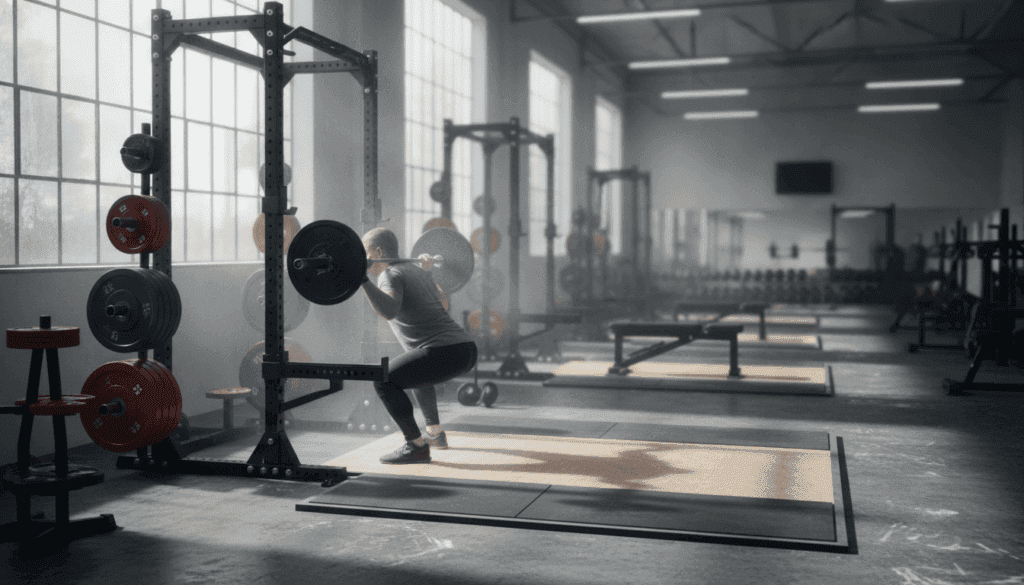
The squat is a full-body lift that mainly targets your quads, glutes and core. You unrack the bar across your upper back, squat down until your hip crease passes below your knee, then stand back up. Depth and a braced core matter more than how much weight is on the bar — a shallow squat with heavy weight won’t count in competition and won’t build strength properly either.
The bench press trains your chest, shoulders and triceps. Lying on a flat bench, you lower the bar to your chest, pause briefly, then press it back up to full arm extension. The pause is what separates a controlled bench press from a bouncy one — and it’s where most beginners need to slow down.
The deadlift is arguably the most functional of the three: picking a heavy object up off the floor. It hits your hamstrings, glutes, back and grip all at once. Keep the bar close to your shins, brace hard, and drive through your heels rather than yanking with your lower back.
Form matters far more than load when you’re starting out. Most gyms offering free inductions will run through the basics of all three lifts, and it’s worth asking — a few sessions with someone checking your technique will save you months of bad habits later.
Why It’s Booming Across the UK Right Now
Strength training has shifted from a niche pursuit to mainstream advice. UK Chief Medical Officers now recommend adults do activities that build strength on at least two days a week, alongside regular aerobic exercise, as part of the official NHS strength and flexibility guidelines. Powerlifting is a straightforward way to hit that target because the three lifts cover almost every muscle group with minimal equipment.
There’s also a cultural shift away from “cardio bunny” stereotypes. Women’s participation in strength sport has grown enormously in the UK over the past few years, and plenty of independent gyms now run dedicated beginner strength classes to meet the demand. The barrier to entry has never been lower — you don’t need a garage gym or a competition federation membership, just access to a barbell and a rack.
Finding a Gym With the Right Kit
Not every gym is set up for serious lifting. A lot of budget chains have a couple of squat racks shared between hundreds of members, no bumper plates, and benches with barely any free weights beyond dumbbells. Before you commit to a membership, check what’s actually on the gym floor.
Look for multiple power racks or squat stands, a dedicated platform or deadlift area with bumper plates, calibrated plates in small increments (1.25kg and 2.5kg) so you can make small jumps, and chalk allowed at the bar. If you’re not sure what to prioritise, our full checklist for choosing a UK gym covers exactly what to look for on a tour, beyond just the price on the door.
This is where GymPal earns its keep — search by facility type on askgympal.co.uk and you can filter for gyms with dedicated free-weights areas and power racks near you, rather than turning up to three different gyms on a Saturday to check for yourself.
Powerlifting Gym Etiquette
Walking up to a rack full of serious lifters for the first time can feel intimidating, but the unwritten rules are simpler than you’d think. Don’t walk in front of someone mid-set, re-rack your plates when you’re done, and if someone’s clearly working through a programme on a rack, don’t hover waiting to jump in between their sets — ask how many sets they’ve got left.
Chalk, grunting, and the occasional dropped bar are all normal parts of a serious lifting session, not something to be embarrassed about or put off by. If you want the fuller picture of what’s expected of you on the gym floor, our guide to UK gym etiquette runs through the wider unwritten rules beyond just the lifting platform.
Your First 12 Weeks: A Simple Beginner Programme
You don’t need a complicated programme to get strong fast as a beginner — in fact, simplicity is what makes beginner progress so quick. A classic linear progression works well for the first few months: train each lift two or three times a week, add a small amount of weight every session (2.5kg on squat and deadlift, 1.25-2.5kg on bench), and keep your rep ranges in the 5×5 or 3×5 range.
When you stop being able to add weight every session — usually after 8 to 12 weeks for most beginners — that’s your sign to switch to a more structured intermediate programme with built-in deload weeks. Plenty of free templates exist online (StrongLifts 5×5 and Starting Strength are the two most common starting points in UK gyms), but the principle matters more than the specific template: progressive overload, consistent technique, and patience.
Fuelling Your Lifts: Nutrition and Recovery
Strength gains happen in recovery, not just in the gym. You need enough protein to repair and build muscle (roughly 1.6-2.2g per kilogram of bodyweight per day for most lifters), enough overall calories to support the extra training load, and enough sleep to actually recover between sessions.
Plenty of beginners also look at supplements once the basics are dialled in. If you’re wondering whether it’s worth it, our beginner’s guide to creatine covers the one supplement with genuinely solid evidence behind it for strength athletes, and what to skip.
Thinking About Competing?
You don’t need to compete to enjoy powerlifting, but if the idea appeals once you’ve built a base level of strength, UK competitions are far more accessible than people expect. Local meets run throughout the year across most regions, entry fees are usually under £40, and categories are split by bodyweight and experience level so you’re never thrown in against seasoned lifters in your first outing.
Most beginners start by training with a local club or gym that has members who already compete — they’ll know the judging standards, the kit rules, and which local meets are beginner-friendly.
Getting Started This Week
Powerlifting rewards patience more than any other gym pursuit — the beginners who stick with it for a full year almost always end up stronger than they ever expected, simply by showing up and adding a little weight each week. Find a gym with proper racks and a platform, nail your form on the three lifts before you worry about load, and track every session so you can see the progress on paper.
If you’re not sure which gyms near you actually have the kit for it, search GymPal to compare facilities, read real member reviews, and find a gym built for lifting rather than just cardio — then get under the bar.

I am Adam Hall, a dedicated fitness professional with over ten years of experience in the UK’s fitness industry. I earned my Master’s degree in Sports Science from Loughborough University and have worked with several top fitness studios across the UK. My certifications include a Level 3 Personal Trainer Certificate and a specialised Strength and Conditioning Coach accreditation.
Starting my career as a personal trainer, I quickly moved up to manage multiple gym locations, overseeing their operations and training programs. Beyond managing gyms, I regularly contribute to well-known fitness magazines and have been featured in articles for “Health & Fitness” and “Men’s Health”. My passion also extends online where I run a popular blog on GymPal’s AI-powered directory platform detailing insights into choosing the right fitness venues across the UK. With hundreds of posts reaching thousands of readers monthly, my goal is to influence positive changes in how people approach health and exercise throughout the country.