Obstacle Course Racing UK: Your Guide to Mud Runs
Click Below To Share & Ask AI to Summarize This Article
Mud runs used to be a niche pursuit for ex-forces types and adrenaline junkies. Not anymore. Tough Mudder, Spartan Race and a growing string of smaller UK-based obstacle events now sell out fields from Cheshire to Kent every year, and the start lines are packed with first-timers, office teams and entire families rather than just seasoned athletes.
If you’ve ever watched a mate’s Instagram Reel of them crawling under barbed wire covered head to toe in mud and thought “actually, that looks brilliant,” you’re not alone. Obstacle course racing (OCR) has become one of the fastest-growing participation sports in the UK precisely because it’s forgiving to beginners while still being genuinely tough — there’s a distance and difficulty level for almost everyone, and you don’t need to be able to run a fast 10K to have a great day out.
This guide covers what UK obstacle racing actually involves, what the big events cost, how to train for your first one without injuring yourself, how to stay safe on the day, and what to pack for race morning.
What Is Obstacle Course Racing?
OCR combines trail running with physical obstacles — walls, monkey bars, rope climbs, cargo nets, water crossings and, depending on the event, the odd electric shock wire. The two biggest names in the UK are Tough Mudder and Spartan Race, and they take slightly different approaches.
Tough Mudder is built around teamwork rather than timing chips. Courses typically run 5K to 15K with obstacles like greased quarterpipes, ice-water plunges and the infamous Electroshock Therapy finish line, and events take place across the country from Manchester to London South. Spartan Race, by contrast, is competitive by design, with age-group rankings and a structured race ladder: Sprint (roughly 5K, beginner-friendly), Super (around 10K with more obstacles), and Beast (closer to half-marathon distance for the seriously committed). Burpees are the standard penalty for a failed obstacle on Spartan courses, so grip strength and upper-body endurance matter more than raw speed.
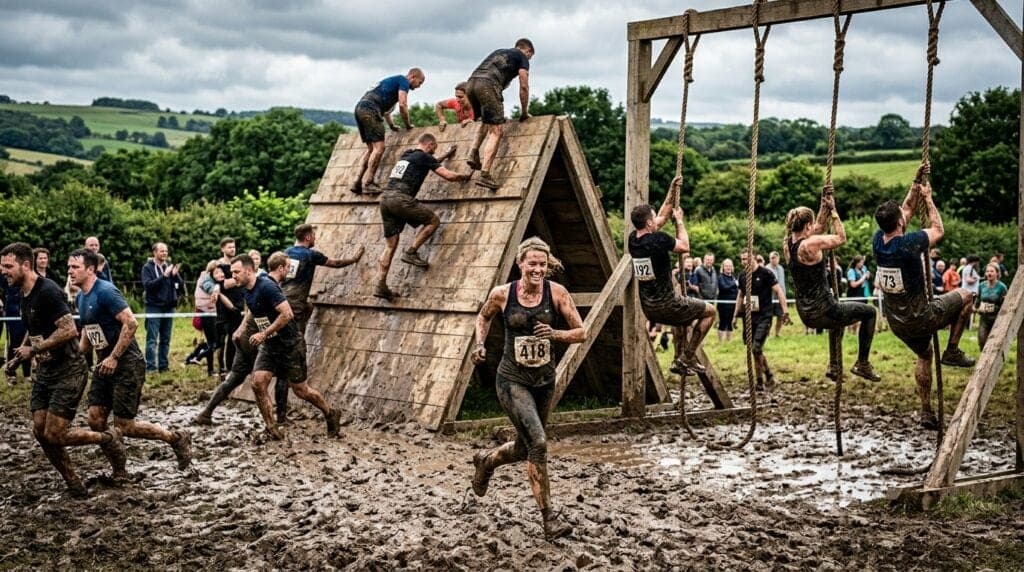
Most obstacles fall into a handful of categories: grip and hang (monkey bars, rings, rope traverses), carry and drag (sandbag carries, tyre drags, log carries), climb and vault (walls of varying heights, cargo nets, A-frames), and water or mud immersion, which is as much a mental challenge as a physical one when it’s a chilly UK morning. Understanding which category you’re weakest in makes it much easier to target your training rather than just running more miles.
Beyond the big two, plenty of smaller UK operators run local mud runs and army-style assault courses at a fraction of the cost, which are a sensible way to try the format before committing to a headline event.
Picking Your First Race
For a first attempt, a Tough Mudder 5K or a Spartan Sprint is the sensible entry point — both are designed to be completable by a reasonably fit beginner, with obstacles that can usually be bypassed if you genuinely can’t do them. Entry prices vary by event and how early you book, but expect to pay somewhere in the £70–£130 range for a Sprint-length race, rising well past £200 for the longer Beast and Ultra distances. Season or “Trifecta” passes that bundle several races together can work out cheaper if you’re planning to make a habit of it.
Racing with a team is worth considering for your first go. Tough Mudder in particular leans into this — obstacles like the Berlin Walls are genuinely easier with a leg-up from a teammate, and having people to laugh with in the mud pit takes the edge off the nerves. If you’re doing a Spartan event solo, don’t be shy about asking a stranger for a hand over a wall; the OCR community is famously supportive, and helping each other over obstacles is part of the culture rather than an exception to it. Most events also let you defer or transfer your place if something comes up, so check the terms before you book.
How to Train for a Mud Run
You don’t need to be able to deadlift a small car, but you do need a base level of aerobic fitness plus functional strength — the ability to pull, push, carry and climb, not just run in a straight line. The NHS’s physical activity guidelines for adults recommend at least 150 minutes of moderate aerobic activity a week plus two strength sessions, and that’s a solid baseline to be hitting before you sign up for anything longer than a 5K obstacle course.
A simple 8–10 week block works well for most beginners. A typical week might look like: one steady 30–40 minute run, one hill or interval session (since UK courses are rarely flat), two functional strength sessions, and one longer weekend session that mixes running with bodyweight circuits to simulate racing while fatigued. Functional sessions should include farmer’s carries, pull-ups or assisted pull-ups, sled pushes, box step-ups and grip work like dead hangs — grip endurance is the single most common reason people fall off obstacles, so don’t neglect it in favour of just logging running miles.
If you enjoy short, intense circuit-style training, a HYROX-style training block crosses over neatly with OCR prep, since both sports reward the same blend of running and functional strength under fatigue. In the final two weeks before your event, taper the volume right down so you turn up to the start line fresh rather than fried — this is the stage most beginners skip, and it’s usually why they feel flat on race day.
Is Obstacle Racing Safe? Injury Prevention Tips
OCR has a reputation for being extreme, but the vast majority of finishers walk away with nothing worse than bruises and a mild case of hypothermia by the finish line. The injuries that do happen are usually preventable: shoulder strains from monkey bars attempted with cold, untrained muscles, ankle rolls on uneven ground, and grazed knees from crawling obstacles.
A proper warm-up before your wave starts matters more than people expect, particularly in cold conditions — mobilise your shoulders, hips and ankles rather than just standing around chatting. Listen to the marshals stationed at each obstacle; they’re there for a reason and will pull you off something if it’s not safe for you to attempt. And be honest with yourself about which obstacles to skip. Every major UK event allows you to bypass an obstacle you’re not confident with, usually for a small time penalty or a set of burpees, and that’s always the smarter choice over forcing a fall from height.
Where to Train in the UK
Not every gym has the kind of kit you need for OCR-specific work — sled tracks, rope climbs, monkey bar rigs — but functional fitness studios and CrossFit-style boxes usually do, and they’re becoming easier to find outside major cities. Outdoor sessions are another great option: joining an outdoor bootcamp gets you used to training in mud, wind and rain, which is exactly the environment you’ll be racing in come event day. If you’re not sure what’s available near you, you can search for gyms with functional training zones and outdoor classes using GymPal, which lists facilities and class types across the UK so you can find somewhere that actually has the equipment your training plan needs.
What to Wear and Bring on Race Day
Cotton is the enemy — it soaks up water, gets heavy and chafes. Go for synthetic or merino base layers, compression tights or shorts, and old trainers you’re happy to retire afterwards (trail shoes with decent grip are ideal, since UK mud fields get genuinely slippery). If your event has an early start, layer up for the wait in the holding pen and be prepared to strip down before you actually begin — you’ll warm up fast once you’re moving.
Pack a dry base layer, a warm top and a towel for the car, plus bin bags to sit on the driver’s seat and protect the boot — you will be muddier than you think possible. A refillable water bottle, some energy chews for longer distances, sun cream in summer, and blister plasters round out a sensible kit list. Leave the jewellery, the good watch and anything you’re not prepared to lose in a bog at home.
Recovery After Your Race
Obstacle racing is brutal on the joints and grip in particular, so don’t skip the cool-down just because you’re freezing and desperate for a hot shower. A short walk, some light stretching and rehydration go a long way, and the days that follow matter as much as the race itself. Good rest and recovery habits — sleep, protein intake and active recovery sessions rather than total inactivity — will get you back to training faster and reduce the risk of the nagging shoulder or ankle niggles that put people off signing up again.
Your First Mud Run
Obstacle course racing rewards effort over talent — nobody finishes a Tough Mudder or Spartan Sprint looking graceful, and that’s rather the point. Pick an entry-level distance, give yourself two to three months to build a functional base, warm up properly, and get comfortable training outdoors before race day arrives. Whether you’re after a one-off bucket-list challenge or a new training obsession, GymPal’s gym finder can help you track down functional fitness facilities, bootcamps and outdoor classes near you to get race-ready.

I am Adam Hall, a dedicated fitness professional with over ten years of experience in the UK’s fitness industry. I earned my Master’s degree in Sports Science from Loughborough University and have worked with several top fitness studios across the UK. My certifications include a Level 3 Personal Trainer Certificate and a specialised Strength and Conditioning Coach accreditation.
Starting my career as a personal trainer, I quickly moved up to manage multiple gym locations, overseeing their operations and training programs. Beyond managing gyms, I regularly contribute to well-known fitness magazines and have been featured in articles for “Health & Fitness” and “Men’s Health”. My passion also extends online where I run a popular blog on GymPal’s AI-powered directory platform detailing insights into choosing the right fitness venues across the UK. With hundreds of posts reaching thousands of readers monthly, my goal is to influence positive changes in how people approach health and exercise throughout the country.