Kettlebell Training for Beginners: Your Complete UK Guide
Click Below To Share & Ask AI to Summarize This Article
Walk past the free weights section of any UK gym these days and you’ll spot them: cast-iron bells with a handle, stacked in neat rows from 8kg right up to 32kg. Kettlebells have gone from “that weird Russian thing in the corner” to one of the most popular tools in British gyms, and for good reason. A single kettlebell can deliver a strength session, a cardio blast, and a mobility workout all in one go.
If you’ve been eyeing them up but aren’t sure where to start, you’re not alone. Kettlebell training looks deceptively simple from across the room, but the technique matters, and getting it wrong is the fastest way to tweak your back instead of building strength. The good news is that with a few fundamentals under your belt, kettlebells are one of the most time-efficient ways to get fit.
This guide covers exactly what you need to know before your first session: the core exercises, how to pick a weight, where to train, and the mistakes that trip up almost every beginner.
What Is Kettlebell Training, Exactly?
A kettlebell is a cast-iron or vinyl-coated weight shaped like a cannonball with a handle on top. Unlike a dumbbell, where the weight is evenly distributed around your hand, a kettlebell’s weight sits below and away from the handle. That off-centre load is what makes kettlebell training unique — it forces your core and stabiliser muscles to work constantly, even during exercises that look like simple swings or squats.
Kettlebell training blends strength work with cardiovascular conditioning. A 20-minute kettlebell circuit can leave you as out of breath as a run, while also building grip strength, hip power, and shoulder stability. It’s become a staple in UK gyms, CrossFit-style boxes, and increasingly in mainstream chains that have added kettlebell racks alongside their usual dumbbell sets.
The Benefits of Kettlebell Training for Everyday Fitness
The biggest appeal of kettlebells is efficiency. Because most kettlebell moves are compound, full-body exercises, you can get a complete workout from just two or three movements, which is ideal if you’re squeezing training into a lunch break or an early morning slot before work.
Kettlebells are also brilliant for building what’s often called “functional strength” — the kind that helps with everyday tasks like lifting shopping bags, picking up kids, or carrying suitcases up station steps. The hip-hinge pattern used in the kettlebell swing, for example, mirrors the movement you should be using every time you bend down to pick something up off the floor, which makes it genuinely useful for injury prevention as well as fitness.
There’s a cardiovascular benefit too. Kettlebell complexes (chaining several exercises together without putting the bell down) spike your heart rate in a way that’s closer to interval training than traditional weightlifting, so you get a strength and conditioning session in one block of time.
Essential Kettlebell Exercises for Beginners
Before you touch a heavier bell, get comfortable with these four foundational movements. Most reputable gyms will have an induction session or a kettlebell-specific class where an instructor can check your form before you train unsupervised.
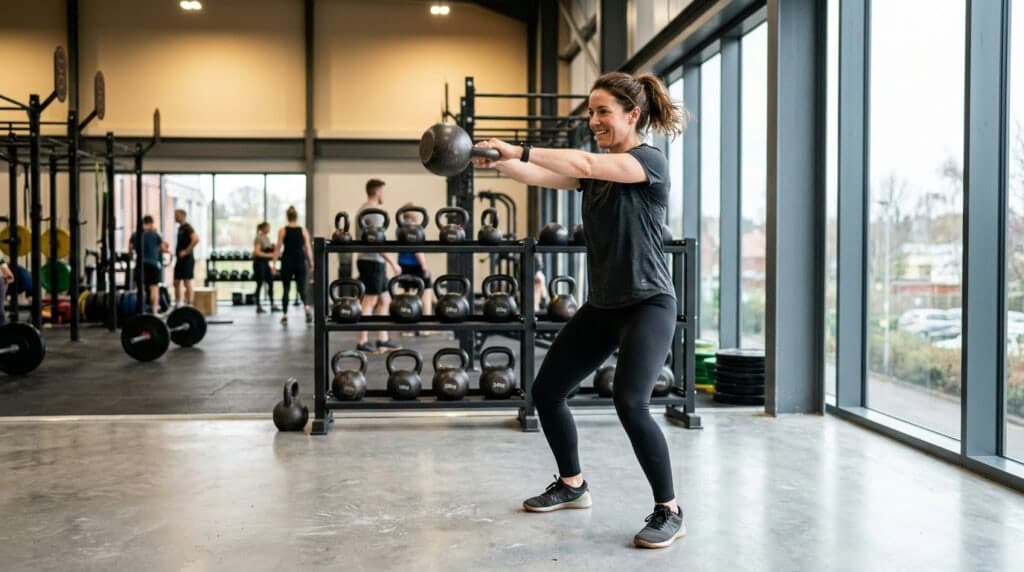
The kettlebell swing is the signature kettlebell exercise. Hinge at the hips (not your knees), let the bell swing back between your legs, then drive your hips forward explosively to swing the bell up to chest height. The power comes from your glutes and hamstrings, not your arms.
The goblet squat involves holding the kettlebell close to your chest by the horns (the sides of the handle) and squatting down, keeping your chest up and knees tracking over your toes. It’s one of the best ways to learn a proper squat pattern because holding the weight at your chest naturally improves your posture.
The Turkish get-up is a slower, more technical movement that takes you from lying on the floor to standing while holding the kettlebell overhead throughout. It’s excellent for shoulder stability and core control, but it’s worth learning from an instructor rather than a video alone.
The kettlebell deadlift teaches the hip-hinge pattern in its simplest form — bending at the hips to lift the bell from the floor, keeping your back flat and the bell close to your shins throughout.
How to Choose the Right Kettlebell Weight
This is where most beginners get it wrong — usually by grabbing something too heavy because it feels underwhelming in the gym changing room. As a rough starting point, women often begin around 8-10kg and men around 12-16kg for swings, but these numbers vary hugely depending on existing strength and experience with weight training.
A better approach is to test the goblet squat and the swing separately, since your legs and glutes can usually handle more weight than your shoulders can control safely overhead. If your lower back rounds during a swing or you can’t maintain a flat back during a deadlift, the bell is too heavy — technique breaks down under excess load before anything else. Many gyms stock bells in 2-4kg increments specifically so you can find a weight that challenges you without compromising form.
Where to Train: Gym Floor, Classes, or Home
Most UK gyms now have a dedicated kettlebell rack on the main gym floor, so you can incorporate a few kettlebell movements into an existing routine without booking a class. If you’d rather learn in a structured setting, kettlebell-specific classes have become common at independent studios and some of the larger chains, usually run by an instructor who’ll correct your form in real time, which is genuinely valuable for a tool this technical.
If budget or location makes classes tricky, plenty of functional fitness gyms build their entire programming around kettlebells alongside other compound movement tools like sandbags and battle ropes, which is worth considering if you want kettlebell work baked into every session rather than bolted on as an extra.
Common Mistakes to Avoid
The most frequent error is turning the kettlebell swing into a squat with an arm raise — using your arms and quads to muscle the bell up rather than driving the movement from the hips. Watch for lower back rounding on swings and deadlifts, which usually means the weight is too heavy or the hip hinge hasn’t clicked yet.
Another common issue is rushing straight into complex movements like snatches or cleans before mastering the basics. These exercises involve the bell flipping around your wrist at speed, and poor technique here is how people end up with bruised forearms — or worse. Spend several weeks bedding in swings, goblet squats, and deadlifts before progressing.
Building a Weekly Kettlebell Routine
Two to three kettlebell sessions a week is plenty for a beginner, with at least one rest day between sessions to let your lower back and grip recover. A simple starting structure might be: five minutes of mobility work, three sets of ten kettlebell swings, three sets of eight goblet squats, and three sets of six deadlifts per side, finishing with a short core circuit.
If you’re completely new to resistance training in general, it’s worth reading up on how to start strength training as a beginner before adding kettlebells into the mix, since the general principles of progressive overload and recovery apply just as much here as they do with barbells and dumbbells.
Should You Hire a Personal Trainer?
Given how technical movements like the swing and the Turkish get-up are, a handful of sessions with a qualified trainer can save you months of bad habits. Even if you can’t justify ongoing one-to-one coaching, understanding what personal training actually costs in the UK can help you budget for two or three introductory sessions purely to nail your form before training independently.
This isn’t just about avoiding injury for its own sake — the NHS’s muscle-strengthening exercise guidelines recommend adults do activities that work all the major muscle groups at least twice a week, and kettlebell training is one of the most time-efficient ways to tick that box alongside your regular cardio.
Kettlebells for Different Goals and Ages
One reason kettlebells have stuck around in UK gyms rather than fading as a fad is how adaptable they are. For runners, a few sets of kettlebell swings and deadlifts twice a week build the posterior chain strength that improves stride power and helps prevent the hamstring niggles that plague a lot of distance training. For older gym-goers, lighter kettlebell work focused on controlled squats and hip hinges is an excellent way to maintain the bone density and balance that matter more with every passing decade, provided the weight stays conservative and the focus stays on technique rather than speed.
Pregnant and postnatal exercisers should treat kettlebell training with extra caution, particularly around core-intensive moves like the Turkish get-up, and should get the green light from a GP or women’s health physio before starting. For most other beginners, though, kettlebells are one of the more forgiving entry points into strength training precisely because the exercises scale so easily — you can make a swing gentler by using a lighter bell and a shorter range of motion rather than avoiding the movement altogether.
A quick note on kit: if you’re training at home rather than relying on a gym’s equipment, buy a single kettlebell in a mid-range weight rather than a full set — you’ll get more mileage adjusting your reps and tempo than you will from owning five different bells gathering dust in a cupboard. Check the handle width too; a lot of budget kettlebells have thinner handles than gym-standard competition bells, which can make double-handed swings feel cramped if you have larger hands.
Final Thoughts
Kettlebells reward patience. Spend the first few weeks nailing the hip hinge on a swing and a controlled goblet squat, and you’ll build a foundation that carries over into almost every other gym exercise you do. Start lighter than your ego wants, get a session or two of coaching if you can, and progress the weight only once your form is solid.
Not sure which of your local gyms actually has a kettlebell setup worth training on? You can search for gyms near you on GymPal and filter by facilities, so you can find a spot with a proper free weights area before you commit to a membership.

I am Adam Hall, a dedicated fitness professional with over ten years of experience in the UK’s fitness industry. I earned my Master’s degree in Sports Science from Loughborough University and have worked with several top fitness studios across the UK. My certifications include a Level 3 Personal Trainer Certificate and a specialised Strength and Conditioning Coach accreditation.
Starting my career as a personal trainer, I quickly moved up to manage multiple gym locations, overseeing their operations and training programs. Beyond managing gyms, I regularly contribute to well-known fitness magazines and have been featured in articles for “Health & Fitness” and “Men’s Health”. My passion also extends online where I run a popular blog on GymPal’s AI-powered directory platform detailing insights into choosing the right fitness venues across the UK. With hundreds of posts reaching thousands of readers monthly, my goal is to influence positive changes in how people approach health and exercise throughout the country.