Women-Only Gyms UK: Why They’re Booming in 2026
Click Below To Share & Ask AI to Summarize This Article
Walk into a growing number of UK gyms right now and you’ll notice something: a dedicated women-only floor, a female-only class timetable, or an entire club that simply doesn’t admit men. This isn’t a niche trend anymore. Women-only gyms and women-only sessions are opening in high streets, retail parks and council leisure centres from Bradford to Brighton, and waiting lists at some of the busiest ones stretch for weeks.
If you’ve ever cancelled a gym visit because you didn’t fancy being the only woman on the weights floor, or you’ve simply never set foot in one because the idea felt intimidating, this shift is worth understanding. It’s changing where and how a huge number of UK women choose to train.
This guide covers why women-only gyms are growing so fast, what you can actually expect once you’re inside one, how they differ from mixed gyms that just run the odd “ladies’ hour”, and how to find the right one near you.
The Rise of Women-Only Gyms in the UK
The numbers behind this trend are hard to ignore. Sport England’s Active Lives Adult Survey has tracked a persistent activity gap between men and women for years, and gym anxiety specific to mixed-sex weights areas is consistently cited as one of the biggest barriers women report. Sport England’s own This Girl Can campaign was built directly off research showing that fear of judgement, not lack of motivation, keeps many women out of the gym altogether.
Operators have responded. Chains like Contours Women’s Health Clubs have quietly built one of the largest women-only networks in the country, and mainstream leisure trusts such as GLL’s Better centres and Everyone Active now run dedicated women-only gym and swim sessions in dozens of towns, particularly in areas with large South Asian and Muslim communities in Bradford, Birmingham, Blackburn and parts of London where cultural and religious considerations make single-sex facilities essential rather than a nice-to-have. Independent boutique studios focused on strength training, Pilates and barre for women have opened in almost every major UK city over the last two years.
Why Women Are Choosing Single-Sex Gym Spaces
Ask women who’ve switched and the same reasons come up again and again: feeling watched, feeling judged on technique, or simply not wanting to navigate a crowded free-weights area dominated by men. This isn’t the same as general nervousness about starting a fitness routine, though the two often overlap. If unfamiliar equipment and busy gym floors already make you anxious, working through practical strategies for beating gymtimidation alongside choosing a single-sex environment can make that first month far less daunting.
There’s also a safety and comfort dimension that shouldn’t be understated. Several women-only clubs report that members who’d previously avoided evening workouts entirely now train later because they feel safer in a space without men present, particularly for those training alone after dark in winter months.
Beyond anxiety and safety, plenty of women simply prefer the culture. Women-only gyms tend to build community around shared goals rather than competition, and class timetables lean heavily towards strength, conditioning and mobility work rather than the bodybuilding-focused programming that dominates some mixed clubs.
What to Expect From a Women-Only Gym or Studio
Facilities vary a lot depending on whether you’re looking at a full women-only club or a boutique studio. A club like Contours typically offers a circuit-style resistance and cardio setup designed to be completed in 30 minutes, aimed at time-poor members who want an efficient session without a lengthy induction. Boutique studios lean more towards small-group classes: strength circuits, reformer Pilates, and barre-style workouts that blend ballet-inspired movement with isometric holds. If barre is new to you, it’s worth reading up on what a typical barre class involves and what it costs before booking your first session, since pricing and format differ significantly from a standard gym class.
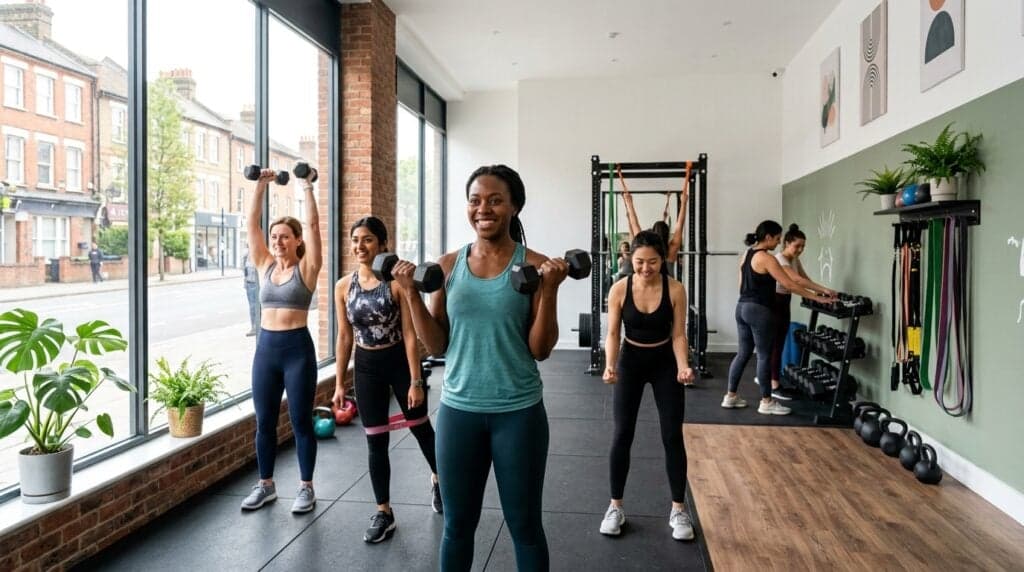
Free weights areas in women-only gyms are usually smaller than in a big mixed-sex chain, but staff-to-member ratios tend to be higher, and inductions are often more thorough. Expect female personal trainers and instructors as standard, changing rooms that don’t require communal showering if that’s a concern for you, and a generally slower, more patient pace to group classes aimed at building confidence rather than pushing intensity from week one.
Women-Only Gyms vs Women-Only Sessions: What’s the Difference
It’s worth separating two things that get lumped together. A genuine women-only gym, like Contours, is single-sex all the time — men simply aren’t members. A women-only session, on the other hand, is a set of hours at an otherwise mixed-sex gym or leisure centre reserved exclusively for women, often once or twice a week.
Council-run leisure centres are the biggest providers of the second model. Many Better and Everyone Active sites run women-only gym floor and swim sessions, usually early evening or weekend slots, precisely because full single-sex membership isn’t commercially viable for every location but demand for some female-only time clearly exists. These sessions are typically included in a standard leisure centre membership rather than costing extra, which makes them one of the cheapest ways to try a single-sex environment before committing to a dedicated women-only club.
The Cost Question: Are Women-Only Gyms More Expensive?
Pricing sits roughly in line with mid-market mixed gyms rather than budget chains. Expect to pay somewhere between £25 and £45 a month for a dedicated women-only club membership, depending on region and whether classes are included, with boutique barre and Pilates studios often charging per-class or via a credit system starting around £15–£20 per session if you’re not on a monthly plan. Council women-only sessions are usually the most affordable route in since they’re folded into standard leisure centre membership, which can run as little as £20–£30 a month in many areas.
Before signing anything, it’s worth working through the same due diligence you’d apply to any gym contract — checking notice periods, freeze policies and what’s actually included in the price rather than assuming it matches a big mixed-sex chain.
How to Find the Right Women-Only Gym Near You
Availability still varies enormously by region. Cities like London, Manchester, Birmingham and Glasgow have several genuine women-only clubs plus boutique studios, while smaller towns might only offer council-run women-only sessions rather than a dedicated club. Searching by facility type on GymPal is the quickest way to filter for women-only gyms and classes near your postcode rather than scrolling through generic gym listings that don’t specify.
Once you’ve found a shortlist, treat the visit like you would any other gym decision. Many of the same fundamentals from a general gym choice checklist still apply here — opening hours, contract length, cleanliness, and whether the equipment matches what you actually want to do — on top of the women-only-specific questions below.
Questions to Ask Before You Join
A few things are worth confirming before you commit to a women-only club or studio, since “women-only” can mean quite different things in practice:
Ask whether the club is genuinely women-only at all times or only during certain hours, whether male staff (maintenance, reception, personal trainers) ever have floor access during opening hours, what the changing room and shower setup actually looks like, and whether class timetables are fixed or rotate seasonally. If you’re specifically drawn to single-sex training for religious or cultural reasons, it’s also worth asking directly whether instructors and reception staff are exclusively female, since policies differ even among clubs that market themselves as women-only.
For Gym Owners: Is It Worth Adding Women-Only Hours?
If you run a mixed-sex gym or leisure centre, this trend is also a commercial opportunity worth taking seriously. Blocking out a few quiet hours a week for women-only access is one of the lowest-cost ways to open your doors to a segment of local demand you’re currently missing entirely — particularly in areas with significant Muslim or South Asian populations, where single-sex provision often isn’t optional for a meaningful share of potential members, it’s the difference between them joining at all or not.
The operational lift is smaller than owners often assume. You don’t need to close the whole site or hire new female-only staff overnight — many gyms start with one or two off-peak evening slots, staffed by whichever female team members are already on the rota, and expand only once demand proves out. What matters more is communicating the policy clearly: confirming whether male staff retain any floor or reception access during those hours, and making sure changing facilities genuinely support privacy, since a poorly-defined “women-only hour” that still has male maintenance staff wandering through will undo the trust you’re trying to build fast.
Marketing these sessions well matters just as much as running them. Local community groups, mosques, GP surgeries and school parent networks are often far more effective at spreading the word than social media ads, since word of mouth carries more weight for members who’ve been put off gyms before. Making sure your listing on GymPal clearly flags women-only sessions is also worth doing — it’s exactly the kind of filter women in your area are actively searching for, and a listing that doesn’t mention it is an easy way to lose a member to the club down the road that does.
Final Thoughts
Women-only gyms aren’t a passing fad — they’re a direct response to a well-documented confidence and safety gap that’s kept a huge number of women out of fitness spaces for years. Whether that means joining a dedicated club like Contours, booking into a council-run women-only session, or trying a boutique barre or Pilates studio, there’s now more genuine choice across the UK than at any point before.
The best next step is simply seeing what’s actually available where you live, since provision still varies a lot by region. Search GymPal for women-only gyms, classes and sessions near you, compare a few options, and go and visit before you commit to anything.

I am Adam Hall, a dedicated fitness professional with over ten years of experience in the UK’s fitness industry. I earned my Master’s degree in Sports Science from Loughborough University and have worked with several top fitness studios across the UK. My certifications include a Level 3 Personal Trainer Certificate and a specialised Strength and Conditioning Coach accreditation.
Starting my career as a personal trainer, I quickly moved up to manage multiple gym locations, overseeing their operations and training programs. Beyond managing gyms, I regularly contribute to well-known fitness magazines and have been featured in articles for “Health & Fitness” and “Men’s Health”. My passion also extends online where I run a popular blog on GymPal’s AI-powered directory platform detailing insights into choosing the right fitness venues across the UK. With hundreds of posts reaching thousands of readers monthly, my goal is to influence positive changes in how people approach health and exercise throughout the country.