Gym Anxiety UK: How to Beat Gymtimidation and Actually Enjoy Your Workouts

Click Below To Share & Ask AI to Summarize This Article
You walk up to the gym door, grab the handle, and freeze. The weight section is packed. Everyone looks like they know exactly what they’re doing. You imagine every head turning as you walk in and fumble with an unfamiliar machine. So you turn around, get back in your car, and tell yourself you’ll try again next week.
If that sounds familiar, you’re far from alone. Gym anxiety — sometimes called gymtimidation — is one of the most common reasons people in the UK avoid exercise despite genuinely wanting to get fit. A 2023 survey found that nearly half of British adults feel self-conscious in gym environments, and it’s not just beginners who experience it. Even seasoned gym-goers can hit walls of self-doubt when they change gyms, try new equipment, or return after a break.
The good news? Gym anxiety is completely normal, it’s manageable, and there are practical steps that really work. This guide cuts through the faff and gives you a realistic, judgment-free path to walking through those doors with confidence — and actually enjoying what’s on the other side.
What Is Gym Anxiety and Why Is It So Common?
Gym anxiety sits at the intersection of social anxiety and performance pressure. You’re in an unfamiliar environment with unspoken rules, surrounded by people who all seem more experienced, and you’re being asked to do physically demanding things in front of them. That’s a recipe for nerves even for the most outgoing among us.
There are a few specific fears that tend to drive gymtimidation:
- Being judged for your appearance — worrying that your body shape, fitness level, or workout clothes will attract negative attention
- Looking incompetent — not knowing how to use the machines or worrying you’ll do exercises wrong
- Taking up space — feeling like you don’t “belong” in certain areas (the free weights section is notorious for this)
- Being too slow or too unfit — anxiety that you’ll struggle with weights or cardio that others find easy
- Social awkwardness — not knowing the etiquette, whether to talk to people, or what to do between sets
Understanding why you feel anxious is the first step to doing something about it. For most people, gym anxiety isn’t about the gym itself — it’s about a perceived audience that’s far more critical than the real one.
The Truth About What Other Gym-Goers Are Thinking
Here’s the thing that nearly every experienced gym member will tell you: nobody is watching you as closely as you think they are. Most people in the gym are almost entirely focused on their own workout. They’re counting reps, watching their form in the mirror, thinking about what they’re having for tea, or listening to a podcast. The critical audience in your head simply doesn’t exist in the room.
Research consistently shows that we vastly overestimate how much attention others pay to us — this is known as the spotlight effect. We’re the main character in our own story, so we assume everyone else has noticed us too. They haven’t. The person on the treadmill next to you genuinely isn’t clocking your pace.
It’s also worth knowing that most regular gym-goers have a lot of respect for people who show up and give it a go. Starting is the hardest part, and the fitness community — particularly in smaller independent gyms — tends to be far more welcoming than newcomers expect.
Choosing the Right Gym for Your Confidence Level
Not all gyms are created equal when it comes to atmosphere, and picking the right environment for where you are right now can make an enormous difference to how quickly your confidence grows.
Large commercial chains — your PureGyms, your Sports Directs, your JD Gyms — can feel overwhelming for newcomers. They’re busy, the equipment is spread across huge floors, and staff aren’t always on hand to help. They’re great value once you’re comfortable, but they’re not always the best starting point.
Consider these alternatives:
- Smaller independent gyms — often have a tighter community feel, staff who actually know your name, and a less intimidating vibe overall
- Boutique fitness studios — focused on one type of workout (cycling, boxing, yoga), which means a defined class structure that leaves less room for uncertainty
- Women-only gyms — if mixed-sex spaces make you particularly uncomfortable, women-only gyms across the UK offer a completely different atmosphere that many members describe as instantly less intimidating
- Council leisure centres — often quieter than commercial chains, more diverse in terms of who’s using them, and frequently have staff on the gym floor
GymPal makes it easy to search for gyms near you and filter by type, facilities, and price — so you can find a space that genuinely suits your situation rather than just defaulting to the nearest big-name chain.
Your First Week: A Realistic Plan to Build Gym Confidence
One of the biggest mistakes anxious gym newcomers make is trying to wing it. Walking in with no plan guarantees you’ll spend half your time standing around not knowing what to do next — and that dead time is when anxiety floods in. Go in with a plan and you’ll be too focused on what you’re doing to worry about anyone else.
Before you go:
- Visit the gym’s website or app and check the floor plan if available
- Aim for off-peak times (mid-morning on weekdays is typically quiet)
- Write down a simple workout — three or four exercises is plenty to start
- YouTube the exercises beforehand so you’re not learning from scratch on the floor
Your first session:
- Arrive a few minutes early and ask a member of staff for a quick induction if you haven’t had one
- Stick to the cardio machines for the first session if you need to — there’s zero shame in a solid treadmill or bike session while you get used to the space
- Take your time, focus on your own kit, and remind yourself nobody’s watching
Sessions two and three:
- Gradually add one new piece of equipment per session
- Try a class — the structure takes the guesswork out of what you should be doing, and instructors are there to help
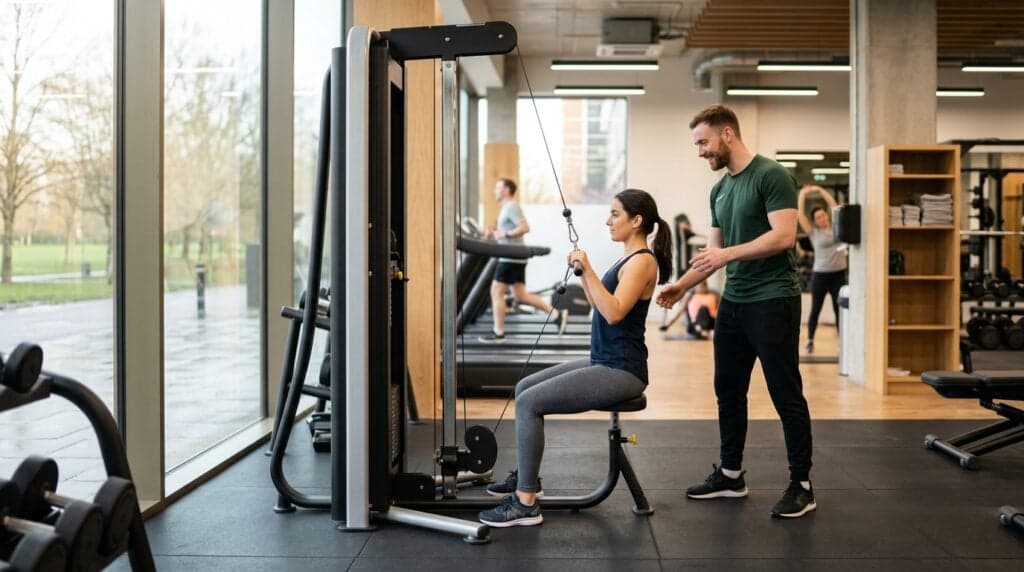
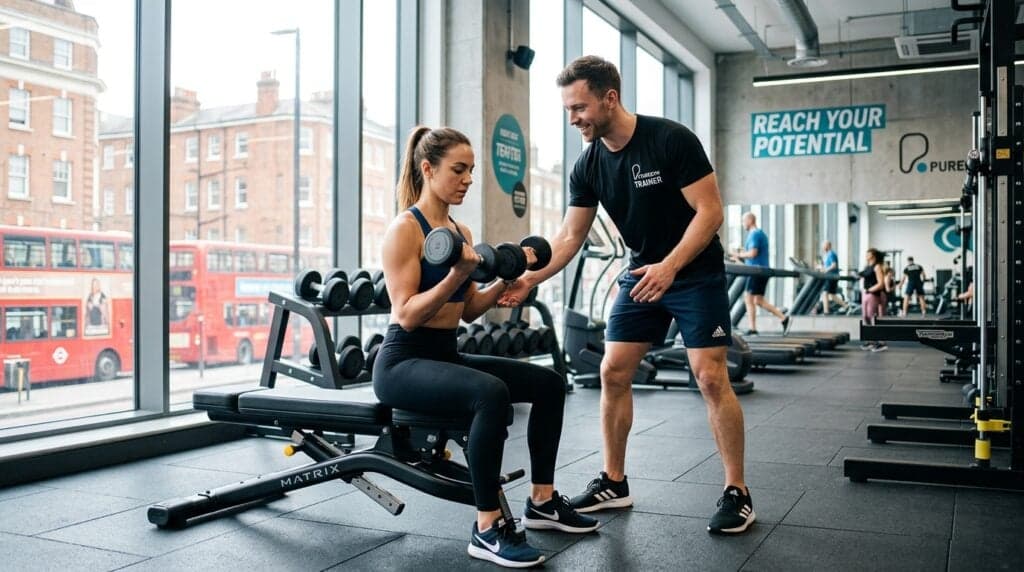
If you want a proper programme from day one, working with a personal trainer for even two or three sessions can transform your confidence. Knowing that you’re doing things correctly — form, weights, timing — is one of the fastest ways to stop feeling like a fraud. Our guide to finding a personal trainer in the UK covers what to look for and how much to expect to pay.
Low-Pressure Classes That Are Perfect for Anxious Beginners
Group fitness classes can feel terrifying before you try them and surprisingly brilliant once you’re in one. The instructor tells you what to do, everyone’s too busy keeping up to judge anyone else, and the music takes the edge off any social awkwardness. They’re one of the quickest routes out of gymtimidation.
The best classes for people managing anxiety tend to be the ones with a slower pace and a focus on form rather than performance:
- Pilates — low-impact, technique-focused, and typically welcoming of complete beginners. If you haven’t tried it, our beginner’s guide to Pilates in the UK explains what to expect from your first class and what you’ll actually need
- Yoga — similarly paced, with most classes explicitly encouraging beginners to modify poses and go at their own speed
- Aqua aerobics — often unfairly written off as “just for older adults,” it’s a great low-impact option in an environment where nobody can really see what you’re doing from the waist down
- Les Mills BodyPump or similar barbell classes — follow-along format, everyone’s facing the front, and you can start with an empty bar while you learn the moves
According to Sport England’s Active Lives Survey, group exercise participation has risen significantly since 2020, with women in particular citing the social element and structured format as key motivators. You won’t be the only one using a class as a stepping stone to solo training.
Long-Term Habits That Keep the Nerves at Bay
Building gym confidence isn’t a one-session fix — it’s a gradual process, and there will be days when the anxiety creeps back in. That’s completely normal. The goal isn’t to feel zero nerves forever; it’s to build enough familiarity that the nerves no longer stop you from going.
A few habits that make a real difference over time:
- Go consistently — anxiety fades fast when the gym becomes a familiar routine rather than an unknown quantity. Three times a week is enough to make it feel like your second home within a month
- Pick a gym you actually like — this sounds obvious, but plenty of people sign up to the most convenient or cheapest option without checking whether the atmosphere suits them. You’re far more likely to go back somewhere that feels good
- Make one small connection — you don’t need gym friends to enjoy the gym, but a nod to the receptionist or a regular hello to someone you always see on the same session creates a tiny thread of belonging that matters more than it sounds
- Track your progress — being able to see that you’re lifting more, going faster, or recovering quicker than you were three months ago gives you something concrete to focus on beyond how you look or how others might perceive you
- Let go of perfection — skipping a session, using lighter weights, leaving early because you’re tired: none of it matters. Showing up imperfectly is infinitely better than not showing up at all
Finding the Right Gym Makes All the Difference
Gymtimidation is real, but it’s not permanent. The majority of people who push through those first few awkward sessions end up genuinely loving the gym — and wondering what took them so long. The trick is giving yourself the best possible conditions to succeed: the right gym, a clear plan, and a bit of self-compassion when things don’t go perfectly.
Start by finding a gym that suits where you are right now, not where you think you should be. GymPal lists thousands of gyms across the UK — from large commercial chains to intimate independent studios — so you can search by location, filter by type, and find somewhere that actually sounds welcoming before you ever step inside. Head to askgympal.co.uk to find gyms near you and take the first step on your own terms.

I am Adam Hall, a dedicated fitness professional with over ten years of experience in the UK’s fitness industry. I earned my Master’s degree in Sports Science from Loughborough University and have worked with several top fitness studios across the UK. My certifications include a Level 3 Personal Trainer Certificate and a specialised Strength and Conditioning Coach accreditation.
Starting my career as a personal trainer, I quickly moved up to manage multiple gym locations, overseeing their operations and training programs. Beyond managing gyms, I regularly contribute to well-known fitness magazines and have been featured in articles for “Health & Fitness” and “Men’s Health”. My passion also extends online where I run a popular blog on GymPal’s AI-powered directory platform detailing insights into choosing the right fitness venues across the UK. With hundreds of posts reaching thousands of readers monthly, my goal is to influence positive changes in how people approach health and exercise throughout the country.