How to Run a Gym Open Day That Actually Converts Visitors to Members
Click Below To Share & Ask AI to Summarize This Article
Why Open Days Work (and Why Most Gyms Do Them Wrong)
A gym open day done well is one of the most cost-effective new member acquisition tools available to an independent gym. It lets prospective members experience your gym with no financial commitment, builds community around a shared event, and creates a natural context for a joining conversation that doesn’t feel like a hard sell., and dates within two weeks of a competitor’s known event.
Five weeks out: Prepare your offer
Every open day needs a compelling joining offer that is available on the day (or for a short window after it). The offer creates urgency and gives visitors a concrete reason to decide now rather than “thinking about it”. Effective open day offers:
- Waived joining fee — particularly effective if your normal joining fee is £30+. The headline “join today for free” is powerful.
- First month at a discounted rate — “Join today and your first month is half price” is simple to understand and creates immediate value.
- Free personal training session with membership — adds perceived value without a cash cost to your gym. Good for gyms with in-house PTs.
- Limited-time offer window — “This offer is only available today and for 48 hours after” gives urgency without dishonesty. Make the expiry real.
Avoid over-complicating the offer with tiers, conditions, and caveats. The simpler it is, the easier it is for your staff to explain and for visitors to act on.
Four weeks out: Design your promotional plan
An open day with no marketing is a quiet morning of empty rooms. Your promotional plan should run on multiple channels simultaneously:
- Social media — create a Facebook event and post about the open day at least twice per week from four weeks out. Instagram stories with a countdown, “behind the scenes” content, and member testimonials build anticipation. Encourage existing members to share the event with their networks.
- Local Facebook groups — post in your local community groups (neighbourhood groups, parents’ groups, local business groups). These tend to reach people who are not yet following your gym account.
- Door leaflets — in residential streets within a 1–1.5 mile radius of your gym. A simple A5 flyer with the date, offer, and QR code to register is enough. Print 500–1,000 copies and distribute over two weekends.
- Local press — send a short press release to your local newspaper and local news websites four weeks ahead. Community events frequently get a mention in the listings, which provides free visibility and a credible third-party reference.
- Your existing members — email your active membership with a “bring a friend” message. Offer a small reward (a free smoothie, a discount month) for every friend they bring who joins. Member referrals convert at a far higher rate than cold visitors.
- Email list — if you have any historical enquiry or lapsed member email data, send an event invitation. Lapsed members who liked your gym but drifted away are some of your best re-engagement candidates.
Two weeks out: Confirm logistics
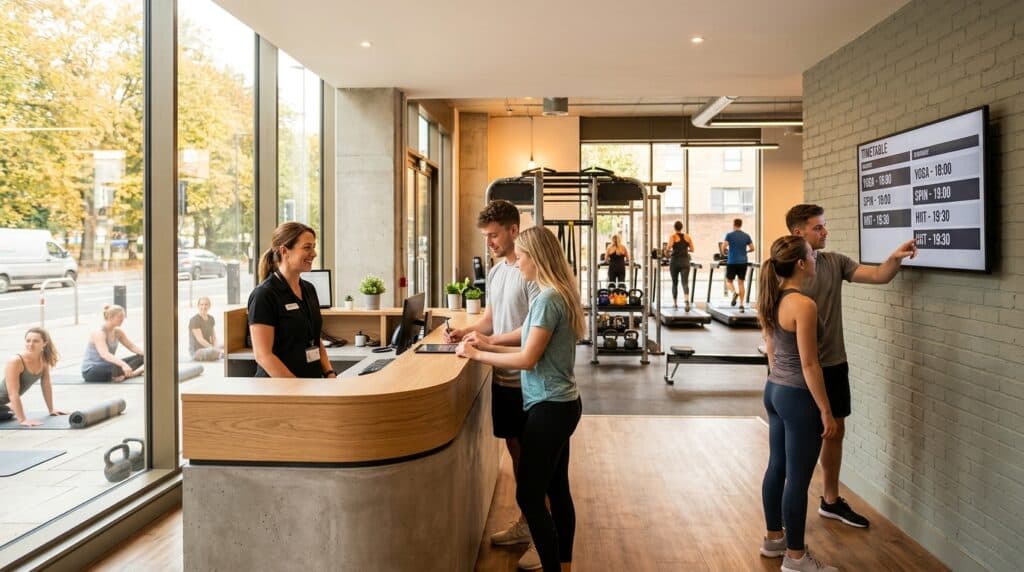
Brief every staff member on what the day involves. Define roles: who is greeting visitors at the door, who is giving tours, who is running taster classes, who is handling the joining conversation. No one should be doing everything — having one person responsible for welcoming visitors and another handling sign-ups avoids bottlenecks.
Confirm your taster class schedule with instructors in advance. A good open day timetable includes two or three 20-30 minute taster sessions in different formats (e.g. HIIT at 10am, yoga at 11am, spin at 12pm). This gives visitors an experience rather than just a tour, and creates social energy in the gym that makes the facility feel alive.
One week out: Final push on promotion
Increase posting frequency on social media. Create a simple registration form (Google Forms, Typeform, or your gym management system) so you can collect visitor names and email addresses ahead of the day. Pre-registration helps you plan staffing numbers and gives you a follow-up list even for people who do not join on the day.
Running the Day Itself
Set the scene
Your gym should look its best. Tidy every area thoroughly the day before. Stock the changing rooms with fresh towels and toiletries. Put fresh flowers or plants near the entrance if you have them. Make sure all equipment is working and clean. First impressions are made in the first 15 seconds of a visit.
Greet everyone personally
Station a staff member at the entrance from open to close. Every visitor should be personally greeted, offered a brief tour, and introduced to what is happening. Do not leave visitors to wander alone — they will feel lost and leave without connecting with your gym.
Make the joining conversation natural
Train your team to ask one simple question: “Is there anything that would stop you joining today?” This surfaces objections in a natural way and allows your team to address them. The most common objections are cost, timing (“I’m starting a new job next month”), and decision-making with a partner. Have a brief, honest response ready for each.
Do not push hard or use high-pressure tactics. Visitors who feel pressured leave with a negative impression that they share with their networks. A natural, informative conversation converts far better than a sales pitch.
Capture details for everyone who doesn’t join
Not everyone will be ready to join on the day. That is normal. Make sure every visitor leaves their name and email address (offer a prize draw entry as an incentive). This is your follow-up list — arguably the most valuable output of the day.
Following Up After the Day
This is where most gym open days fail. Visitors who did not join on the day are not lost — they are interested leads who need a nudge.
48-hour follow-up email
Within 48 hours of the event, send a personal email to every visitor who did not join on the day. Keep it short: “It was great to meet you on Saturday. Our open day offer — [X] — is available until [date]. If you have any questions, reply to this email or call us on [number].”
One-week follow-up
If they haven’t joined after the first email, send a second message at one week. Include a member testimonial or a photo from the event. This email can acknowledge that the formal offer has expired but offer to discuss membership options personally.
Monthly newsletter going forward
Add open day visitors who haven’t joined to your regular email list (with their consent). A significant proportion of gym-seekers take 4–8 weeks to decide where to join. Remaining present in their inbox with valuable content (not just promotions) keeps your gym top of mind during that decision period.
What to Measure
After every open day, record: total visitors, number who joined on the day, number who joined within two weeks of the day, cost of the event (staff time, printing, refreshments), and revenue generated from new members over their first three months. This data tells you whether the event was worth repeating and what to improve next time.
Be Easy to Find Before the Open Day Begins
All of your open day promotion is most effective when prospective members can already find your gym online. GymPal puts your gym in front of UK gym-seekers who are actively looking — and a claimed listing means you’re visible before they ever see your event promotion.
Claim your free GymPal listing so that every piece of marketing you run has a credible online home for gym-seekers to land on.

I am Adam Hall, a dedicated fitness professional with over ten years of experience in the UK’s fitness industry. I earned my Master’s degree in Sports Science from Loughborough University and have worked with several top fitness studios across the UK. My certifications include a Level 3 Personal Trainer Certificate and a specialised Strength and Conditioning Coach accreditation.
Starting my career as a personal trainer, I quickly moved up to manage multiple gym locations, overseeing their operations and training programs. Beyond managing gyms, I regularly contribute to well-known fitness magazines and have been featured in articles for “Health & Fitness” and “Men’s Health”. My passion also extends online where I run a popular blog on GymPal’s AI-powered directory platform detailing insights into choosing the right fitness venues across the UK. With hundreds of posts reaching thousands of readers monthly, my goal is to influence positive changes in how people approach health and exercise throughout the country.