Gym Owner Guide to Local SEO: How to Get Your Fitness Business Found on Google
Click Below To Share & Ask AI to Summarize This Article
Why Local SEO Matters for UK Gyms
When someone in your area searches “gym near me” or “fitness classes in Manchester,” Google shows them a map pack with the top three local results. If your gym isn’t there, you’re invisible to people actively looking to join. Local SEO is how you change that — and most of it costs nothing but time.
2. Get Listed on Fitness Directories
Directory listings build what SEO professionals call “citations” — mentions of your gym name, address, and phone number across the web. The more consistent citations you have, the more Google trusts your business is real and relevant.
GymPal is a UK-focused fitness directory with over 10,000 businesses listed. Claiming your free listing takes minutes and gives you another citation, another place for potential members to find you, and a backlink to your website.
3. Encourage and Respond to Reviews
Reviews are one of the strongest local ranking factors. A gym with 45 Google reviews will outrank one with 3 reviews almost every time. Here’s how to build them:
- Ask happy members to leave a Google review after their first month
- Add a QR code at reception that links directly to your review page
- Respond to every review — positive and negative — within 48 hours
4. Optimise Your Website for Local Keywords
Your website should clearly signal where you are and what you offer. Include your city, neighbourhood, and postcode naturally in page titles, headings, and body text.
Good examples:
- Boxing Gym in Clapham, London
- “Yoga Studio Near Birmingham City Centre”
- “Personal Training in Edinburgh — First Session Free”
Each of your services can have its own page targeting a specific local keyword. A page about “crossfit-classes-bristol” will rank for people searching exactly that.
5. Make Sure Your Website Loads Fast and Works on Mobile
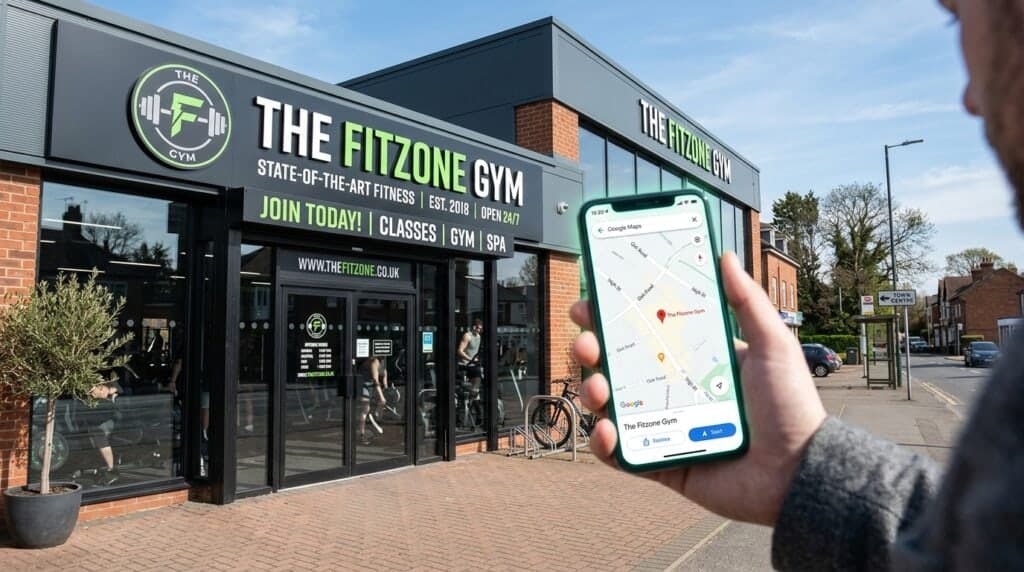
Over 60% of local searches happen on mobile phones. If your website takes more than a few seconds to load or the text is too small to read on a phone, potential members will bounce to a competitor. Google also uses mobile-friendliness as a ranking signal for local results.
Quick wins:
- Compress your images (large photos slow everything down)
- Use a mobile-responsive theme
- Make your phone number and address clickable
The Quickest Win: Claim Your GymPal Listing
If you do one thing today, claim your free GymPal listing. It gives you a citation, a profile page with your gym details, and exposure to thousands of UK fitness seekers actively browsing for gyms in their area. The Pro plan at £9/month adds priority placement in GymPal’s AI chatbot — so when someone asks about gyms near them, your business comes first.
Key Takeaways
- Claim and complete your Google Business Profile
- Build citations on directories like GymPal
- Collect and respond to Google reviews
- Target local keywords on your website
- Ensure your site is fast and mobile-friendly
Local SEO isn’t a one-time task — it’s an ongoing process. But even small improvements compound over time. Start with the basics, be consistent, and you’ll see more enquiries from people in your area who are ready to train.

I am Adam Hall, a dedicated fitness professional with over ten years of experience in the UK’s fitness industry. I earned my Master’s degree in Sports Science from Loughborough University and have worked with several top fitness studios across the UK. My certifications include a Level 3 Personal Trainer Certificate and a specialised Strength and Conditioning Coach accreditation.
Starting my career as a personal trainer, I quickly moved up to manage multiple gym locations, overseeing their operations and training programs. Beyond managing gyms, I regularly contribute to well-known fitness magazines and have been featured in articles for “Health & Fitness” and “Men’s Health”. My passion also extends online where I run a popular blog on GymPal’s AI-powered directory platform detailing insights into choosing the right fitness venues across the UK. With hundreds of posts reaching thousands of readers monthly, my goal is to influence positive changes in how people approach health and exercise throughout the country.