How to Build Your First Gym Workout Programme (A Complete Beginner Template)
Click Below To Share & Ask AI to Summarize This Article
Compound + isolation, moderate rest
8–12 reps
General fitness
Mix of strength and cardio
8–15 reps
Weight loss
Full-body circuits, cardio emphasis
10–15 reps + cardio
For most beginners, “general fitness” or “build muscle” is the best starting point. You can specialise later once you have a foundation.
The Beginner Full-Body Programme
A full-body routine performed three times per week is the optimal starting point. It trains every major muscle group multiple times per week, builds a solid movement foundation, and fits most schedules. Here is a complete template:
Warm-Up (5–10 Minutes)
Never skip this. A proper warm-up reduces injury risk and improves performance.
- 5 minutes light cardio (treadmill walk, rowing machine, or stationary bike)
- Dynamic stretches: arm circles, leg swings, hip rotations, bodyweight squats
- 2 light sets of your first exercise (e.g. goblet squat with just the bar or light weight)
Workout A
| Exercise | Sets | Reps | Rest |
|---|---|---|---|
| Goblet Squat | 3 | 8–12 | 90 seconds |
| Dumbbell Bench Press (flat) | 3 | 8–12 | 90 seconds |
| Lat Pulldown | 3 | 8–12 | 90 seconds |
| Dumbbell Walking Lunges | 3 (each leg) | 8–10 | 60 seconds |
| Dumbbell Shoulder Press (seated) | 3 | 8–12 | 90 seconds |
| Plank | 3 | 30–45 seconds | 60 seconds |
Workout B
| Exercise | Sets | Reps | Rest |
|---|---|---|---|
| Leg Press | 3 | 10–12 | 90 seconds |
| Dumbbell Row (single arm) | 3 (each arm) | 8–12 | 90 seconds |
| Chest Press Machine | 3 | 8–12 | 90 seconds |
| Leg Curls | 3 | 10–12 | 60 seconds |
| Cable Face Pulls | 3 | 12–15 | 60 seconds |
| Dead Bug | 3 (each side) | 8–10 | 60 seconds |
Weekly Schedule
| Day | Workout |
|---|---|
| Monday | Workout A |
| Tuesday | Rest |
| Wednesday | Workout B |
| Thursday | Rest |
| Friday | Workout A |
| Saturday / Sunday | Rest or light activity (walk, swim, yoga) |
Alternate A and B each session. In week two, your Friday session becomes Workout B. In week three, Monday is Workout A again. This creates a natural rotation that ensures balanced training.
Understanding the Key Exercises
Every exercise in this programme was chosen for a reason. Here is what each one does and why it matters:
Goblet Squat
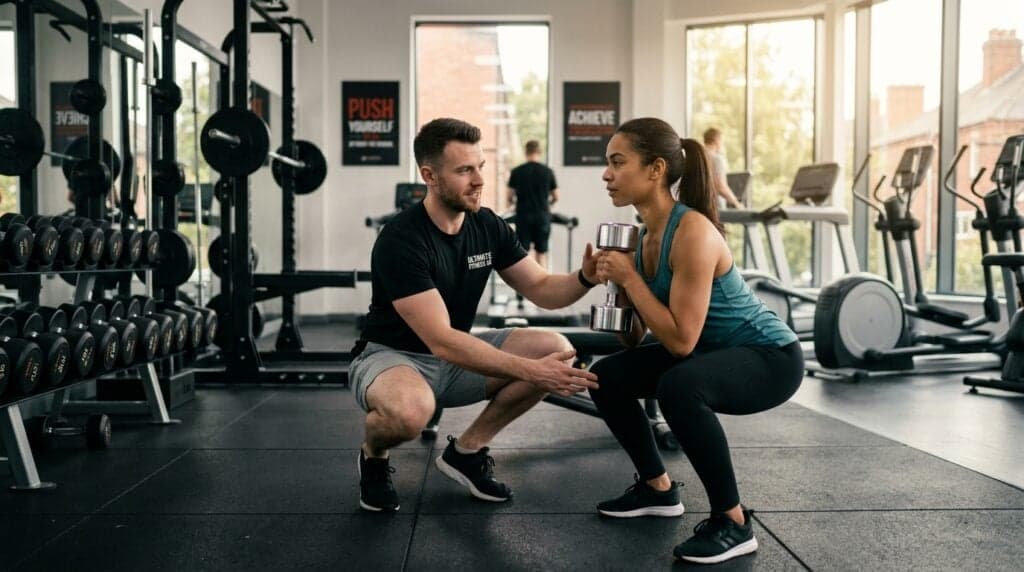
The best squat variation for beginners. Holding a dumbbell at chest height teaches proper squat mechanics — upright torso, knees tracking over toes, and depth — without the complexity of a barbell. It trains your quads, glutes, and core simultaneously.
Dumbbell Bench Press
The foundational chest exercise. Dumbbells are safer than barbells for beginners (you will not get pinned under them) and allow a greater range of motion. Lie flat on a bench, press the dumbbells up until your arms are extended, and lower them to chest level with control.
Lat Pulldown
Builds your back muscles (latissimus dorsi) and biceps. Most beginners have underdeveloped back muscles from daily life (sitting at desks, looking at phones). The lat pulldown is the gateway exercise that leads to pull-ups and barbell rows as you progress.
Dumbbell Row
The single-arm dumbbell row targets your mid-back and rear deltoids. It also challenges your core stability since you need to brace against a bench while pulling. This is one of the most important exercises for developing a strong, balanced upper body.
Dumbbell Shoulder Press
Builds your deltoid (shoulder) muscles. Strong shoulders improve posture and upper body aesthetics. Seated is recommended for beginners as it provides back support and reduces the temptation to use momentum.
Plank and Dead Bug
Core training is essential but often neglected. The plank builds isometric strength (holding a position under tension) while the dead bug teaches your core to stabilise your spine during limb movement. Together, they build a foundation that protects your lower back during heavier lifts.
Progression: How to Get Stronger Over Time
The programme above will work for 4–8 weeks as written. After that, you need to progress to keep seeing results. Here is how to do it systematically:
Method 1: Add Weight
If you completed all sets and reps of an exercise easily, increase the weight by the smallest increment available (usually 1–2.5kg for dumbbells). If you can only manage one more rep at the new weight, that is fine — stay at that weight until you hit all the target reps.
Method 2: Add Reps
If you are not ready to increase weight, add one rep per set. When you hit 15 reps across all sets at a given weight, increase the weight and drop back to the starting rep range.
Method 3: Improve Form
Slower, more controlled reps are harder reps. If you have been rushing through your sets, slow down the eccentric (lowering) phase to 2–3 seconds. This increases time under tension and stimulates more muscle growth.
Track Everything
Use your phone’s notes app, a spreadsheet, or a dedicated app (like Strong, Hevy, or JEFIT) to log every workout. Write down the exercise, weight, sets, and reps. This makes progression tangible and motivating.
Common Beginner Mistakes to Avoid
- Skipping the warm-up. Five minutes now saves five weeks of injury recovery later.
- Lifting too heavy too soon. Start lighter than you think you need to. Master the movement first.
- Only training muscles you can see in the mirror. Back, legs, and glutes make up the majority of your muscle mass. Train them.
- Resting too little or too much. Stick to the rest periods in the template. They are there for a reason.
- Comparing yourself to others. Everyone in the gym was a beginner once. Focus on your own progress.
- Programme hopping. Stick with this programme for at least 8 weeks before changing it. Consistency beats novelty.
- Ignoring nutrition and sleep. You cannot out-train a poor diet or chronic sleep deprivation.
Finding the Right Gym for Your Programme
This programme uses equipment found in virtually every UK gym — dumbbells, benches, machines, and cables. Whether you prefer a budget chain, an independent gym, or a boutique studio, you can run this programme effectively.
If you are still looking for the right gym, GymPal makes it easy to compare UK gyms by location, facilities, and price. Look for a gym with a good free weight area, benches, and cable machines — these are the essentials for this programme and for long-term training progression.
The Bottom Line
You do not need a complex programme to see results. A simple full-body routine, performed three times per week with progressive overload, will transform your fitness over the first three to six months. The key is not the programme itself — it is the consistency with which you follow it.
Write down the workouts. Go to the gym. Do the work. Track your progress. In eight weeks, you will look back and be amazed at how far you have come.
Ready to start training? Search GymPal to find a UK gym near you with the equipment and atmosphere that fits your goals. Compare prices, read reviews, and claim a free trial — your first workout is closer than you think.

I am Adam Hall, a dedicated fitness professional with over ten years of experience in the UK’s fitness industry. I earned my Master’s degree in Sports Science from Loughborough University and have worked with several top fitness studios across the UK. My certifications include a Level 3 Personal Trainer Certificate and a specialised Strength and Conditioning Coach accreditation.
Starting my career as a personal trainer, I quickly moved up to manage multiple gym locations, overseeing their operations and training programs. Beyond managing gyms, I regularly contribute to well-known fitness magazines and have been featured in articles for “Health & Fitness” and “Men’s Health”. My passion also extends online where I run a popular blog on GymPal’s AI-powered directory platform detailing insights into choosing the right fitness venues across the UK. With hundreds of posts reaching thousands of readers monthly, my goal is to influence positive changes in how people approach health and exercise throughout the country.