Music Licensing for UK Gyms: Do You Need a PRS or PPL Licence?
Click Below To Share & Ask AI to Summarize This Article
Walk into almost any UK gym and you’ll hear music playing — over the main floor speakers, piped into a spin class, or blasting through a bootcamp session in the car park. It’s such a basic part of the atmosphere that most owners never stop to ask whether they’re actually allowed to play it. The answer, legally, is often no — not without paying for the right to do so.
Playing recorded music in a commercial space in the UK, including a gym, is covered by copyright law, and that means two separate licences are usually required before a single track can legally be played to your members. Skip them and you’re not just cutting a corner — you’re committing copyright infringement, with the exact same enforcement machinery that chases pubs, shops, and salons for unlicensed music.
It’s also an area where a lot of well-meaning gym owners genuinely don’t realise they’ve got it wrong, because the rules for music licensing were written decades before streaming apps, class playlists, and Bluetooth speakers existed in anything like their current form. The law has simply been applied to new technology rather than rewritten for it, which is exactly why so many small business owners — not just gyms — end up unlicensed by accident rather than design.
This guide explains which licences a UK gym actually needs, what they cost, where owners most commonly get this wrong, whether solo trainers and small studios are covered by the same rules, and what happens if you’re caught without one.
Why This Catches So Many Gym Owners Out
The confusion usually comes from one simple assumption: “I’m not selling the music, I’m just playing it in the background, so it must be fine.” Copyright law doesn’t work that way. The moment music is played to anyone outside your own household — staff, members, or anyone passing through a commercial premises — it counts as a “public performance,” regardless of whether you charge for entry or whether the music is incidental to a class.
This applies whether the music comes from a radio, a streaming app, a DJ, or a Bluetooth speaker an instructor brings in themselves. Format and source don’t matter. What matters is that the music is being played in a business context to an audience, and that triggers a licensing requirement under UK copyright law.
The Two Licences You Actually Need
UK music licensing is split between two separate organisations, and most gyms need cover from both. PRS for Music collects on behalf of songwriters, composers, and publishers — the people who wrote the song. PPL licenses the sound recording itself, covering the performers and the record label that released that specific recording. A single three-minute pop song involves both sets of rights simultaneously, which is why one licence alone doesn’t cover you.
In practice, most gyms buy a joint licence through PPL PRS Ltd, the joint venture the two organisations set up specifically so businesses don’t have to deal with each separately. You can check exactly what’s required for your type of premises through PPL PRS, which covers everything from small studios to full-scale leisure centres.
What It Actually Costs
Pricing is based on factors like your floor area, how the music is used (background ambience versus structured fitness classes), and whether you’re running live instructor-led sessions. As a rough guide, a small independent gym or studio typically pays somewhere in the £300 to £700 a year range for a combined licence, with larger multi-studio gyms or those running high-volume class timetables paying more. Fitness classes specifically can attract a different tariff to general background music, because the commercial value of music used to drive a paid class session is treated differently to music simply playing in a reception area.
It’s a genuinely small cost against the risk. Compare it to the budget you’d set aside for other legally required cover, in the same way you’d never skip employers’ liability insurance to save a few hundred pounds a year.
As a rough worked example: a single-studio gym of around 500 square metres running a mix of background music and a handful of weekly classes might expect an annual combined PPL PRS bill somewhere in the low hundreds of pounds, while a larger multi-site operator running wall-to-wall class timetables across several locations could be looking at a bill running into four figures once every site and every weekly class session is factored in. Get an actual quote for your specific floor plan and timetable rather than guessing, since the tariff structure is detailed and specific to how music is actually used across your premises.
Does This Apply to Small Studios and Personal Trainers Too?
Yes, and this is where a lot of smaller operators assume they’re exempt simply because of their size. A one-room PT studio, a small boxing gym, or a self-employed trainer running sessions from a rented unit all need the same cover if music is played to clients. The licence is scaled to your premises and usage, so a small studio pays considerably less than a large multi-studio gym, but “small” doesn’t mean “exempt.”
The one genuine exception is a trainer who works entirely without music, or who relies on a client’s own personal device and headphones rather than playing anything through shared speakers. The moment a shared sound system is involved, even in a single small room, the same rules apply as they would in a 2,000-member gym.
Streaming Services Don’t Solve This
This is the single most common mistake independent gyms make. A personal Spotify, Apple Music, or Amazon Music subscription is licensed for private, non-commercial listening only. The terms of service explicitly exclude playing that music to the public or in a business setting, and using a personal account to soundtrack your gym floor breaches both your streaming agreement and the underlying copyright licences the streaming service itself holds.
There are commercial streaming products built specifically for this — business-tier music services designed for gyms, retail, and hospitality that bundle the necessary rights into the subscription. If you want the convenience of a curated streaming service, use one licensed for commercial play rather than assuming your personal account will do.
Live Classes vs Background Music: Does It Matter?
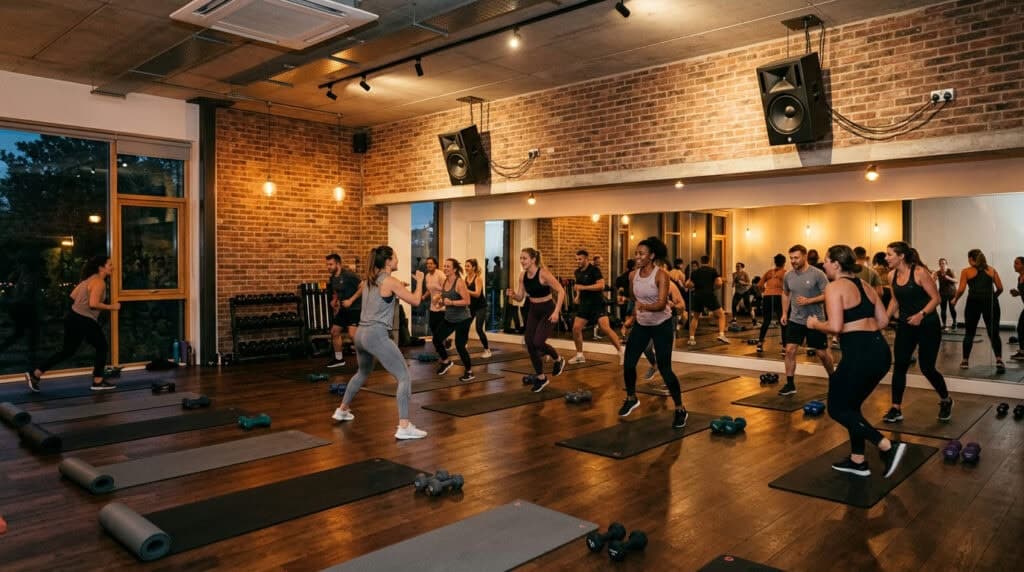
Yes, and this is where gym owners often underestimate their exposure. A spin class, HIIT session, or bootcamp where music is a core part of the experience — driving pace, timing intervals, building energy — is treated as a more significant commercial use of that music than ambient background noise in a reception area. If you’re running a full timetable of music-led classes, it’s worth reviewing how those sessions are structured and priced. Our guide to running fitness classes profitably covers the wider economics of class scheduling, and licensing cost is one more line item that belongs in that calculation rather than being treated as an afterthought.
Outdoor sessions carry the same requirement. A bootcamp instructor running intervals to a playlist in a local park is still a public performance, even though there’s no building involved.
What Happens If You Don’t Have One
PPL PRS runs an active enforcement operation, including site visits, phone checks, and written correspondence for businesses that appear to be playing music without cover. Field officers do genuinely visit gyms, leisure centres, and studios, often prompted by a tip-off or simply by working through local business listings systematically. If you’re found to be unlicensed, you’ll typically be asked to buy a licence going forward and can be backdated for the period you were playing music without one, which can add up to a meaningfully larger bill than if you’d simply licensed from day one.
It’s handled as a civil copyright matter rather than a criminal one in almost all cases, but it’s an entirely avoidable cost, a distraction from running your gym, and a bad look if a member or a competitor ever reports it. There’s also no grace period for “we didn’t know” — ignorance of the requirement doesn’t reduce the backdated liability once it’s identified.
This sits in the same bracket as other “boring but essential” compliance work gym owners have to stay on top of — it won’t make or break your member experience, but getting caught out costs far more than doing it properly from the start. If you haven’t audited where else your gym might have compliance gaps, our breakdown of GDPR and data protection requirements for gym owners is a good companion piece — both are exactly the kind of paperwork that’s easy to postpone until it becomes a problem.
Getting Covered Without the Hassle
Sort your licence before you open, or audit it now if you’ve been operating without checking. Get a joint PPL PRS licence sized correctly for your premises and class schedule, switch any background music off a personal streaming account onto a properly licensed commercial service, and keep your certificate on file in case anyone from the licensing bodies ever asks.
If noise and music are a live issue at your gym for other reasons too — complaints from neighbours, volume levels during early morning or late evening classes — it’s worth reading alongside our guide to gym noise, neighbours, and planning compliance, since licensing and noise management often need sorting out together.
The Takeaway
Music licensing is one of those compliance tasks that’s genuinely easy to overlook because nobody ever asks to see your licence at the door — until the day someone does. Two licences, a modest annual cost, and five minutes to check you’re covered is a far better outcome than a backdated bill and an awkward conversation with your members about why the speakers just went quiet.
Getting the operational basics right matters just as much as being easy to find — if your gym isn’t yet listed, claim your free GymPal business listing so UK gym-goers searching for a gym near them can find you alongside everything else you’re getting right.

I am Adam Hall, a dedicated fitness professional with over ten years of experience in the UK’s fitness industry. I earned my Master’s degree in Sports Science from Loughborough University and have worked with several top fitness studios across the UK. My certifications include a Level 3 Personal Trainer Certificate and a specialised Strength and Conditioning Coach accreditation.
Starting my career as a personal trainer, I quickly moved up to manage multiple gym locations, overseeing their operations and training programs. Beyond managing gyms, I regularly contribute to well-known fitness magazines and have been featured in articles for “Health & Fitness” and “Men’s Health”. My passion also extends online where I run a popular blog on GymPal’s AI-powered directory platform detailing insights into choosing the right fitness venues across the UK. With hundreds of posts reaching thousands of readers monthly, my goal is to influence positive changes in how people approach health and exercise throughout the country.