Legionella and Water Hygiene Compliance for UK Gyms
Click Below To Share & Ask AI to Summarize This Article
Showers running, hot tubs bubbling, sauna steam rising, water fountains topped up every day — a gym is one of the most water-intensive businesses on any UK high street. That’s exactly why environmental health officers pay closer attention to fitness facilities than almost any other leisure premises when it comes to Legionella control.
Most independent gym owners know they need a fire risk assessment and public liability insurance. Far fewer realise that under UK law, they’re also legally responsible for a written Legionella risk assessment covering every water system on site — showers, spa pools, cooling towers, even that rarely-used tap in the store cupboard. Get it wrong and you’re not just risking a fine; you’re risking a genuinely dangerous, sometimes fatal, illness among your members and staff.
This guide breaks down what UK gym owners actually need to have in place, in plain English, without the jargon-heavy compliance-consultant sales pitch.
What Legionella Actually Is, and Why Gyms Are High-Risk
Legionella bacteria occur naturally in water and become dangerous when they multiply in warm, stagnant conditions (roughly 20–45°C) and are then inhaled as fine droplets — a shower head, a spa jet, or an air conditioning cooling tower are all classic sources. Breathing in contaminated droplets can cause Legionnaires’ disease, a severe form of pneumonia that’s fatal in around 1 in 10 confirmed cases, hitting older adults, smokers, and people with weakened immune systems hardest.
Gyms tick almost every risk-factor box on the Health and Safety Executive’s list: multiple showers used intermittently throughout the day, spa pools and jacuzzis in higher-end facilities, sauna and steam room plumbing, and periods of low usage overnight or at weekends when water sits still in the pipework. A shower that’s barely used on a quiet Tuesday morning is exactly the kind of stagnant, lukewarm environment Legionella thrives in.
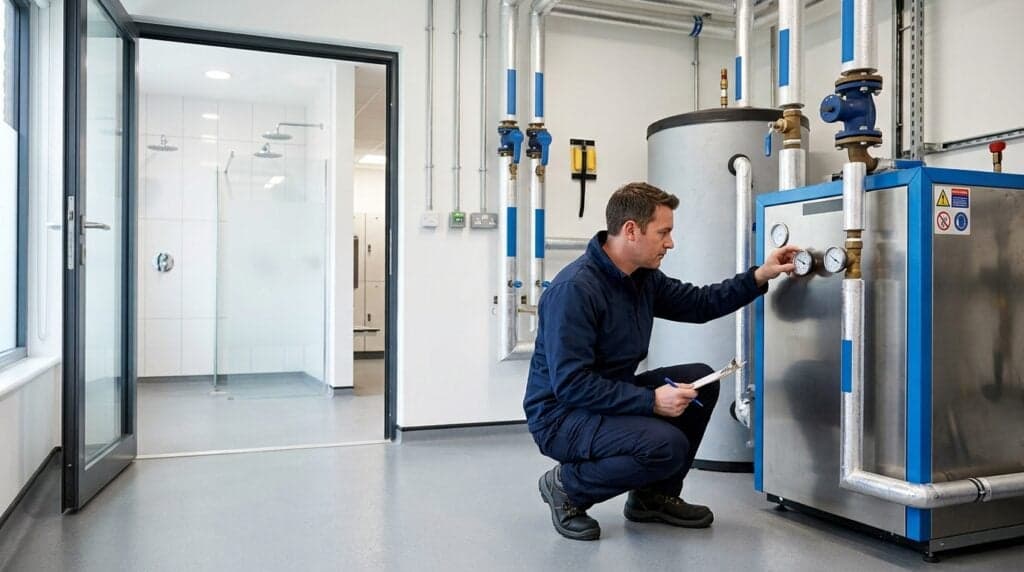
It isn’t just showers, either. Bigger sites with a pool, spa pool, or steam generator have more complex plant — calorifiers, header tanks, and cooling towers on the roof for air conditioning — and each one needs its own line on the risk assessment. Even a straightforward 24-hour gym with no wet-side facilities still has a water system worth assessing: the cold water storage tank, the pipework feeding the drinking fountain, the outlet nobody’s touched since the last refurb.
Your Legal Duty as a Gym Owner
The Health and Safety at Work etc. Act 1974, backed by the Control of Substances Hazardous to Health Regulations (COSHH), places a legal duty on anyone running premises with a water system to identify and control the risk of exposure to Legionella. The HSE’s Approved Code of Practice L8 sets out exactly what “control” looks like in practice, and it applies whether you run a single studio with two showers or a multi-site chain with a spa suite.
In practice, this means you need:
- A written Legionella risk assessment for every water system on the premises, reviewed at least every two years or whenever something changes (a refurbishment, a new spa pool, an extended closure)
- A named, competent “responsible person” who understands the risks and has the authority to make sure controls are actually carried out
- A written scheme of control, including who checks what, how often, and how it’s recorded
- Records kept for at least five years, ready to produce if your local authority environmental health team asks
None of this requires an in-house microbiologist. Most independent gyms either train a manager to competent-person standard through a short accredited course, or contract a specialist water hygiene company to write the assessment and carry out sampling.
The Practical Checks That Actually Prevent an Outbreak
The risk assessment on paper matters less than the routine that follows it. The controls that make the real difference are simple, cheap, and easy to build into a weekly checklist:
- Flush rarely-used outlets weekly. Any shower, tap or hose that isn’t used regularly should be run at full flow for at least five minutes to clear stagnant water — especially important after a bank holiday closure or a quiet week.
- Check hot water temperatures monthly. Water should leave the calorifier above 60°C and reach outlets above 50°C within a minute of running (with thermostatic mixing valves fitted to prevent scalding).
- Keep cold water genuinely cold. Cold storage and distribution should stay below 20°C; insulate pipework that runs near boilers or plant rooms.
- Descale and disinfect shower heads quarterly. Limescale build-up shelters bacteria and disrupts the fine spray that keeps droplet size (and inhalation risk) down.
- Test and log spa pools daily if you have them. Chlorine and pH levels need checking multiple times a day when in use, with clear records — spa pools are consistently the highest-risk feature in any leisure facility.
Whoever owns this checklist should be logging it the same way they’d log a fire alarm test — dated, signed, and filed. If your gym already uses a gym management system for staff task lists, water hygiene checks are a natural fit for the same recurring-task feature.
Extra Risk During Closures, Refurbishments and Quiet Spells
Risk spikes sharply whenever water sits unused for more than a few days. A refurbishment that takes changing rooms offline for a fortnight, a Christmas or New Year closure, or even a quieter August when fewer members shower on-site all create exactly the stagnant conditions Legionella needs. The fix is straightforward but easy to forget in the rush to reopen: flush every outlet at full flow before members are let back in, and if a system has been down for more than a month, consider a full disinfection (a chlorine or thermal shock treatment) rather than a simple flush.
The same logic applies when you’re commissioning something new. A newly installed spa pool, a replacement calorifier, or pipework altered during a refit should all be commissioned with a documented flush and disinfection before members use them, and added to the risk assessment from day one rather than retrofitted in six months later when someone remembers.
Where This Overlaps With Your Wider Facilities Compliance
Legionella control rarely sits in isolation. It’s part of the same facilities conversation as your changing room and shower standards, and it directly affects your utility costs — running hot water at compliant temperatures around the clock is one of the hidden line items behind rising bills, alongside the heating and lighting factors covered in our guide to reducing gym energy bills. Some owners try to save money by turning boilers down overnight; from a Legionella standpoint, that’s exactly the wrong move, since sustained temperatures below 50°C anywhere in the system are what let bacteria multiply.
It’s also worth folding into your incident response planning. If a member or member of staff falls seriously ill and Legionnaires’ disease is suspected, your gym needs the same clear-headed emergency procedure you’d use for a cardiac event or serious injury — know who calls 111 or 999, who documents what happened, and who notifies environmental health.
What Happens If You Get It Wrong
Enforcement is real and it isn’t rare. Local authority environmental health officers can and do inspect gyms, especially those with spa facilities, and can issue improvement notices or prohibition notices that shut down water systems with immediate effect. Where a serious failure leads to illness, the HSE has prosecuted leisure operators under health and safety law, with fines running into hundreds of thousands of pounds for larger operators and reputational damage that’s far harder to put a number on for a small independent gym relying on local trust.
The upside is that compliance here is genuinely achievable on an independent gym’s budget. A basic risk assessment from a water hygiene specialist typically costs a few hundred pounds, with ongoing monitoring adding a modest monthly cost — a fraction of what a single enforcement notice or, worse, a genuine health incident would cost in fines, closure time, and lost member trust.
Quick Answers to Common Questions
Do I need a Legionella risk assessment if my gym has no pool or spa? Yes. Any premises with a water system — even just cold taps, a water fountain, and a couple of showers — falls under the same legal duty. Pools and spas simply raise the risk level and the frequency of checks required.
Can I do the risk assessment myself? You can, provided whoever does it is genuinely competent to identify and assess the risk, which usually means completing a recognised short course first. Most independent gym owners find it’s more cost-effective and defensible to bring in a specialist for the initial assessment, then manage the day-to-day monitoring in-house.
How often does the risk assessment need reviewing? At least every two years, and immediately after any significant change — a refurbishment, new plant, an extended closure, or a change of use for part of the building.
What records should I actually keep? Dated logs of water temperature checks, flushing of little-used outlets, descaling of shower heads, and (if applicable) spa pool chemical readings, plus the risk assessment itself and any correspondence with your water hygiene contractor. Keep all of it for a minimum of five years.
Building It Into Your Routine, Not Treating It as a One-Off
The gyms that stay on the right side of this rarely think of it as a compliance project with a start and end date. They treat it the way they treat cleaning rotas or equipment servicing — a named person, a recurring checklist, and a folder (physical or digital) that any inspector could pick up and understand in five minutes. If you’re already building out staff systems and delegation as your gym grows, water hygiene is one more checklist that belongs in the same structure rather than living in someone’s head.
Get the assessment written, get someone trained as your responsible person, and build the weekly flushing and monthly temperature checks into whatever system your team already uses. It’s unglamorous work, but it’s the kind of unglamorous work that keeps members safe and keeps your gym open.
Want more members to find your gym in the first place? Claim your free GymPal listing and make sure the compliance and quality work you’re already doing gets seen by gym-goers searching in your area.

I am Adam Hall, a dedicated fitness professional with over ten years of experience in the UK’s fitness industry. I earned my Master’s degree in Sports Science from Loughborough University and have worked with several top fitness studios across the UK. My certifications include a Level 3 Personal Trainer Certificate and a specialised Strength and Conditioning Coach accreditation.
Starting my career as a personal trainer, I quickly moved up to manage multiple gym locations, overseeing their operations and training programs. Beyond managing gyms, I regularly contribute to well-known fitness magazines and have been featured in articles for “Health & Fitness” and “Men’s Health”. My passion also extends online where I run a popular blog on GymPal’s AI-powered directory platform detailing insights into choosing the right fitness venues across the UK. With hundreds of posts reaching thousands of readers monthly, my goal is to influence positive changes in how people approach health and exercise throughout the country.