How to Reduce Your Gym’s Energy Bills — A UK Independent Gym Owner’s Guide

Click Below To Share & Ask AI to Summarize This Article
Why Energy Is One of Your Biggest Controllable Costs
Energy costs are typically the second or third largest operating expense for a UK independent gym, behind rent and staffing. Unlike rent (fixed for the lease term) and staffing (tied to service levels), energy consumption can be meaningfully reduced through relatively straightforward changes — without affecting member experience. means that energy management deserves deliberate attention. This guide covers where gym energy goes, which changes have the highest impact, and how to ensure you’re on the right commercial tariff.
Where Gym Energy Goes: Understanding Your Consumption
Before you can reduce energy costs, you need to understand what is consuming energy in your gym. The typical breakdown for a UK independent gym:
- HVAC (heating, ventilation, air conditioning) — 40–55% of total energy consumption in most gyms. Maintaining appropriate temperature and air quality in a space filled with exercising bodies generating heat and moisture is the dominant energy load.
- Lighting — 15–25% of consumption. Gyms have large floor areas that require consistent illumination during all operating hours.
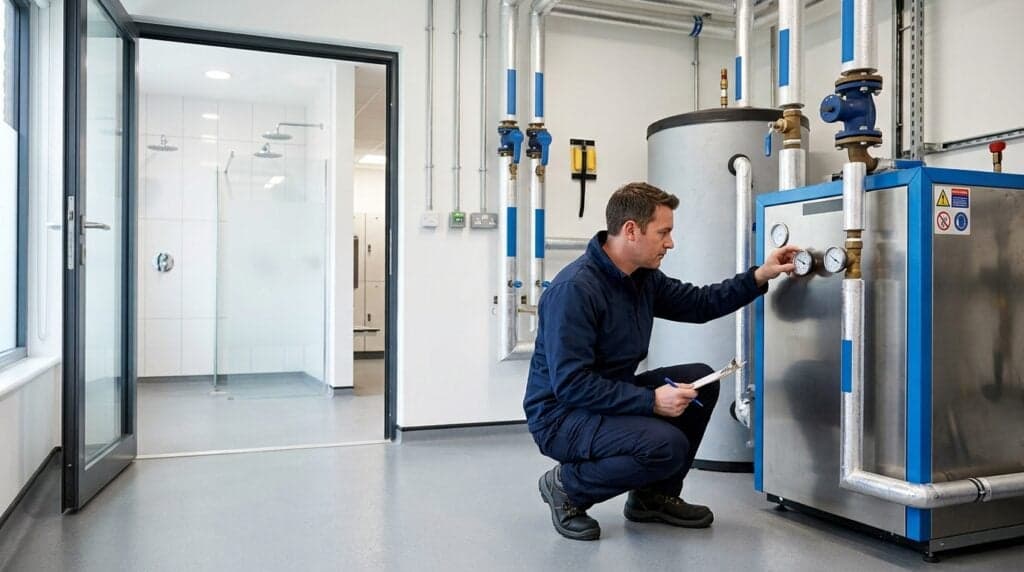
- Domestic hot water (showers) — 10–20%, particularly high in gyms with heavy post-session shower usage.
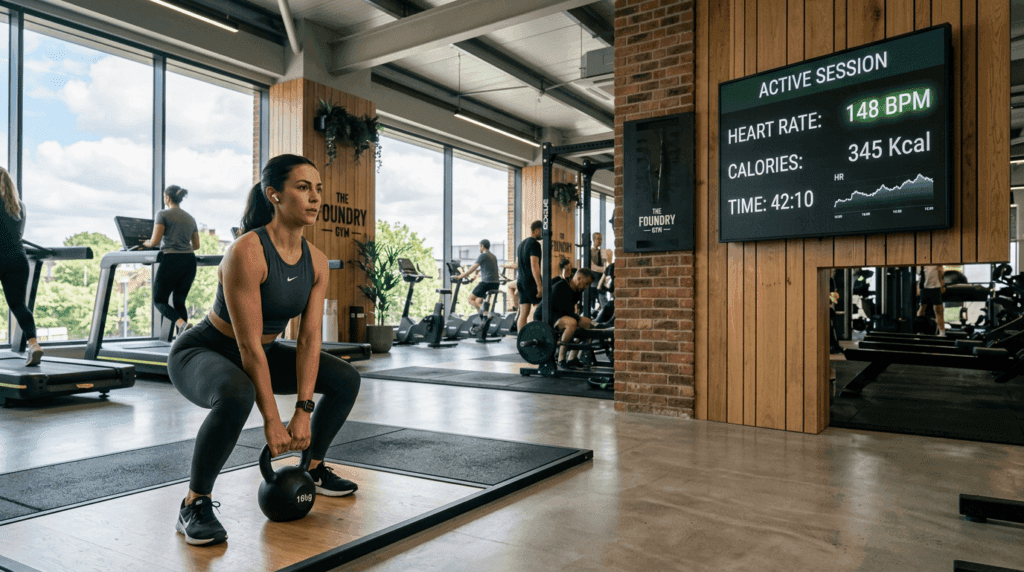
- Cardio and strength equipment — 5–10%. Modern commercial treadmills, cross trainers, and bikes consume significant power when in use; resistance machines and free weights consume very little.
- Other — office equipment, reception terminals, vending machines, café equipment if applicable.
If you don’t have a smart meter or sub-metering, you won’t be able to break down consumption this precisely — but the categories above tell you where to focus first: HVAC, lighting, and hot water typically offer the most significant savings.
The Highest-Impact Changes
1. LED lighting conversion (high impact, moderate cost)
If your gym still has fluorescent tube lighting, halogen spotlights, or older metal halide fixtures, converting to LED is typically the single highest-return energy efficiency investment available. LED lighting uses 60–80% less electricity than fluorescent or halogen equivalents, lasts 3–5x longer, and produces better quality light.
A gym floor with 50 four-foot fluorescent tubes running 16 hours per day will use approximately 40,000 kWh of electricity per year on lighting alone. Converting to LED equivalents reduces this to approximately 12,000 kWh — a saving of around £4,500 per year at £0.16/kWh commercial rates. Payback on a full LED conversion is typically 18–36 months.
Ask LED suppliers for a lighting audit — most will provide one free as part of a sales process. Focus on areas with the longest daily run times first: the main gym floor, changing rooms, and reception.
2. HVAC controls and zoning (high impact, varies by system)
HVAC is your largest energy load and typically has significant room for improvement in independently operated gyms. Key actions:
- Programmable controls — heating and cooling should follow your actual operating hours, not run continuously. A gym that is open from 6am to 10pm should not be maintaining full operating temperature at 3am. If your HVAC does not already have time-clock controls, this is a priority.
- Temperature setpoints — gym floors should be maintained at 16–18°C (cooler than other commercial spaces because members are exercising); changing rooms at 20–22°C. Review your setpoints — many gyms overheat their main floor.
- Zoning — if your gym has unused or low-use areas (a studio during off-peak hours, a reception area outside staffed hours), zoned controls allow you to reduce conditioning in those areas without affecting the rest of the facility.
- Maintenance — dirty filters, blocked coils, and poorly maintained units reduce efficiency significantly. An annual service by a qualified HVAC engineer typically pays for itself in energy savings within a few months.
3. Hot water heating (high impact for high shower usage)
For gyms with high shower usage — typically 100+ showers per day — hot water heating is a major energy cost. Options:
- Heat pump water heaters — use electricity far more efficiently than direct electric water heaters (coefficient of performance of 2–4, meaning they generate 2–4 kWh of heat for every 1 kWh of electricity consumed). Where replacing aging electric water heaters, heat pump alternatives offer significant running cost savings.
- Gas boiler servicing and controls — if you have a gas-fired hot water system, regular servicing and good controls (preventing the system cycling unnecessarily, maintaining appropriate storage temperature to prevent Legionella while not overheating) can reduce consumption by 15–25%.
- Low-flow shower heads — reducing water flow rate from 9L/min to 6L/min reduces hot water consumption by 33% with minimal impact on perceived shower quality.
4. Equipment standby and sleep modes
Commercial cardio equipment left permanently powered on consumes energy even when not in use. Most modern commercial treadmills, bikes, and cross trainers have sleep or standby modes that reduce consumption by 70–90% when not in use. Ensure these are enabled in equipment settings — many facilities have equipment running at full power 24 hours a day when members are present for 16 hours.
5. Smart meters and monitoring
A smart meter (required for all commercial properties in the UK under the government’s smart meter rollout) gives you half-hourly consumption data that allows you to identify spikes, compare consumption against operating hours, and measure the impact of changes you make. If you don’t have one, contact your energy supplier to request installation — it is free and provides a foundation for everything else.
Getting the Right Commercial Energy Tariff
The price you pay per unit of energy is at least as important as how much you consume. UK commercial energy is not regulated in the same way as domestic energy — there is no price cap, and tariffs vary enormously between suppliers and contract terms.
Key principles
- Never auto-renew — commercial energy contracts that auto-renew typically move onto high out-of-contract rates. Diarise your renewal date (usually 6 months before contract end) and actively go to market.
- Use a broker — a commercial energy broker can access rates from multiple suppliers simultaneously and takes a commission from the supplier rather than charging you. The market is competitive and broker-negotiated rates are typically 5–15% lower than direct approaches for small-medium businesses.
- Compare on unit rate and standing charge — a low unit rate with a high standing charge may be worse than a slightly higher unit rate with a low standing charge depending on your consumption pattern. Calculate total annual cost for each option rather than comparing headline rates.
- Consider fixed vs. flexible contracts — fixed-rate contracts provide cost certainty; flexible contracts track wholesale markets and can be cheaper in falling markets but expose you to spikes. For most independent gyms, a 12–24 month fixed contract provides the planning certainty that budgeting requires.
Half-hourly meters
If your electricity consumption exceeds 100,000 kWh per year (approximately £16,000 at current rates), you will have a half-hourly (HH) meter. HH-metered businesses have access to wholesale market pricing structures that can be significantly cheaper than standard commercial tariffs. If you are in this band, ensure your broker or supplier is pricing your supply on HH terms.
Solar Panels: Does It Make Sense for Your Gym?
Solar PV (photovoltaic) panels are increasingly cost-effective for commercial properties, particularly those with large south-facing roof areas. For a gym, the key question is whether your energy consumption profile aligns with solar generation — i.e. whether you use significant electricity during daylight hours.
Gyms that are busy from early morning through late evening typically have good solar alignment for the morning and middle portion of the day. Gyms with morning-focused memberships that are quieter in the evening are well-suited to solar. Gyms that do most of their business in evenings align poorly with solar generation and would need battery storage to capture daytime generation.
A solar installation for a medium-sized gym roof (200–400 panels) typically costs £25,000–£60,000 and generates 50,000–100,000 kWh per year. At current commercial electricity prices, payback periods are typically 6–10 years. If you own the building, solar is often a strong long-term investment. If you lease, you need landlord consent and careful consideration of whether the lease term is long enough to justify the investment.
Government Schemes and Incentives
Several UK government schemes may be relevant for energy efficiency investments:
- Super-deduction / Full Expensing — from April 2023, UK companies investing in qualifying plant and machinery (including energy-efficient equipment) can claim 100% first-year capital allowances under the Full Expensing scheme, reducing the upfront tax cost of efficiency investments.
- Energy Savings Opportunity Scheme (ESOS) — mandatory energy audits for large businesses (250+ employees). Most independent gyms are below this threshold, but participating voluntarily can identify significant savings.
- Local authority grants — some local authorities have business energy efficiency grant programmes, often funded through the UK Shared Prosperity Fund. Check with your local authority or local enterprise partnership.
- Enhanced Capital Allowances — investments in specific energy-efficient products on the Energy Technology List may qualify for enhanced capital allowances. Check the government’s ETL at gov.uk.
Get More Members to Spread Those Fixed Energy Costs
Every new member improves your energy cost per member — your fixed energy overhead is spread across a larger revenue base. GymPal helps UK gym-seekers find independent gyms in their area, putting your gym in front of people who are actively looking to join.
Claim your free GymPal listing and keep the membership growing while you manage costs down.

I am Adam Hall, a dedicated fitness professional with over ten years of experience in the UK’s fitness industry. I earned my Master’s degree in Sports Science from Loughborough University and have worked with several top fitness studios across the UK. My certifications include a Level 3 Personal Trainer Certificate and a specialised Strength and Conditioning Coach accreditation.
Starting my career as a personal trainer, I quickly moved up to manage multiple gym locations, overseeing their operations and training programs. Beyond managing gyms, I regularly contribute to well-known fitness magazines and have been featured in articles for “Health & Fitness” and “Men’s Health”. My passion also extends online where I run a popular blog on GymPal’s AI-powered directory platform detailing insights into choosing the right fitness venues across the UK. With hundreds of posts reaching thousands of readers monthly, my goal is to influence positive changes in how people approach health and exercise throughout the country.