Swimming for Fitness UK: Why Your Pool Is Your Best Gym
Click Below To Share & Ask AI to Summarize This Article
There are over 12.5 million adults in the UK who swim at least once a year. That makes it one of the most popular physical activities in the country — yet somehow, the pool still gets overlooked when people are planning their fitness routine. Most people think of swimming as something you did in school, or something your nan does on a Tuesday morning. They are wrong. Dead wrong.
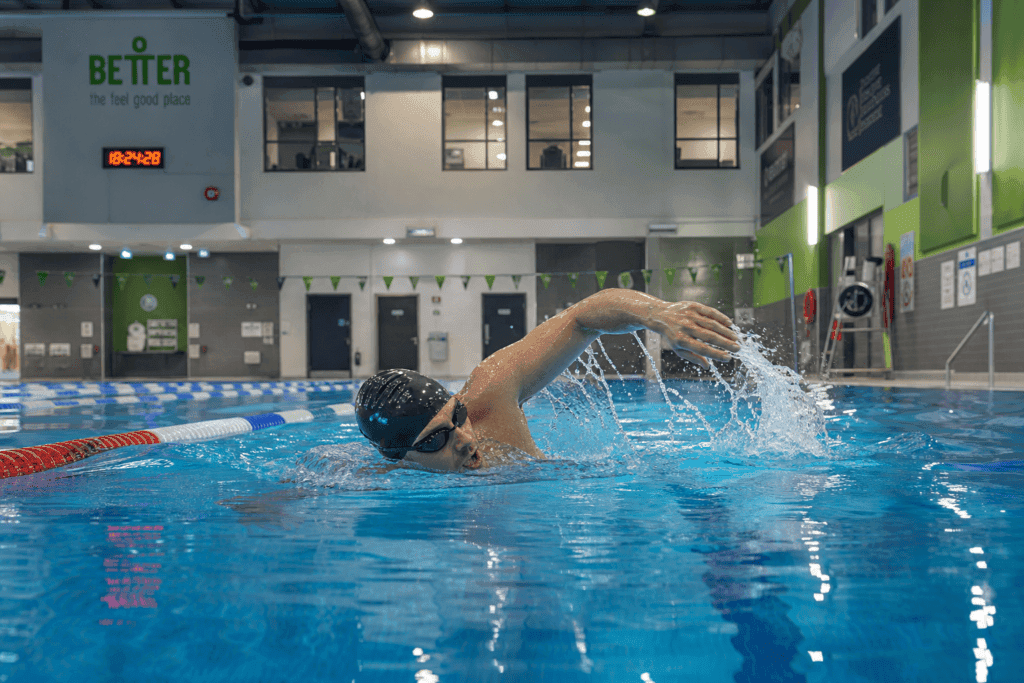
Swimming is, without question, one of the most complete full-body workouts you can do. It builds strength, improves cardiovascular fitness, burns serious calories, and goes incredibly easy on your joints. Whether you are recovering from an injury, training for your first triathlon, or just looking for a way to get fit without dreading every session, the pool has something for you.
And the good news? The UK is packed with places to swim — from local leisure centres charging a fiver a session to stunning outdoor lidos and world-class aquatic facilities. This guide covers everything you need to know to make the pool your secret fitness weapon.
Why Swimming Delivers a Better Workout Than You Think
Let us be straight with you: a solid 45-minute swim will burn somewhere between 400 and 700 calories, depending on your pace and stroke. That is comparable to an hour on a treadmill — but without the pounding on your knees and hips that puts so many people off running.
What makes swimming genuinely special as a fitness tool is the muscle coverage. Every major muscle group is engaged in the water. Your lats, shoulders, and triceps pull you through each stroke. Your core stabilises your entire body position. Your legs kick continuously, working your glutes, hamstrings, and quads in a way that feels deceptively gentle but absolutely is not.
According to Swim England’s key statistics, regular swimming can reduce the risk of serious long-term conditions including heart disease and type 2 diabetes by up to 40 per cent. It also improves lung capacity, lowers blood pressure, increases bone strength, and — because the water provides natural resistance — builds lean muscle mass without loading your joints.
For anyone with a bad back, dodgy knees, or recovering from injury, swimming is often the first exercise a physio will recommend. The buoyancy of water reduces effective body weight by around 90 per cent, meaning you can work hard with almost zero impact. But do not mistake gentle for easy — water resistance is roughly 800 times denser than air. Every movement requires real effort.
UK Swimming Venues: More Options Than You Probably Realise
One of the biggest barriers people cite when it comes to swimming is access — but the UK actually has a remarkably dense network of swimming facilities if you know where to look.
Council leisure centres are the backbone of recreational swimming in Britain. Almost every town has at least one, and session prices are typically affordable — often between £4 and £8 for an adult swim. Places like Ponds Forge International Sports Centre in Sheffield, Crystal Palace National Sports Centre in London, and Manchester Aquatics Centre are world-class facilities that anyone can book into for a casual lane swim.
Private health clubs and gyms frequently include pools as part of their membership offer. Virgin Active, David Lloyd, and Nuffield Health all run pools across England, Wales, and Scotland. Membership prices are higher, but if you are already planning to use a gym regularly, a pool-inclusive club can be excellent value.
Outdoor lidos and open-water spots have seen a huge resurgence in popularity over the last five years. London has Serpentine Lido, Tooting Bec Lido, and the Parliament Hill Lido. Bristol has Clifton Lido. The Outdoor Swimming Society maps hundreds of wild swimming spots across the UK, from coastal coves in Cornwall to river pools in the Yorkshire Dales. There is something about cold open water that unlocks a kind of primal fitness motivation that a chlorinated pool simply cannot match.
Finding a venue near you has never been easier. GymPal lists swimming facilities across the UK — search by postcode, town, or region to find pools, lidos, and leisure centres with pool access near you.
Building a Swimming Fitness Plan That Actually Works
The number one mistake beginners make is turning up at the pool, swimming until they are exhausted, and then wondering why they dread going back. Swimming looks effortless when you watch elite swimmers glide through the water. It is not. Without solid technique, even a short swim can leave you gasping and going nowhere fast.
Here is a sensible framework to build your swimming fitness from scratch:
Beginners (0–4 weeks)
- Aim for two sessions per week, 20–30 minutes each
- Focus on front crawl or breaststroke — get comfortable in the water first
- Rest between lengths — it is completely fine to swim one length, pause, then go again
- Consider a single swim lesson to correct your technique early — it pays dividends forever
Intermediate (4–12 weeks)
- Increase to three sessions per week, 30–45 minutes each
- Introduce interval sets: swim 100m at effort, rest 30 seconds, repeat
- Mix strokes: front crawl for cardio, breaststroke for recovery lengths, backstroke to work different muscle groups
- Use a pull buoy between your legs to isolate upper body on some lengths
Advanced (3 months+)
- Target 2,000–3,000 metres per session
- Follow structured training programmes (Swim England and SwimTrek both publish free plans)
- Add strength work on land — shoulder, back, and core conditioning complements pool training significantly
- Consider joining a masters swimming club — the social element massively increases adherence
Aqua Aerobics and Group Classes: Swimming That Does Not Feel Like Training
Lane swimming is not for everyone, and that is absolutely fine. If the idea of swimming up and down in a straight line for 45 minutes sounds like mild torture, aqua aerobics might be your way in.
Aqua aerobics classes — sometimes called aqua fit or water aerobics — are offered at the vast majority of UK leisure centres and pool-equipped gyms. They are typically 45 minutes of instructor-led exercise in the shallow end of the pool, involving jumping, squatting, lunging, and resistance work using the water. The water provides between four and 42 times more resistance than air (depending on movement speed), making it an extraordinarily effective workout that genuinely does not feel like hard work while you are doing it.
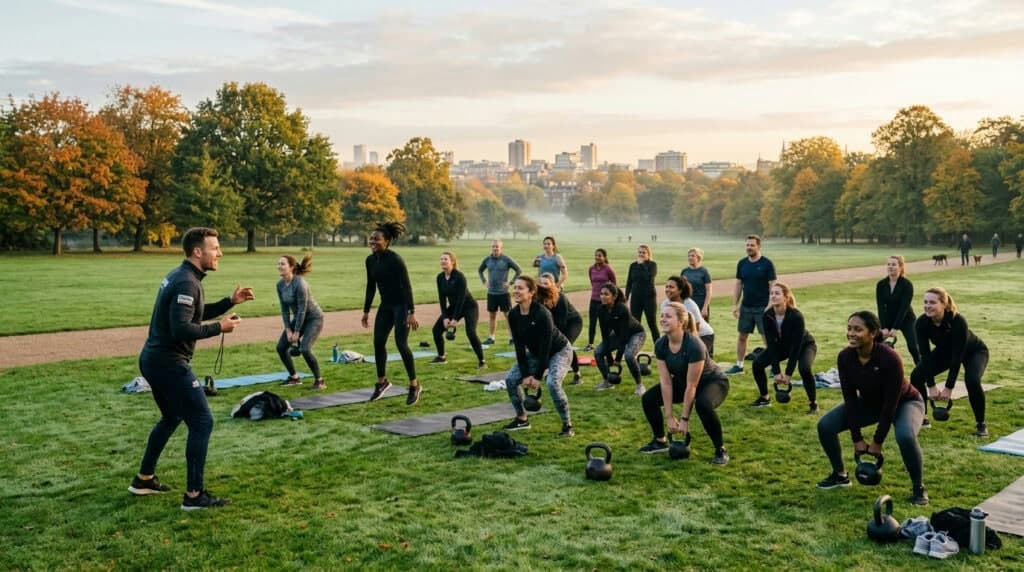
The social atmosphere of a group class is also a powerful motivator. If you enjoy the energy of group exercise — the music, the instructor, the camaraderie — aqua aerobics scratches exactly that itch. It is also one of the few exercise formats that attracts a genuinely mixed age group, which can be refreshing. For those who also enjoy high-intensity land training, UK bootcamp fitness classes offer another high-energy group option worth pairing with your pool sessions.
Other pool-based classes to look out for include:
- Aqua Zumba — dance-based cardio in the water, enormous fun and a serious calorie burn
- Aqua cycling — stationary bikes submerged in a pool, now available at specialist studios in London, Manchester, and Birmingham
- Adult swimming lessons — if you cannot swim confidently, this is the best fitness investment you will ever make
Most leisure centres post their class timetables online. When choosing a facility, look for one that runs multiple aqua classes across different times of the day — a well-structured pool class timetable with good coverage across mornings, lunchtimes, and evenings makes it far easier to build swimming into a realistic weekly routine.
The Mental Health Case for Getting in the Water
Ask anyone who swims regularly why they keep going, and within ten seconds the conversation will shift from calories and cardio to how it makes them feel. There is something about the water that is genuinely therapeutic in a way that differs from almost any other exercise.
Research backs this up comprehensively. Over half of UK adults who swim cite stress relief as a primary motivator. Studies show that three to five moderate-intensity swimming sessions per week over four to sixteen weeks leads to a statistically significant reduction in depression symptoms. The rhythm of swimming — the repetitive stroke cycle, the muffled sound underwater, the full sensory immersion — produces what researchers call a meditative state, quieting the mind in a way that is genuinely difficult to replicate on land.
Cold water swimming takes this even further. The shock of cold water triggers a flood of dopamine and noradrenaline — the same neurochemicals that many antidepressants target. The open-water swimming community in the UK has grown dramatically for precisely this reason, with wild swimming clubs springing up around reservoirs, rivers, and coastlines from the Highlands to the Jurassic Coast. You do not need to swim in a frozen lake to access the benefits — even ending a warm shower with thirty seconds of cold water has measurable effects on mood and alertness.
What You Actually Need to Get Started
One of swimming’s other great virtues is how little kit it requires. Compare the upfront cost to cycling, running (decent shoes are not cheap), or any racquet sport. Swimming asks for remarkably little.
Essential kit for pool swimming:
- Goggles — non-negotiable. A decent pair costs £15–£30 and lasts years. Speedo Biofuse and TYR Special Ops are solid mid-range options.
- Swimsuit or swim shorts — board shorts create drag; a proper swim brief or jammers (knee-length race shorts) will make you noticeably faster and more comfortable
- Swim cap — often required in lane sessions and for open water. Keeps hair out of your face and reduces drag.
- Towel — a microfibre travel towel dries faster and packs far smaller than a standard bath towel
Useful extras as you progress:
- Pull buoy — foam float held between your legs; isolates your upper body stroke for targeted arm and shoulder work
- Kickboard — held out front while kicking; isolates leg work
- Fins — for kick drills; they make technique work feel far more manageable
- Waterproof fitness tracker — swim-enabled versions of Garmin and Apple Watch automatically count lengths and track pace, which is genuinely motivating
For open-water swimming, add a tow float (a bright inflatable bag that clips to your waist, making you visible to boats — mandatory at most organised open-water events) and a wetsuit if you plan to swim beyond late summer in UK waters.
Find Your Perfect Pool With GymPal
The UK has a genuinely impressive variety of swimming facilities — but finding the right one for your goals, location, and budget takes time if you are searching venue by venue. GymPal makes it easy.
Search by your postcode or town at askgympal.co.uk/swimming to browse pools, leisure centres with pool access, health clubs, and outdoor venues near you. Each listing includes opening hours, pricing, and facilities so you can find a spot that fits your schedule and budget before you even unpack your swim bag.
Whether you are after a quiet lane swim at 6am before work, a Saturday morning aqua aerobics class, or an outdoor lido to enjoy on a summer afternoon, GymPal has you covered.
Start Swimming This Week
Swimming asks very little of you to begin. You do not need to be fit. You do not need expensive kit. You do not need to be a fast or confident swimmer. You just need to show up at the pool and get in the water.
The first few sessions will feel harder than you expect — swimming uses muscles and movement patterns that most adults never access in daily life or in a conventional gym. Stick with it for three or four sessions and you will feel the difference. By session eight or ten, you will understand why so many people who start swimming never stop.
Your local pool is ready. All you need to do is book a lane.

I am Adam Hall, a dedicated fitness professional with over ten years of experience in the UK’s fitness industry. I earned my Master’s degree in Sports Science from Loughborough University and have worked with several top fitness studios across the UK. My certifications include a Level 3 Personal Trainer Certificate and a specialised Strength and Conditioning Coach accreditation.
Starting my career as a personal trainer, I quickly moved up to manage multiple gym locations, overseeing their operations and training programs. Beyond managing gyms, I regularly contribute to well-known fitness magazines and have been featured in articles for “Health & Fitness” and “Men’s Health”. My passion also extends online where I run a popular blog on GymPal’s AI-powered directory platform detailing insights into choosing the right fitness venues across the UK. With hundreds of posts reaching thousands of readers monthly, my goal is to influence positive changes in how people approach health and exercise throughout the country.