Yoga Classes UK: How to Find the Right Style for You
Click Below To Share & Ask AI to Summarize This Article
You’ve decided you want to try yoga. Good decision. Millions of Brits are doing it — and not just the ones who travel with a rolled-up mat under their arm. From rugby players using it for recovery to office workers managing back pain, yoga has quietly become one of the most widely practised fitness activities in the UK.
Here’s the problem: you turn up to book a class and you’re immediately faced with a bewildering menu. Hatha, Vinyasa, Yin, Ashtanga, Restorative, Power Yoga, Kundalini, Bikram… It looks like a foreign language, and picking the wrong one can leave you either bored stiff or completely out of your depth.
This guide cuts through the confusion. We’ll explain exactly what each major yoga style involves, who it’s best suited to, and how to find quality yoga studios near you anywhere in the UK — from Birmingham and Bristol to Edinburgh and Belfast.
How Popular Is Yoga in the UK?
It’s more mainstream than you might think. Surveys have consistently found Hatha the most common style in the UK at around 28% of all classes, followed by Iyengar (26%) and Vinyasa (15%). According to the British Wheel of Yoga — yoga’s governing body in England — tens of thousands of instructors are now teaching across the country, with studios in virtually every market town and city.
The boom isn’t slowing down either. Drop-in classes typically cost £10–£20, monthly studio memberships run around £80–£100, and many gyms now include yoga in their group class timetable at no extra charge. There are genuinely more ways to try yoga in the UK than ever before.
The question isn’t whether you’ll find a class. It’s which one is actually right for you.
The Big Three: Hatha, Vinyasa, and Yin
These three styles between them account for the vast majority of yoga classes you’ll find in UK studios. Get comfortable with what they mean and you’ll immediately feel more confident booking your first session.
Hatha Yoga
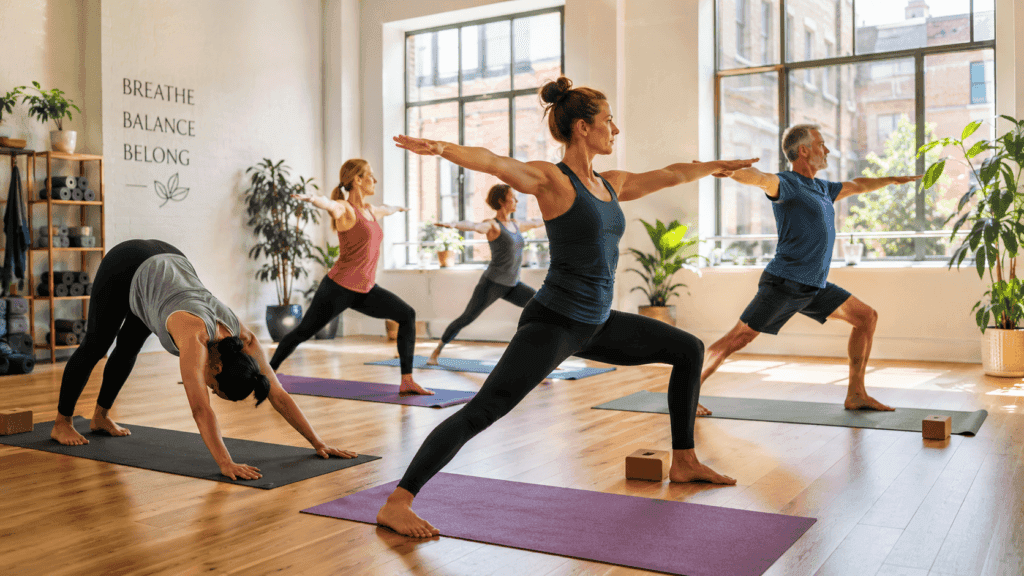
Hatha is the foundation of almost everything in modern yoga. In its broad sense, the term covers any yoga that uses physical postures, but in practice a “Hatha class” in the UK typically means a slower-paced session where you hold poses for several breaths before moving on. Teachers spend time on alignment — making sure you’re doing each position safely — and classes rarely feel rushed.
Best for: Complete beginners, anyone returning after injury, people who want a gentle introduction to the postures without feeling overwhelmed.
Typical class: 60–75 minutes, includes warm-up, standing poses, floor work, and savasana (final relaxation).
Vinyasa Yoga
Vinyasa links postures together into flowing sequences synchronised with the breath. You move constantly — inhale into one pose, exhale into the next — which gives classes a more athletic, rhythmic feel. Many Vinyasa teachers play music, and the intensity can range from moderate to genuinely challenging depending on the studio.
Best for: People who want to break a sweat, anyone who finds slow-paced exercise boring, gym regulars looking for variety.
Typical class: 60–90 minutes. Expect to get warm quickly. The first class might feel fast — by the second or third you’ll start to find your flow.
Yin Yoga
Yin is the polar opposite of Vinyasa. Poses are held for 3–5 minutes at a time, sometimes longer, targeting deep connective tissue, fascia, and joints rather than the muscles. It feels almost meditative and is deliberately challenging in a different way — holding stillness requires real mental discipline.
Best for: Athletes and gym-goers who are tight through the hips and hamstrings, anyone with high stress levels, people who struggle to switch off.
Typical class: 60–75 minutes, low number of poses, extremely quiet atmosphere. Don’t be surprised if you fall asleep in the final pose.
Other Styles Worth Knowing
Beyond the big three, you’ll regularly see these on UK studio timetables:
Ashtanga Yoga — A structured, physically demanding sequence of poses always performed in the same order. Ashtanga mysore-style classes let you work at your own pace through the sequence with one-to-one teacher guidance. Traditional and disciplined; not ideal for absolute beginners but brilliant once you have some foundation.
Restorative Yoga — The quietest style of all. Poses are fully supported with bolsters, blankets, and blocks, and held for up to 10 minutes. The aim is complete physical release rather than stretch. Excellent for stress recovery and burnout.
Power Yoga — A Westernised, gym-friendly version of Ashtanga that drops the rigid sequence. Think circuits with a yoga mat. High intensity, high energy, popular with people who come from a gym background.
Kundalini Yoga — Significantly more spiritual and ritualistic than most styles. Involves chanting, breathwork, and repetitive movement. Can be brilliant for mental health but feels unfamiliar to those expecting a purely physical practice.
Bikram / Hot Yoga — Hot yoga classes in the UK are typically held in rooms heated to 37–42°C and follow a set sequence of 26 poses. Love it or hate it, there’s rarely a middle ground — but many practitioners swear by the combination of heat and yoga for improving flexibility and releasing tension.
How to Choose the Right Style for Your Goals
Still not sure? Use this as a quick filter:
You want to lose weight or build strength → Start with Vinyasa or Power Yoga. Both raise your heart rate and engage the whole body.
You’re recovering from injury or managing chronic pain → Hatha or Restorative. Slower pace, more teacher attention to alignment, lower risk.
You’re a regular gym-goer who ignores stretching → Yin. It will target exactly the places gym work tightens up — hips, hamstrings, thoracic spine.
You want to reduce stress and improve sleep → Restorative, Yin, or a gentle Hatha class with a strong savasana.
You’ve tried yoga before and found it too slow → Vinyasa, Ashtanga, or Power Yoga.
You’re a complete beginner worried about keeping up → Book a beginner-specific Hatha class, not a general class. The difference matters. Many people who feel put off by yoga have accidentally walked into an intermediate Vinyasa session on their first try.
If you’re generally nervous about turning up somewhere new, you’re definitely not alone — the same social anxiety that affects gym newcomers hits yoga studios too. Overcoming gym anxiety is a genuinely common challenge, and most yoga teachers are excellent at making first-timers feel welcome.
Yoga vs. Pilates: What’s the Difference?
This question comes up constantly. Both involve controlled movement, breathing, and floor-based work — it’s easy to see why people confuse them.
The key difference: yoga is rooted in an ancient tradition with spiritual dimensions (though most UK classes are entirely secular and fitness-focused). Pilates was developed in the 20th century specifically to rehabilitate and strengthen the body, with a consistent emphasis on core stability and spinal alignment.
In practical terms, yoga tends to involve more flexibility, balance, and variety in movement, while Pilates maintains a tighter focus on core strength and controlled precision. Pilates for beginners is a great complementary practice — many regular practitioners do both, and the two disciplines genuinely reinforce each other. If you enjoy one, there’s a good chance you’ll enjoy the other.
What to Bring to Your First Yoga Class
Keep it simple for the first few sessions:
- Mat — Most UK studios provide them for hire (usually £1–£2). Buy your own once you know you’ll stick with it.
- Comfortable clothing — Leggings or shorts, a fitted top. Baggy t-shirts work fine for Hatha but can be awkward in inversions.
- Water bottle — Essential for Vinyasa and anything heated.
- Bare feet — Yoga is always done without shoes, so a pair of socks to wear in the changing room is handy.
- An open mind — There will be Sanskrit words you don’t recognise. Pick them up gradually; nobody expects you to know them on day one.
Arrive 5–10 minutes early, tell the teacher it’s your first class, and mention any injuries or health conditions. Most UK teachers will adapt poses for you without making a fuss about it.
How to Find Yoga Classes Near You in the UK
The easiest way to find yoga classes — whether you’re in Glasgow, Cardiff, Manchester, or a market town in Suffolk — is to search by location and filter by style. GymPal lists yoga studios across the UK, so you can compare what’s available near you, check what styles are on offer, and read venue details before you commit to anything.
Find yoga studios near you on GymPal and filter by your area. Most studios offer a first-class trial or an introductory-week pass — it’s worth trying two or three different places and styles before settling on a regular session.
Final Thoughts
Yoga is one of those activities that rewards curiosity. The people who get the most from it are usually the ones who try a few different styles before deciding what clicks. A single difficult Vinyasa session shouldn’t put you off any more than one bad run should stop you lacing up again.
Start with a beginner-labelled Hatha class if you’re genuinely new. Move to Vinyasa when you want more challenge. Add Yin when your body starts telling you it needs something slower. That progression covers most people’s yoga journey and doesn’t require any more planning than that.
The studios are there. The styles are varied. Whether you’re after your first downward dog or looking to deepen an existing practice, GymPal makes it easy to find the right yoga class near you.

I am Adam Hall, a dedicated fitness professional with over ten years of experience in the UK’s fitness industry. I earned my Master’s degree in Sports Science from Loughborough University and have worked with several top fitness studios across the UK. My certifications include a Level 3 Personal Trainer Certificate and a specialised Strength and Conditioning Coach accreditation.
Starting my career as a personal trainer, I quickly moved up to manage multiple gym locations, overseeing their operations and training programs. Beyond managing gyms, I regularly contribute to well-known fitness magazines and have been featured in articles for “Health & Fitness” and “Men’s Health”. My passion also extends online where I run a popular blog on GymPal’s AI-powered directory platform detailing insights into choosing the right fitness venues across the UK. With hundreds of posts reaching thousands of readers monthly, my goal is to influence positive changes in how people approach health and exercise throughout the country.