Barre Classes UK: What to Expect, What It Costs, and Whether It’s Worth It
Click Below To Share & Ask AI to Summarize This Article
If you’ve scrolled past “barre” on a gym timetable and wondered what on earth it involves, you’re not alone. The name suggests something to do with ballet — and you’d be right — but barre classes aren’t just for retired dancers or those who spent their childhood in a tutu. They’re one of the fastest-growing fitness formats in the UK, and for good reason.
Barre is a full-body workout that combines elements of ballet, Pilates, and yoga. Classes are low-impact but surprisingly intense — you’ll spend a lot of time holding positions at a horizontal bar while your legs shake in ways you didn’t think possible. The movements are small and controlled, targeting muscles that traditional gym work often misses entirely.
Whether you’re looking for a gentler alternative to bootcamp, something to complement your strength training, or simply a fresh challenge, this guide covers everything you need to know before your first session — from what happens in the room to how much it’ll cost across the UK.
What Actually Happens in a Barre Class?
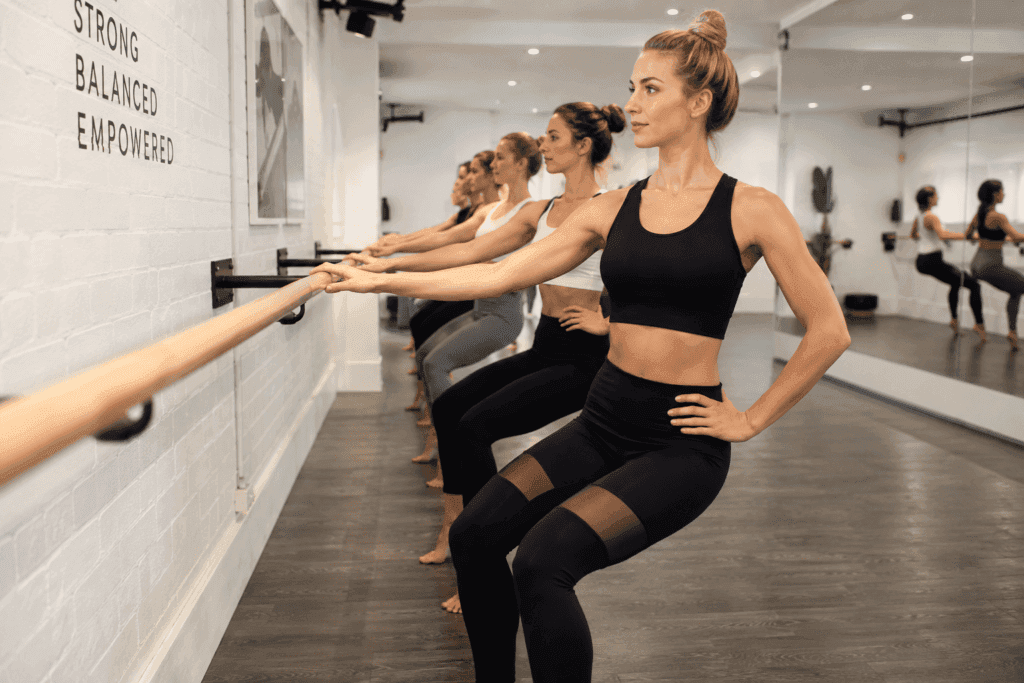
Walk into any barre studio across the UK and you’ll likely find a horizontal bar fixed to a mirrored wall, a sprung or cushioned floor, and a group of people warming up with light weights or resistance bands. The atmosphere is calm but focused — less like a gym floor, more like a dance studio with fitness-class energy.
A typical class runs for 45–60 minutes and follows a loosely consistent structure:
- Warm-up (5–10 minutes): Light cardio and dynamic stretching to prepare joints and raise the heart rate
- Upper body work (10 minutes): Tricep dips, press-ups, and small weighted arm movements — think 1–2kg dumbbells held for longer than feels reasonable
- Barre work (20–25 minutes): The core of the session. You’ll use the barre for balance while working through plié squats, arabesques, relevés, and the infamous “seat work” targeting the glutes
- Core section (10 minutes): Mat-based abdominal work, often influenced by Pilates principles
- Cool-down and stretch (5–10 minutes): Deep work for the hips, hamstrings, and thoracic spine
What surprises most first-timers is the intensity of the isometric holds. You’re not jumping, sprinting, or lifting heavy — but holding a plié at 90 degrees for three minutes will make your legs burn in a way that running doesn’t come close to replicating. The small, sustained movements create genuine muscular fatigue, and you’ll often find yourself shaking well before the exercise changes.
Instructors cue everything to music, and sessions have a rhythm to them — more choreographed than a standard gym class, but nowhere near as technically demanding as an actual ballet lesson. No prior dance experience is needed or expected.
Barre vs Pilates vs Yoga: What’s Actually Different?
These three disciplines get lumped together constantly, but each has a genuinely distinct focus.
Pilates centres on deep core stabilisation. Movement ranges are small and controlled, with particular attention to the muscles that support the spine and pelvis. If you’ve ever tried reformer Pilates, you’ll know the emphasis on alignment and spinal articulation — it’s methodical, deliberate, and highly effective for postural correction.
Yoga prioritises flexibility, breathwork, and mindfulness. While you’ll definitely build strength — especially in the upper body and core — yoga is fundamentally about range of motion and the mind-body connection. The pacing is different, the intention is different, and the spiritual dimension (depending on the style) is unique to it.
Barre sits somewhere in between. It has Pilates’ attention to alignment and small-range movements, yoga’s emphasis on mind-muscle connection, and its own distinct element: sustained, low-movement muscle fatigue at the barre. Sessions also tend to have considerably more energy — pumping playlist over ambient music, quicker transitions, and a slightly cardio-adjacent finish.
If you’re trying to decide between the three: want core stability and posture? Pilates. Want flexibility and stress relief? Yoga. Want to feel your thighs tremble in a completely new way while listening to Beyoncé? Barre.
How Much Do Barre Classes Cost in the UK?
Pricing varies significantly depending on whether you’re going to a dedicated barre studio or a general gym with barre on the timetable.
Dedicated barre studios — like Barrecore (London, with studios in Chelsea, Fitzrovia, and Chiswick), The Barre Class (Edinburgh), or Frame (London) — typically charge:
- £18–£28 per drop-in class
- £90–£160/month for unlimited membership packages
- Introductory offers around £30–£50 for the first two weeks unlimited
Independent studios and boutique gyms offering barre as part of a wider timetable:
- Often included in standard gym membership (£30–£60/month)
- Drop-in rates of £10–£18 if you’re not a member
Leisure centres — a significantly more affordable option. Many local authority gyms in Birmingham, Leeds, Sheffield, Bristol, and Manchester now include barre variants on their class schedules as part of a general membership (£25–£45/month).
Online barre is widely available too, with platforms like Alo Moves and YouTube channels offering subscription content from around £10/month — useful for home practice, though you’ll miss the instructor corrections that matter most when you’re starting out.
What to Wear to Your First Barre Class
Barre has a few specific kit requirements that set it apart from most gym classes.
Grip socks are almost universally required. They prevent sliding during mat work and on polished studio floors. Most studios sell them for £8–£15 if you arrive without them — it’s worth buying a pair to keep in your gym bag regardless.
Fitted, stretchy clothing works best. Leggings or fitted joggers with a vest or long-sleeved top are ideal. Avoid baggy clothing — instructors need to see your alignment and positioning to give accurate corrections, and loose fabric masks whether your hips are square or your knees are tracking correctly.
What not to wear: Running trainers. Barre is done in socks or flat ballet-style shoes, not thick-soled trainers. And resist the urge to bring a full gym bag onto the studio floor — most studios have lockers in a separate changing area.
The Health Benefits of Barre: What the Research Shows
Barre enthusiasts talk about improved posture, stronger core, better balance, and increased flexibility — and the research broadly supports these claims.
A 2018 study in the Journal of Strength and Conditioning Research found that barre participants showed significant improvements in balance, muscular endurance, and lower-body flexibility over an eight-week period — results comparable to those seen in Pilates groups. The low-impact nature makes it particularly suitable for people returning from injury, those in later stages of pregnancy, or anyone for whom high-impact exercise is problematic.
According to Sport England’s Active Lives data, women remain underrepresented in gym-based strength and conditioning activities. Formats like barre — which don’t require prior experience, heavy equipment, or a particular body type — consistently show higher engagement among women who wouldn’t otherwise identify as “gym people.”
That said, barre is not a complete fitness solution in isolation. It builds impressive muscular endurance and flexibility, but cardiovascular conditioning requires additional aerobic work. And if building muscle mass is a primary goal, pairing barre with some form of strength training for women will deliver significantly better results than barre alone.
What to Look for in a Good Barre Class
Not all barre classes are equal. If your first experience is poorly taught, you might write off the format before it’s had a fair chance.
Signs of a quality class:
- Small class sizes — more than 20 people and individual form corrections become impossible
- Proper alignment instruction — a good instructor will talk you through neutral spine, anterior pelvic tilt, and exactly where you should feel each exercise
- Modifications at every level — every movement should have an easier and harder variation; if the instructor assumes everyone can do the same thing, find a different class
- A real cool-down — barre loads muscles in unusual ranges of motion; skipping the stretch is a reliable route to next-day soreness in places you didn’t know existed
Things to be wary of:
- Studios growing class sizes to 25–30 to offset rent costs — quality drops sharply past 18
- Instructors with online-only certifications who haven’t learned hands-on corrections
- Classes labelled “barre-inspired” that are really aerobics classes with a ballet soundtrack
How to Find Barre Classes Near You in the UK
Dedicated barre studios are concentrated in London, Manchester, Edinburgh, Brighton, and Bristol, but smaller UK towns are increasingly well-served by independent studios and leisure centres expanding their timetables.
The simplest way to find barre classes nearby is to search on GymPal — you can filter by fitness type across thousands of UK venues, compare prices, and see what’s available in your area without ringing round every studio in town.
Don’t overlook leisure centres. Local authority gyms often charge a fraction of what boutique barre studios do, and the class quality can be genuinely high — especially in cities where councils have invested in broader fitness programming. If you’re in Yorkshire, the Midlands, or the North West, many leisure trusts run excellent group exercise timetables for under £40/month all-in.
Is Barre Worth Trying?
For most people: yes — with realistic expectations about what it does and doesn’t deliver.
Barre is an excellent choice if you want a low-impact workout that genuinely challenges your muscular endurance; if you’re working on posture and flexibility; if you find high-intensity classes hard on your joints; or if you simply want a change from the weights floor. It’s not the right primary format if cardiovascular fitness or significant muscle mass are your main goals — for those, you’ll need to supplement.
The first class is almost always harder than expected. The shake is very real. But it’s also oddly satisfying, and most people who try barre find themselves back the following week. Give it three or four sessions before making a judgement — the first one is mostly spent figuring out which way to face.
Use GymPal to find barre studios and fitness venues across the UK — filter by class type, location, and price to find the right fit without the guesswork.
Adam Hall writes about fitness venues, class types, and UK gym culture for GymPal.

I am Adam Hall, a dedicated fitness professional with over ten years of experience in the UK’s fitness industry. I earned my Master’s degree in Sports Science from Loughborough University and have worked with several top fitness studios across the UK. My certifications include a Level 3 Personal Trainer Certificate and a specialised Strength and Conditioning Coach accreditation.
Starting my career as a personal trainer, I quickly moved up to manage multiple gym locations, overseeing their operations and training programs. Beyond managing gyms, I regularly contribute to well-known fitness magazines and have been featured in articles for “Health & Fitness” and “Men’s Health”. My passion also extends online where I run a popular blog on GymPal’s AI-powered directory platform detailing insights into choosing the right fitness venues across the UK. With hundreds of posts reaching thousands of readers monthly, my goal is to influence positive changes in how people approach health and exercise throughout the country.