How to Build a Gym Website That Actually Converts Visitors Into Members

Click Below To Share & Ask AI to Summarize This Article
The 5 Pages Every Gym Website Needs
Your gym website does not need twenty pages. It needs five, done properly: should be visible above the fold. Most gym searches are local — “gym near me”, “gym in [town]”. If a visitor cannot tell they are in the right place within three seconds, they leave.
What you offer. A concise headline that says what your gym does. “Full-service gym in Kingston upon Thames with group classes, personal training, and 24/7 access” is far more effective than “Welcome to [Gym Name]”.
One clear next step. A single prominent call-to-action button. “Book a free tour”, “Start your free trial”, or “View membership options”. Do not give visitors five choices — decision paralysis kills conversions. Pick one primary CTA and make it impossible to miss.
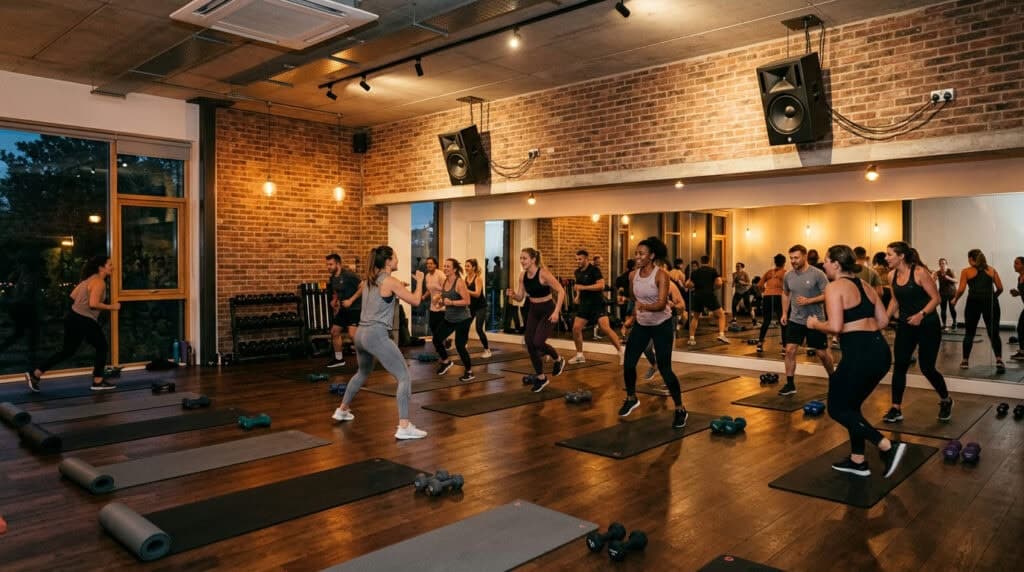
Keep the homepage clean. High-quality photos of your actual gym (not stock images), a brief value proposition, social proof (star rating, review count), and that single CTA. Everything else is secondary.
The Pricing Page Debate: Show Your Prices
One of the most common questions gym owners ask is whether to display prices on their website. The answer is yes — show them.
Here is why hiding your prices hurts you:
- Visitors who cannot find pricing assume the gym is expensive and leave without enquiring
- The people who enquire anyway often waste your time because they cannot afford your rates
- Visitors who see prices and still get in touch are genuinely interested and much closer to joining
Display your membership tiers clearly: monthly rolling, annual commitment, student or off-peak rates if you offer them. Include what is included in each tier so visitors can compare at a glance.
If you are worried about competitors undercutting you, remember that gym memberships are local. Someone searching for a gym in Bristol is not travelling to Manchester because it is £5 cheaper per month. Transparency builds trust, and trust converts.
Class Timetable: The Underused Trust Signal
An up-to-date class timetable on your website does more than help members plan their week — it proves your gym is active and well-run.
A current timetable with real classes, real times, and named instructors signals that your gym is a busy, functioning facility. An empty or outdated timetable suggests the opposite.
Make the timetable easy to read on mobile (which is where most people will view it). Use a clear grid layout, show class times, and include a brief description of each class type. If you offer booking links, include them directly in the timetable.
Testimonials and Reviews: Social Proof That Works
Word of mouth has always been the most powerful marketing tool for gyms. Online, that means reviews and testimonials.
Google reviews are critical. Claim and optimise your Google Business Profile, then encourage happy members to leave reviews. Embed your Google review average and count on your website — “Rated 4.8/5 by 127 members on Google” is a powerful trust signal.
Use real testimonials. If a member tells you they lost two stone, gained confidence, or finally stuck to a fitness routine, ask if you can feature their story on your website. Include a photo if possible — face and name make testimonials credible in a way anonymous quotes never will.
Avoid fabricated reviews. Consumers are good at spotting them, and a single fake review undermines everything else on your site.
The Contact Page: Your Final Conversion Tool
Most gym websites treat the contact page as an afterthought. It should be one of your strongest conversion pages.
Include:
- A phone number that someone actually answers during business hours
- A Google Maps embed so visitors can see your exact location and check proximity
- A direct booking link or contact form that leads somewhere — not into a black hole
- Your opening hours clearly stated
- An email address as a fallback option
If someone has scrolled this far, they are interested. Make the contact page the easiest possible way for them to take the final step.
Mobile Optimisation: Non-Negotiable
Over 70% of gym website traffic comes from mobile devices. If your website is not optimised for mobile, you are losing the majority of your potential members before they even read a word.
Key mobile requirements:
- Text readable without pinching and zooming
- Tap targets (buttons, phone numbers, links) large enough to tap easily
- No horizontal scrolling
- Images that load quickly and scale properly
- Navigation that works with a thumb
Test your website on your own phone. Better yet, ask someone who has never visited your site before to try finding your pricing and contact information on their phone. Watch where they struggle and fix it.
Page Speed: Slow Sites Lose Members
Google reports that 53% of mobile users abandon a site that takes longer than 3 seconds to load. If your gym website takes 5 or 6 seconds, you are losing over half your potential members before the page even renders.
Use Google PageSpeed Insights (free) to test your site. Focus on:
- Compressing images (most gym websites have oversized hero images)
- Enabling browser caching
- Minimising JavaScript and CSS bloat
- Using a reputable hosting provider
A fast website ranks better in Google and converts better. It is one of the simplest fixes with the highest return.
Local SEO: Getting Found in Search
Most of your potential members will find you through a Google search. Local SEO ensures your gym appears when people search for gyms in your area.
On-page basics:
- Your H1 heading should include your location keyword — “Gym in [Your Town]” or “Fitness Centre [Your Area]”
- Your meta title should be specific — “Your Gym Name | Gym in [Town] | Membership from £X/month”
- Include your town or area naturally throughout your page content
- Ensure your name, address, and phone number (NAP) are consistent across your website
Off-page essentials:
- Claim and complete your Google Business Profile with accurate hours, photos, and services
- Get listed in local directories (including GymPal)
- Encourage Google reviews — quantity and recency both matter
- Build local backlinks where possible (sponsorships, partnerships, local press mentions)
Measuring What Works: Google Analytics Goal Tracking
You cannot improve what you do not measure. Set up Google Analytics on your gym website and configure goal tracking for the actions that matter:
- Contact form submissions
- Phone number clicks (available as a Google Analytics event)
- Free trial sign-ups
- Directions clicks on your Google Maps embed
Track these monthly. If your contact form submissions drop, investigate why. If phone clicks are high but form submissions are low, your phone number placement is working but your form needs attention.
Data tells you where to focus your limited time and budget. Use it.
Your Gym Website as a Conversion Engine
A gym website that converts is not about fancy design or expensive features. It is about clarity, speed, and trust. Make it easy for visitors to find what they need, remove every barrier between them and the next step, and prove that your gym is worth joining.
Start with the five essential pages, optimise for mobile, speed, and local search, and track your results. Small improvements compound — and every additional member who finds and joins through your website is revenue that costs nothing to acquire.
Not listed on GymPal yet? Claim your free business listing and make it easy for local fitness seekers to find your gym. Over 10,000 UK fitness businesses are already on GymPal — and it takes less than five minutes to set up.
Want more gym owners to find you? Upgrade to GymPal Pro for priority placement in search results and on the GymPal AI chatbot. At £9 per month, it is the most cost-effective marketing channel available to independent gyms.
Looking for more guidance? Browse all our gym owner resources for practical guides on marketing, compliance, and growing your fitness business.

I am Adam Hall, a dedicated fitness professional with over ten years of experience in the UK’s fitness industry. I earned my Master’s degree in Sports Science from Loughborough University and have worked with several top fitness studios across the UK. My certifications include a Level 3 Personal Trainer Certificate and a specialised Strength and Conditioning Coach accreditation.
Starting my career as a personal trainer, I quickly moved up to manage multiple gym locations, overseeing their operations and training programs. Beyond managing gyms, I regularly contribute to well-known fitness magazines and have been featured in articles for “Health & Fitness” and “Men’s Health”. My passion also extends online where I run a popular blog on GymPal’s AI-powered directory platform detailing insights into choosing the right fitness venues across the UK. With hundreds of posts reaching thousands of readers monthly, my goal is to influence positive changes in how people approach health and exercise throughout the country.