Climbing and Bouldering Gyms in the UK: A Complete Beginner Guide
Click Below To Share & Ask AI to Summarize This Article
The UK Climbing Boom
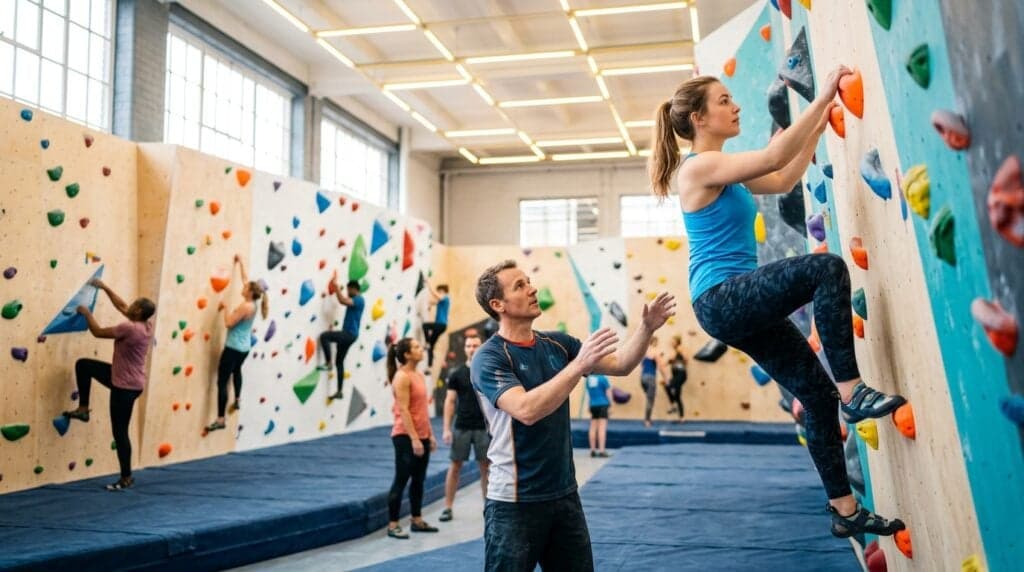
Climbing and bouldering have exploded in popularity across the UK over the past decade. What was once seen as a niche outdoor pursuit is now one of the fastest-growing fitness activities, with over 300 climbing walls and bouldering centres across the country. The inclusion of sport climbing in the Tokyo 2020 Olympics gave the sport a massive visibility boost, and participation has been climbing ever since. According to Sport England Active Lives survey
There are good reasons for the surge. Climbing and bouldering offer a unique combination of physical challenge, mental problem-solving, and community spirit that is hard to find in traditional gyms. They build full-body strength, grip, flexibility, and mental resilience — and most people find them genuinely enjoyable in a way that treadmill running simply is not.
If you are curious but have never tried it, this guide covers everything you need to know before your first session.
Climbing vs Bouldering: What Is the Difference?
These terms are often used interchangeably, but they refer to different activities. Understanding the distinction helps you choose the right gym and the right experience:
| Feature | Bouldering | Rope Climbing |
|---|---|---|
| Height | Up to 4–5 metres (walls are low) | 10–15+ metres (walls are tall) |
| Safety | Thick crash mats below; no ropes or harnesses needed | Ropes and harnesses required; belayer needed |
| Equipment needed | Just climbing shoes and chalk (usually available to hire) | Shoes, chalk, harness, and belay device |
| Training required | None for bouldering walls (watch the safety video on arrival) | Must complete a belay training course (usually 1–2 hours) |
| Cost | Lower (less equipment, no instruction required) | Higher (training course, equipment hire, or partner required) |
| Social | Very social — people chat between attempts and share beta | More focused on the belay partnership |
| Physical intensity | Short, powerful bursts of effort | Sustained effort over longer routes |
| Best for beginners | Yes — the easiest entry point | Yes, but requires a training course first |
Most UK climbing centres offer both bouldering and rope climbing under one roof. If you are completely new, start with bouldering. It is cheaper, requires less equipment and training, and gives you an immediate sense of what climbing feels like.
What to Expect on Your First Visit
Arrival and Registration
When you arrive at a climbing centre, you will need to register. For bouldering, this typically involves:
- Signing a waiver (standard at all climbing centres)
- Watching a short safety video (covers falling technique, mat awareness, and wall rules)
- Hiring shoes and chalk if you do not have your own
The whole process takes about 10–15 minutes. Staff at UK climbing centres are generally very welcoming to beginners — do not be afraid to ask questions.
The Grading System
Climbing routes (called “problems” in bouldering) are colour-coded and graded by difficulty. In the UK, bouldering grades typically use the V-scale or the Font scale:
| Grade | Level | What to Expect |
|---|---|---|
| V0 / Font 3 | Beginner | Simple moves, big holds, straightforward |
| V1–V2 / Font 4–5 | Easy | Slightly harder, requires basic technique |
| V3–V4 / Font 6A–6B | Intermediate | Requires technique, strength, and problem-solving |
| V5–V7 / Font 6C–7A | Advanced | Significant strength, flexibility, and skill required |
| V8+ / Font 7B+ | Expert | Elite-level climbing |
On your first visit, look for the easiest colour on the wall and start there. There is no shame in starting at the bottom — every climber did.
How a Bouldering Session Works
A typical bouldering session looks like this:
- Warm up: 10 minutes of light cardio, dynamic stretching, and easy traversing (climbing sideways along the bottom of the wall)
- Choose a problem: Pick a colour that looks manageable and study the holds from the ground
- Climb: Start from the marked start holds, follow the colour to the top hold, and climb back down (never jump off)
- Rest: Bouldering is intense. Rest 2–3 minutes between attempts
- Repeat: Try the same problem a few times, then move to a different one
- Cool down: Light stretching and forearm exercises
A typical session lasts 60–90 minutes. Your forearms will tell you when you are done.
How Much Does Climbing Cost in the UK?
| Item | Typical Cost |
|---|---|
| Bouldering entry (day pass) | £8–15 |
| Rope climbing entry (day pass) | £10–18 |
| Shoe hire | £2–4 |
| Chalk bag hire | £1–2 |
| Belay training course | £30–50 (one-off, 1–2 hours) |
| Monthly membership (unlimited) | £50–90 |
| Off-peak membership | £35–60 |
Day passes make climbing easy to try without commitment. Many centres offer introductory packages (entry + shoe hire + chalk) for around £10–15. Monthly memberships are competitive with traditional gym prices, and most include both bouldering and rope climbing.
The Physical Benefits of Climbing
Climbing is one of the most comprehensive full-body workouts available. Here is what it trains:
- Grip strength: Your forearms, fingers, and hands get an incredible workout
- Upper body: Back, shoulders, biceps, and chest all engage on every climb
- Core: Keeping your body close to the wall requires constant core activation
- Legs: Surprisingly, your legs do most of the pushing. Climbing is not all upper body
- Flexibility: Reaching for holds in awkward positions improves hip and shoulder mobility
- Balance and coordination: Every move requires body awareness and precise weight shifting
Because climbing is inherently varied (every problem is different), it avoids the repetitive strain patterns of traditional weight training. It also builds functional strength that translates to real-world movement.
The Mental Benefits
Climbing is often described as physical chess. Each problem requires you to:
- Read the sequence of moves from the ground
- Plan your body position and weight distribution
- Adapt when your plan does not work
- Overcome the fear of falling (in a controlled, safe environment)
- Persist through repeated failure until you succeed
This combination of physical exertion and mental problem-solving makes climbing uniquely absorbing. It is very difficult to think about work stress when you are three metres up a wall trying to figure out where to put your left foot. Many climbers describe the experience as meditative.
Finding a Climbing Gym Near You
The UK has climbing walls in most cities and many larger towns. Some of the best-known chains include:
| Chain | Locations | Known For |
|---|---|---|
| The Climbing Hangar | Liverpool, London, Birmingham, Harrogate | Bouldering-focused, strong community |
| Boulder Shack | Exeter, Plymouth | Bouldering specialist |
| Clip n Climb | Nationwide (franchise) | Family-friendly, auto-belay, beginner-focused |
| The Depot | Leeds, Sheffield, Birmingham | Large facilities, bouldering and rope climbing |
| Rocking Frog | Manchester, Nottingham | Bouldering, training boards, youth programmes |
| Creation Climbing | London (multiple) | Bouldering-focused, modern walls |
| Awesome Walls | Liverpool, Sheffield, Stockport | Huge facilities, both bouldering and rope |
Beyond the chains, many independent walls offer excellent experiences. To find climbing gyms near you — including independent operators and specialist centres — GymPal lists thousands of UK gyms with filtering by facilities, location, and member reviews.
What to Bring to Your First Session
- Climbing shoes (or hire them at the centre — £2–4)
- Chalk bag (or hire one — £1–2)
- Comfortable clothes — leggings or shorts and a t-shirt work well. Avoid anything too loose or restrictive.
- Water bottle — climbing is deceptively thirsty work
- A friend (optional but recommended) — climbing is more fun with company, and you can spot each other
Common Beginner Mistakes
- Using too much arm strength. Your legs should do most of the work. Push with your feet, pull with your arms.
- Not warming up. Climbing places intense stress on finger tendons. Always warm up thoroughly.
- Climbing to exhaustion every session. Tendon injuries from overtraining are the most common climbing injury. Stop before your forearms give out completely.
- Skipping easier problems. Even experienced climbers warm up on easy problems. Build up gradually.
- Jumping off the wall. Always climb down. Jumping from height onto crash mats is the most common source of ankle injuries in bouldering.
- Being intimidated. Every climber was a beginner once. The climbing community is famously welcoming.
Should You Combine Climbing with Gym Training?
Many climbers find that supplementing their climbing with gym training improves their performance. Key exercises include:
- Pull-ups and rows — build back and bicep strength for pulling on holds
- Deadlifts and squats — build leg and posterior chain strength for powerful moves
- Planks and hollow body holds — core strength for body tension on the wall
- Forearm exercises — wrist curls, dead hangs, and fingerboarding (advanced only)
If you are looking for a gym that complements your climbing training, GymPal can help you find UK gyms with the right equipment and training atmosphere.
The Bottom Line
Climbing and bouldering offer something rare in fitness: an activity that is physically demanding, mentally engaging, and genuinely fun. The barrier to entry is low (a day pass and shoe hire is all you need), the community is welcoming, and the benefits extend far beyond physical fitness.
If you have been curious about climbing, there has never been a better time to try. Find a local wall, book a day pass, and give it a go. You might just find your new favourite way to stay fit.
Looking for a climbing gym near you? Search GymPal to find UK bouldering walls and climbing centres in your area. Filter by facilities, read member reviews, and compare day pass and membership prices.

I am Adam Hall, a dedicated fitness professional with over ten years of experience in the UK’s fitness industry. I earned my Master’s degree in Sports Science from Loughborough University and have worked with several top fitness studios across the UK. My certifications include a Level 3 Personal Trainer Certificate and a specialised Strength and Conditioning Coach accreditation.
Starting my career as a personal trainer, I quickly moved up to manage multiple gym locations, overseeing their operations and training programs. Beyond managing gyms, I regularly contribute to well-known fitness magazines and have been featured in articles for “Health & Fitness” and “Men’s Health”. My passion also extends online where I run a popular blog on GymPal’s AI-powered directory platform detailing insights into choosing the right fitness venues across the UK. With hundreds of posts reaching thousands of readers monthly, my goal is to influence positive changes in how people approach health and exercise throughout the country.