CrossFit UK: What to Expect, What It Costs, and Whether It’s Right for You
Click Below To Share & Ask AI to Summarize This Article
If you’ve ever walked past a CrossFit box and heard the sound of barbells crashing and people cheering each other on, you’ve probably had one of two reactions: “That looks brilliant” or “That looks absolutely terrifying.” Usually both at once.
CrossFit has built one of the most passionate fitness communities in the UK over the past 15 years — but it’s also one of the most misunderstood. People assume it’s only for ex-athletes, that you’ll injure yourself in week one, or that the membership costs more than a car payment. Some of that reputation is fair. Most of it isn’t.
This guide is for anyone curious about CrossFit but not sure where to start. We’ll cover what actually happens in a session, what it costs across the UK, how to tell a great box from a dodgy one, and whether CrossFit is the right fit for your goals — or whether something else might suit you better.
What Exactly Is CrossFit — and What’s a “Box”?
CrossFit is a strength and conditioning programme built around constantly varied, high-intensity functional movements. That’s the official line. In practice, it means every session is different: one day you might be doing barbell squats and rope climbs, the next it’s rowing, handstand push-ups, and 400-metre runs. No two workouts are the same week to week.
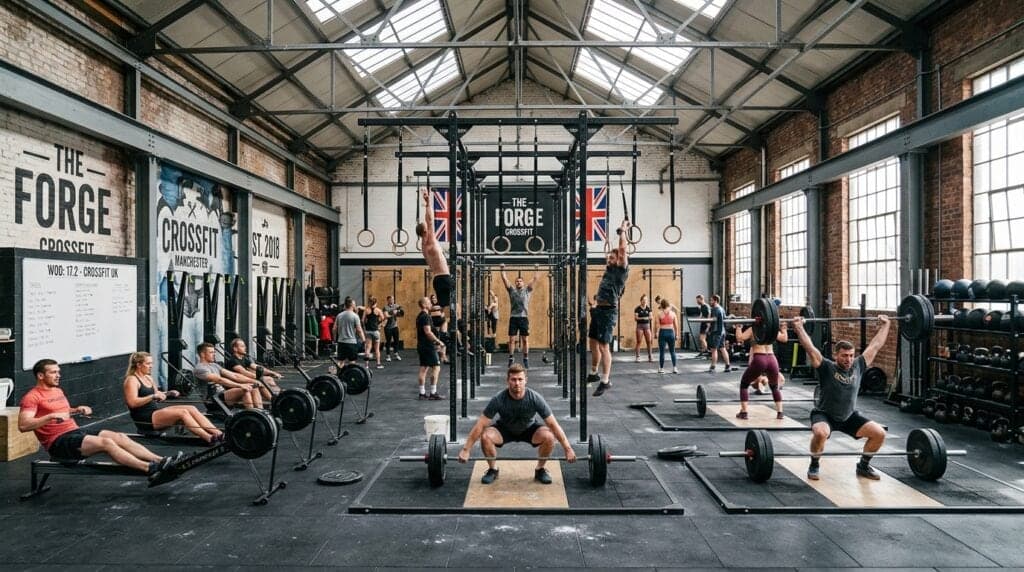
A “box” is simply the CrossFit word for a gym. The name comes from the fact that early CrossFit gyms were often set up in bare warehouse spaces — literal boxes — rather than plush health clubs. Most UK boxes still have that industrial feel: rubber flooring, rigs, kettlebells, pull-up bars, and rowing machines rather than rows of treadmills in front of flatscreen TVs.
The workout itself is called a WOD — Workout of the Day. Every box follows a daily WOD, programmed by the head coach. You turn up, warm up as a group, learn the movements, then do the WOD together. The whole session typically runs 60 minutes.
What Actually Happens in a CrossFit Session?
If you’ve never set foot in a box before, here’s what a standard session looks like:
- Warm-up (10–15 mins): Dynamic stretching, light movement, and activation exercises led by the coach as a group.
- Skill or strength work (15–20 mins): Practising a specific movement — Olympic lifting technique, a barbell complex, or a gymnastics skill like muscle-ups. This is where technical development happens over months.
- The WOD (10–25 mins): The main event. Typically time-capped or scored by reps completed. Could be a 10-minute AMRAP (as many rounds as possible), a classic 21-15-9 descending rep scheme, or a set of intervals.
- Cool-down and chat (5–10 mins): Stretching, recovery work, and — crucially — talking to your fellow members. This social element is a genuine part of the CrossFit experience, not an afterthought.
The group format is central to CrossFit’s appeal. Unlike a traditional gym where you wander in, plug in your earphones, and quietly do your own thing, CrossFit sessions are communal. People cheer each other through the last reps. Coaches know your name. That sense of accountability and shared effort is what keeps most CrossFitters coming back.
It shares DNA with outdoor and indoor bootcamp fitness — that group accountability, coached intensity, and satisfaction of finishing something hard together — except CrossFit’s programming is more structured and the barbell work adds a strength dimension most bootcamps lack.
Is CrossFit Suitable for Beginners?
The honest answer: yes, if you pick the right box. The slightly more complicated answer: it depends on how that box coaches and scales its workouts.
One of CrossFit’s foundational principles is scalability — every movement can be modified to suit any fitness level. Can’t do a pull-up? You use a resistance band or do ring rows instead. Can’t overhead squat with load? You practise the movement with a PVC pipe first. A well-run box will never expect a first-timer to keep pace with someone who’s been training for five years.
Most reputable UK boxes require new members to complete a foundations or onboarding course before joining regular classes. These sessions — usually 2–4 hours spread over a week — teach you the core movements safely before you’re dropped into a live WOD. This is genuinely important: CrossFit uses technically demanding barbell lifts (cleans, snatches, overhead squats) that take time to learn correctly.
When evaluating a box, ask: How do you handle someone who’s never touched a barbell before? A good coach will walk you through their onboarding process with enthusiasm. A red flag is any box that waves you straight into group classes with no assessment or foundations work.
If technical barbell movements genuinely intimidate you, a few sessions with a strength-focused personal trainer before you start CrossFit can build the confidence and motor patterns that make your first weeks in a box far more enjoyable.
How Much Does CrossFit Cost in the UK?
Here’s where CrossFit’s reputation for expense is largely justified — though the reasons are legitimate.
The average CrossFit membership in the UK costs between £70 and £150 per month, with most boxes landing around £80–£100. In London, prices run higher — some boxes charge £150–£184 per month for unlimited sessions. Outside major cities, particularly in the north and midlands, £70–£85 is more typical.
Compare that to a budget gym at £20–£25 per month and CrossFit looks eye-watering. But the comparison isn’t quite fair. What you’re paying for with CrossFit is:
- Coached group sessions — a qualified coach present throughout every class
- Daily programming — no need to design your own workouts; it’s all planned for you
- Specialist equipment — barbells, lifting platforms, rigs, rowers, ski ergs
- Small class sizes — typically 8–20 people, not 50
- A built-in community — arguably the most powerful retention tool in fitness
Most boxes also charge a one-off foundations course fee for new members — usually £30–£80 — so factor that into your first-month budget. Some boxes offer drop-in rates (typically £15–£25 per class) for visitors who want to try before committing. A single drop-in is worth doing before you sign up.
What to Look for in a UK CrossFit Box
Not all boxes are created equal. The CrossFit affiliation model means any gym that pays an annual licence fee can call itself a CrossFit box — so quality varies considerably. Here’s what separates a great box from a mediocre one:
Coaching qualifications: Your head coach should hold at least a CrossFit Level 2 Trainer certificate. Level 1 is the baseline; Level 2 indicates someone who has genuinely invested in developing their coaching. Look for coaches who actively correct movement and offer alternatives — not just cheerleaders shouting encouragement.
Class size limits: Any box cramming 30+ people into a session without multiple coaches is cutting corners on safety. Smaller classes mean more individual attention and a lower risk of unnoticed poor form.
Beginner-friendly culture: Visit and watch a class if you can. Are experienced members patient with newcomers? Do coaches acknowledge everyone regardless of ability? A toxic “elite only” atmosphere doesn’t disappear after the first month.
Structured programming: Does the box follow a clearly periodised programme that builds over months? Or is it just random WODs strung together? Better boxes explain their programming philosophy openly and with evident thought behind it.
Facilities and hygiene: The space should be clean and well-organised. Rubber bumper plates for barbell work, solid flooring, and enough equipment so members aren’t queuing for a single rower mid-WOD are basic standards.
According to ukactive’s research on physical activity retention, coached group exercise is consistently one of the strongest drivers of long-term gym membership retention — which helps explain why CrossFit members tend to stick around far longer than the average gym-goer.
CrossFit vs Traditional Gym: Which Is Right for You?
CrossFit isn’t the right choice for everyone, and that’s absolutely fine. Here’s a rough guide to who tends to thrive where:
CrossFit suits you if:
- You get bored doing the same workout every week
- Accountability and community are what keep you consistent
- You want to build both strength and cardiovascular fitness simultaneously
- You enjoy being pushed hard by a coach and a group
- You like measurable progress — times, weights, rep counts
A traditional gym suits you if:
- You prefer training at your own pace, on your own schedule
- You have specific goals (bodybuilding, marathon prep) that need targeted, solo programming
- Budget is a genuine constraint — a good budget gym at £25/month absolutely can get you fit
- You’re an experienced lifter who knows exactly how to programme their own sessions
There’s a compelling middle ground too: boxing and martial arts gyms offer a similar community-driven, coached experience to CrossFit — often at lower cost — with conditioning benefits that genuinely rival a well-programmed WOD.
How to Find a CrossFit Box Near You
There are over 600 CrossFit-affiliated boxes in the UK, spread across every major city and most sizeable towns. Finding one near you is straightforward — search GymPal for gyms in your area to browse local boxes with contact details, facilities information, and direct links to each box’s website.
Once you’ve shortlisted two or three boxes near you, do the following before committing:
- Request a free introductory session or class observation — most boxes will say yes
- Ask about their onboarding process for complete beginners
- Check Google and social media reviews specifically for comments on coaching quality and community feel
- Confirm the head coach’s CrossFit certification level
The right box will make you feel welcome from the first conversation. The wrong one will make you feel like you haven’t earned your place yet — and that feeling rarely improves.
The Bottom Line
CrossFit is expensive compared to a standard gym membership. It demands more technical skill and physical effort than a treadmill-and-machines routine. And yes, the WODs are hard by design.
But for the right person — someone who thrives with structure, community, and variety — CrossFit can be genuinely transformative. The blend of strength, conditioning, and technical skill development is one of the most comprehensive approaches to fitness you’ll find in a single 60-minute session. And the community you find at a good box is the kind that keeps you showing up on the days you’d normally talk yourself out of it.
Go watch a class. Do the foundations course. Give it a genuine go. And when you’re ready to find your nearest box, GymPal makes it easy to find and compare gyms across the UK — CrossFit boxes included.

I am Adam Hall, a dedicated fitness professional with over ten years of experience in the UK’s fitness industry. I earned my Master’s degree in Sports Science from Loughborough University and have worked with several top fitness studios across the UK. My certifications include a Level 3 Personal Trainer Certificate and a specialised Strength and Conditioning Coach accreditation.
Starting my career as a personal trainer, I quickly moved up to manage multiple gym locations, overseeing their operations and training programs. Beyond managing gyms, I regularly contribute to well-known fitness magazines and have been featured in articles for “Health & Fitness” and “Men’s Health”. My passion also extends online where I run a popular blog on GymPal’s AI-powered directory platform detailing insights into choosing the right fitness venues across the UK. With hundreds of posts reaching thousands of readers monthly, my goal is to influence positive changes in how people approach health and exercise throughout the country.