Functional Fitness Gyms UK: Train Smarter, Move Better
Click Below To Share & Ask AI to Summarize This Article
There’s a quiet revolution happening in gyms up and down the UK. While the treadmill rows and chest-press machines haven’t gone anywhere, a growing number of people are stepping away from isolated, machine-based training and into a very different kind of workout — one built around how the human body actually moves.
Functional fitness gyms are everywhere now, from converted railway arches in Manchester to purpose-built studios in South London. They look different to your standard leisure centre gym. They sound different — kettlebells, boxes, barbells, ropes. And they train you differently too. Instead of targeting a single muscle in a fixed plane of motion, every exercise here serves a purpose: to make you stronger, more mobile, and more capable in real life.
If you’ve been curious about what functional training actually involves, whether it’s right for you, and how to find a quality gym near you, this guide covers everything you need to know.
What Is Functional Fitness? (And Why It’s Not Just CrossFit)
Functional fitness is training that mirrors natural human movement patterns — pushing, pulling, squatting, hinging, rotating, carrying. The goal isn’t to look good in a mirror (though that often follows). It’s to build a body that performs well in everyday life and holds up over time.
Think about the movements you do every day: bending to pick something up, climbing stairs, carrying shopping, throwing something overhead. Most traditional gym machines don’t prepare you for any of those. A leg press, for instance, has you pushing horizontally in a fixed position — completely unlike any real-world load pattern. A kettlebell deadlift, on the other hand, teaches you exactly how to lift something heavy off the floor without blowing out your back.
CrossFit is probably the most famous version of functional training, and there’s plenty of overlap between the two — but they’re not identical. CrossFit uses functional movements but structures them into competitive, high-intensity workouts (WODs) with a specific community culture and methodology. Functional fitness gyms take a broader approach. Some focus on strength and conditioning. Others prioritise movement quality, injury resilience, or athletic development. You’ll find kettlebell studios, strongman gyms, gymnastics-based studios, and general functional training spaces that don’t fit neatly into any single category.
What they share: compound movements, free weights, and training that transfers directly to performance outside the gym.
What to Expect Inside a Functional Fitness Gym
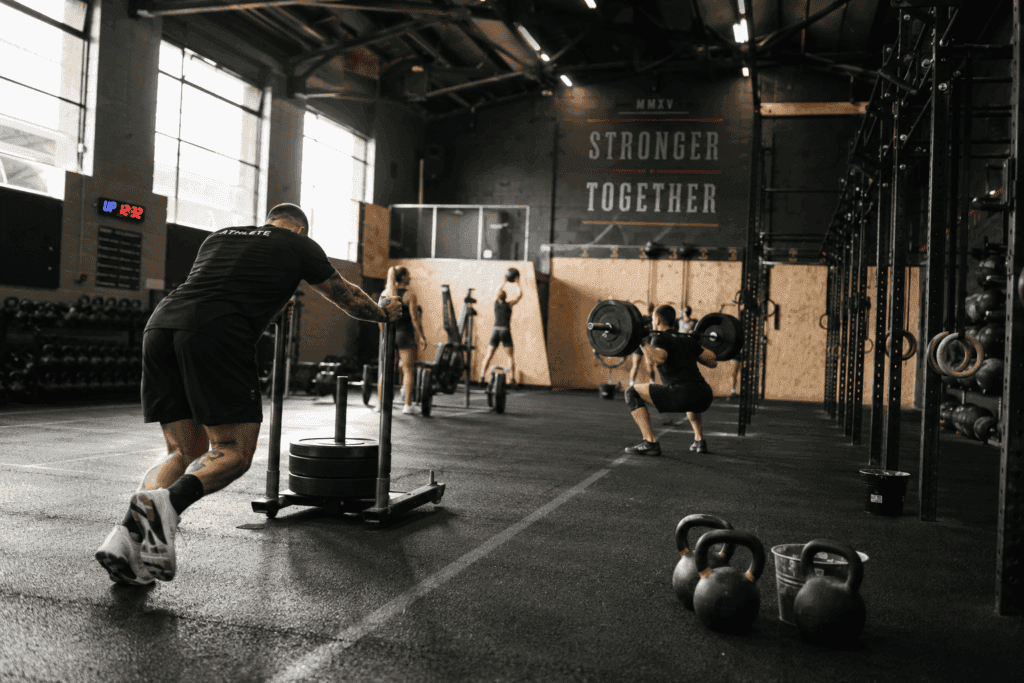
Walk into a functional fitness gym and the layout itself tells you something. There won’t be rows of cardiovascular machines or banks of resistance equipment. Instead, expect open floor space — a lot of it. That space is the point. It’s where movement happens.
Equipment varies by gym but typically includes:
- Kettlebells — the cornerstone of many functional programmes, excellent for swings, presses, carries, and cleans
- Barbells and bumper plates — for deadlifts, squats, cleans, and overhead work
- Pull-up rigs and gymnastics rings — bodyweight pulling work that builds real upper-body strength
- Plyometric boxes — for jumping, stepping, and explosive lower-body training
- Battle ropes, slam balls, sandbags — conditioning tools that build power and grip
- Assault bikes and rowers — short-burst conditioning rather than long steady-state cardio
Classes are common in functional gyms. Coaches typically lead sessions of 8–15 people through a structured workout with a warm-up, skill or strength component, then a conditioning finisher. The coaching-to-client ratio is tighter than a standard gym class, which means you get corrected when your form is off — and that feedback matters enormously when you’re moving under load.
Open gym sessions are also available at most spaces, giving you time to work through your own programme with the equipment available.
Functional Fitness vs Traditional Gym Training: Key Differences
If you’ve spent years training on machines or following a classic bodybuilding split, the shift to functional training can feel jarring at first. Here’s where the philosophies diverge:
Multi-joint vs single-joint movements. A bicep curl isolates one muscle. A pull-up works your biceps, lats, rhomboids, traps, core, and grip simultaneously. Functional training almost always prioritises the latter — more muscles working together, more energy burned, more real-world carryover.
Movement quality vs weight lifted. In a functional gym, a coach will pull you up on poor squat mechanics before they let you add another 10kg. The philosophy is that moving well comes before moving heavy. This emphasis on technique reduces injury risk and produces more durable strength over time.
Conditioning alongside strength. Traditional gym programmes often separate cardio and weights into different sessions or even different days. Functional training usually integrates both — a workout might include heavy barbell work followed by a metabolic conditioning piece that leaves your lungs burning. This mirrors how athletic performance actually works.
Community and accountability. Walk into most functional fitness gyms and you’ll notice the culture. People know each other’s names. Coaches track your progress. There’s a shared goal of getting better, not just getting through. For many people, this social element is what keeps them coming back after the initial motivation fades.
The Best Types of Functional Fitness Training in the UK
Functional training isn’t one-size-fits-all. Across the UK you’ll find several distinct strands, each with its own emphasis and community:
Kettlebell studios. Gyms like Kettlebell Kings in London and independent studios across Birmingham, Leeds, and Edinburgh have built entire programmes around the kettlebell. It’s a remarkably versatile tool — the Turkish get-up alone will challenge your mobility, stability, and strength in ways that years of machine training won’t. Classes are usually small, technique-focused, and accessible to all fitness levels.
Strength and conditioning (S&C) gyms. These spaces borrow heavily from athletic training methodology. You’ll find barbell work — primarily the squat, deadlift, and press — combined with conditioning work, mobility practice, and accessory movements. Bristol, Manchester, and Glasgow all have excellent independent S&C gyms that take a serious, coach-led approach to building athletic capacity.
Gymnastics-based training. Inspired partly by CrossFit but often more focused on bodyweight mastery, these gyms teach handstands, muscle-ups, ring work, and bar skills alongside weighted movements. The Gymnastics Model, popular in London and Edinburgh, emphasises body control and motor patterns as the foundation of all fitness.
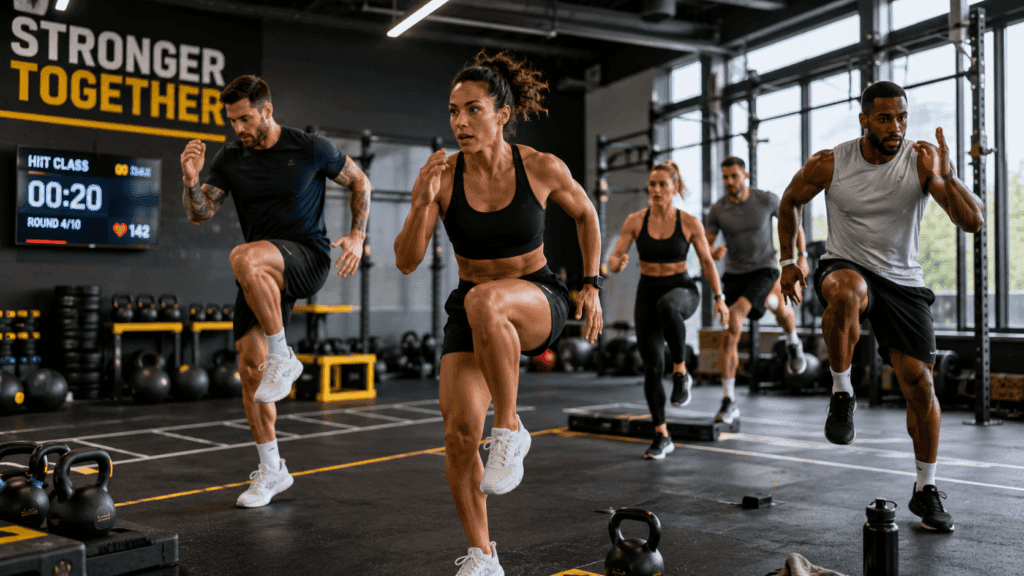
HIIT with a functional foundation. Not all HIIT classes in the UK are functional — plenty rely on treadmills and static bikes. But the best ones incorporate kettlebell swings, sled pushes, battle ropes, and compound movements that make the conditioning work carry over into genuine physical capability.
Hybrid functional gyms. Many newer gym spaces blur all the lines above — they’re part CrossFit box, part strength gym, part movement studio. They offer barbell-based strength classes, kettlebell skills sessions, yoga or mobility work, and open gym time. If you’re someone who doesn’t want to be pigeonholed into one training style, these spaces offer genuine variety.
How to Find a Functional Fitness Gym Near You
This is where it gets practical. The UK has a growing number of excellent functional training spaces, but they’re not always easy to find — many are small independents without huge marketing budgets, operating out of industrial units or standalone buildings away from the high street.
GymPal lists gym facilities across the UK, including functional training spaces, CrossFit boxes, kettlebell studios, and strength gyms — searchable by location. It’s worth running a search for your area before assuming the only options are the national chains.
When you do find a gym that looks promising, most will offer a free or low-cost trial session. Functional fitness gyms almost universally encourage you to try before you commit, because they know the experience speaks for itself. Book a class, show up five minutes early, and tell the coach you’re new. Any good functional gym will spend time on your mechanics before loading you up.
According to Sport England’s Active Lives survey, adults who train in structured, coached environments are significantly more likely to maintain consistent activity levels over time — which aligns with what functional gyms deliver: accountability, progression tracking, and community.
What to Look For Before You Join
Not all functional fitness gyms are equal. A kettlebell hanging from a hook and some floor space doesn’t make a functional gym any more than a treadmill makes a marathoner. Before you commit to a membership, ask these questions:
Are the coaches qualified? Look for Level 3 personal training qualifications as a baseline, plus specialist credentials — kettlebell certifications (StrongFirst, RKC), CrossFit trainer levels, British Weightlifting coaching awards, or equivalent. Good coaching is the single biggest differentiator between a functional gym that transforms people and one that just keeps them busy.
How are beginners onboarded? Any serious functional gym will have a structured intro course or foundations programme for new members. This ensures you learn the foundational movement patterns — the hinge, the squat, the press — before you join regular classes. If a gym will let you walk straight into an advanced class on day one, that’s a red flag.
Is programming structured and progressive? Random workout selection (sometimes called “muscle confusion”) is a marketing gimmick. Sound functional training should follow a structured programme with planned progressions over weeks and months. Ask how the programming works and whether there’s logic behind it.
Does the community feel right? You’ll know within one session whether the vibe works for you. The best functional gyms are welcoming to all ability levels — competitive athletes train alongside complete beginners, and nobody gets left behind. If the atmosphere feels cliquey or intimidating, trust your gut.
If you’re not sure where to start with technique — particularly for barbell-based movements — working with a personal trainer for even a handful of sessions before joining group classes can save months of reinforcing bad habits.
Is Functional Training Right for You?
The honest answer is: probably yes, for most people. If you’re in your twenties and want to build athletic performance, functional training develops the strength, speed, and movement quality that machine-based training rarely touches. If you’re in your forties or fifties and starting to notice that bending, lifting, and carrying are harder than they used to be, functional training builds the real-world capacity to change that. If you’re returning from injury and want to move without pain, the movement-quality emphasis of most functional gyms provides a structured path back.
The caveat: if you have specific aesthetic goals — competitive bodybuilding, for instance — a dedicated functional gym probably isn’t the best primary training environment. But for the vast majority of people who want to be genuinely fit, strong, and capable for the long haul, functional training offers something that rows of machines simply can’t.
Start Your Search Today
The best functional fitness gym for you is out there — it might be a kettlebell studio five minutes from your house, a CrossFit box on the edge of town, or a hybrid strength-and-conditioning space you’ve driven past a hundred times without realising what goes on inside.
GymPal makes it easy to find gyms, studios, and training spaces across the UK — search by location and filter by facility type to find the functional training environment that fits your goals. Give it one trial session. Most people never look back.

I am Adam Hall, a dedicated fitness professional with over ten years of experience in the UK’s fitness industry. I earned my Master’s degree in Sports Science from Loughborough University and have worked with several top fitness studios across the UK. My certifications include a Level 3 Personal Trainer Certificate and a specialised Strength and Conditioning Coach accreditation.
Starting my career as a personal trainer, I quickly moved up to manage multiple gym locations, overseeing their operations and training programs. Beyond managing gyms, I regularly contribute to well-known fitness magazines and have been featured in articles for “Health & Fitness” and “Men’s Health”. My passion also extends online where I run a popular blog on GymPal’s AI-powered directory platform detailing insights into choosing the right fitness venues across the UK. With hundreds of posts reaching thousands of readers monthly, my goal is to influence positive changes in how people approach health and exercise throughout the country.