Padel UK: The Fastest-Growing Racket Sport and Where to Play
Click Below To Share & Ask AI to Summarize This Article
Five years ago, most people in the UK had never heard of padel. Now it’s the fastest-growing sport in the country, with new courts appearing at gyms, tennis clubs and dedicated venues from Aberdeen to Truro almost every month. If you’ve walked past a set of glass-walled courts you didn’t recognise, or seen friends posting about a “padel session” instead of their usual gym class, this is what all the fuss is about.
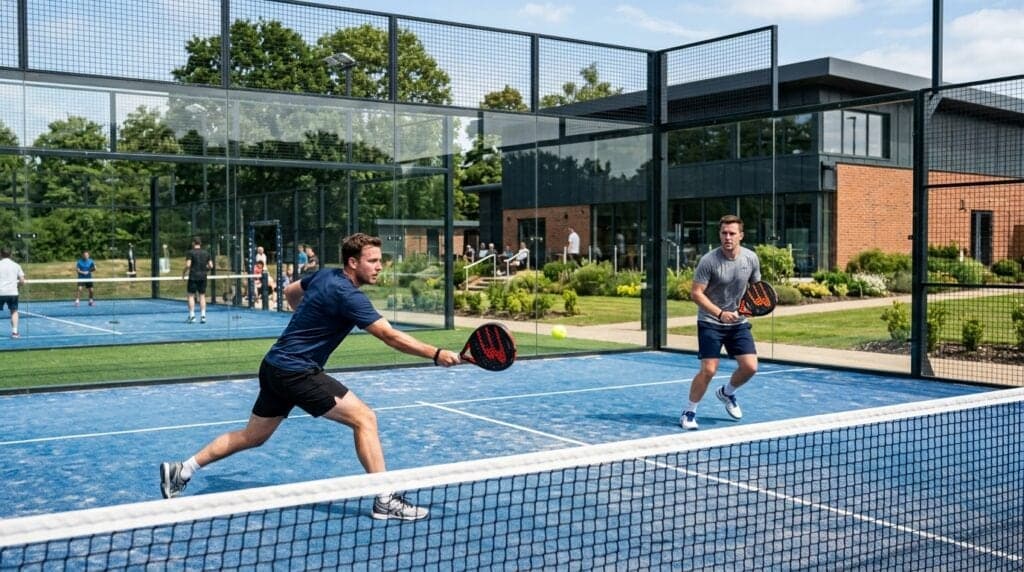
Padel is a racket sport that sits somewhere between tennis and squash, played in doubles on a court roughly a third the size of a tennis court, enclosed by glass and mesh walls that are very much part of the game. It’s easy to pick up, brutally addictive once you do, and — unlike a lot of racket sports — genuinely welcoming to complete beginners from the first session.
This guide covers what padel actually involves, why it’s grown so quickly across the UK, what it costs to play, and how to find a court and get started without feeling completely lost in your first game.
What Is Padel and How Does It Differ From Tennis or Squash?
Padel is played in pairs on an enclosed court about 20 metres by 10 metres, roughly a third the size of a tennis court. You serve underarm, the ball can bounce off the surrounding glass and mesh walls during play, and points are scored exactly as in tennis — 15, 30, 40, game. Rackets are solid, stringless paddles with holes through the face, and the ball is a slightly depressurised tennis ball that bounces lower and slower.
The smaller court and the walls change the game completely. Because the ball stays in play longer and rallies bounce back off the glass rather than ending dead, points tend to be longer and more tactical than tennis, with less reliance on a powerful serve or a booming forehand. That’s a big part of why it’s so beginner-friendly — you can have a genuinely competitive, enjoyable game in your first hour without needing years of technique behind you.
Squash players often pick it up fastest, since the wall-play instincts transfer almost directly, but plenty of complete beginners with no racket sport background at all get comfortable within a couple of sessions too. Because it’s always doubles, there’s also less court to cover individually than in singles tennis or squash, which makes it far more forgiving on the knees and lungs — a genuine plus if your usual exercise is weights or low-impact classes rather than anything cardio-heavy.
Why Padel Has Exploded Across the UK
The growth numbers are hard to overstate. According to the Lawn Tennis Association, which now governs padel development in Britain, the sport has gone from roughly 400,000 players in 2024 to 860,000 players by early 2026, with court numbers rising just as fast as demand for weekend and evening slots continues to outstrip supply in most cities.
Part of the appeal is social rather than purely athletic. Padel is almost always played as doubles, which makes it naturally sociable in a way that solo gym sessions or one-on-one tennis aren’t — a lot of players describe it as feeling more like a get-together with friends that happens to involve exercise. Gyms and leisure operators have noticed too, and it’s now common to see padel courts bolted onto existing health clubs as a way of pulling in members who’d never normally set foot in a squash court.
The sport’s profile has also been helped along by high-profile investment and media coverage — several Premier League footballers and other well-known names have put money into UK padel venues over the past couple of years, and televised Premier Padel tournaments have given the sport a level of visibility that most new activities take a decade to build. Local councils have taken notice too, with a growing number of leisure centres converting underused tennis or squash courts into padel courts to meet demand rather than building from scratch.
What It Actually Costs to Play
Court hire typically runs somewhere between £24 and £48 per hour depending on location and time slot, usually split between four players, which works out at roughly £6 to £12 each for a session — comparable to a decent group exercise class once you divide it up. Peak evening and weekend slots at popular venues get booked up fast, so early mornings and weekday afternoons tend to be both cheaper and easier to book.
Some venues sell padel as a pay-and-play add-on with no commitment beyond the court fee, while others fold it into a wider membership alongside gym access, similar to the tiered pricing you’ll see covered in our breakdown of UK gym membership prices. If you’re already paying for a gym membership elsewhere, it’s worth checking whether padel is included or discounted before booking pay-and-play rates separately, since a bundled membership can work out considerably cheaper if you plan to play regularly.
Rackets can be hired for a few pounds at most venues, so there’s no need to buy your own equipment until you’re sure you’ll keep playing. Balls are usually provided or available to buy cheaply on site.
Your First Session: What to Expect
Turning up to any new sport for the first time comes with a bit of nervous energy, and padel is no exception — you’re stepping onto a court you’ve never played on, with rules you’re still learning, in front of whoever else happens to be at the venue that evening. It’s worth remembering that almost everyone at a padel court was a beginner within the last couple of years, given how new the sport still is in the UK, so there’s far less of a gap between “regulars” and “newcomers” than you’d find at an established tennis club.
If new environments generally make you anxious, the same advice in our guide to beating gym anxiety applies just as well here — booking an off-peak slot, going with a friend rather than joining strangers, and accepting that your first few games will involve a lot of missed shots into the glass will take most of the pressure off. Most venues also run beginner taster sessions or introductory coaching for exactly this reason, and they’re worth booking before your first proper game if you can.
Finding a Court Near You
Because padel has grown so quickly, availability varies a lot by area — some towns have several venues with plenty of free slots, while others have a single court that’s booked solid weeks in advance. It’s worth checking a few different venues within reasonable travelling distance rather than assuming the nearest one will have space when you want it.
The same checklist that applies when picking any gym is just as relevant here. Our guide to choosing the right gym in the UK covers things like opening hours, contract terms and location that matter just as much for a venue you’re booking for padel as one you’re joining for regular training, and it’s worth a read before you commit to a membership built around it.
Independent padel clubs, tennis centres that have added courts, and leisure centres run by local councils all tend to price and book very differently, so it’s worth comparing a few options rather than settling for whichever venue happens to come up first in a search. Some clubs also run ladder leagues and social mixers for members, which are worth asking about if you’re keen to play regularly without having to organise three other players every single week yourself.
Padel Etiquette and Tips for Improving Quickly
A few unwritten rules make padel more enjoyable for everyone. Let the ball bounce off the back or side glass before you play it where possible — trying to volley everything early is a common beginner habit that actually gives away easy points. Call the score clearly before each point so nobody’s arguing over it later, and if a ball from a neighbouring court rolls onto yours, stop play immediately rather than carrying on through it.
The fastest way to improve isn’t power, it’s positioning. Standing close to the net as a team, letting the walls do more of the work than you’d expect, and communicating constantly with your partner about who’s taking which ball will get you playing competent, enjoyable padel far quicker than trying to smash winners from the back of the court.
Getting Started
Padel’s rise in the UK shows no sign of slowing down, and unlike a lot of fitness trends, it’s genuinely as much fun for a complete beginner as it is for someone who’s been playing for years. A pair of trainers, a hired racket and a booked court is all you need to try it — there’s no long build-up or expensive kit list standing between you and your first game.
If you’re weighing up whether to add padel to your regular training routine, GymPal’s gym search makes it easy to find local venues with courts, compare what’s included, and see how it fits alongside whatever else you’re already doing for fitness.

I am Adam Hall, a dedicated fitness professional with over ten years of experience in the UK’s fitness industry. I earned my Master’s degree in Sports Science from Loughborough University and have worked with several top fitness studios across the UK. My certifications include a Level 3 Personal Trainer Certificate and a specialised Strength and Conditioning Coach accreditation.
Starting my career as a personal trainer, I quickly moved up to manage multiple gym locations, overseeing their operations and training programs. Beyond managing gyms, I regularly contribute to well-known fitness magazines and have been featured in articles for “Health & Fitness” and “Men’s Health”. My passion also extends online where I run a popular blog on GymPal’s AI-powered directory platform detailing insights into choosing the right fitness venues across the UK. With hundreds of posts reaching thousands of readers monthly, my goal is to influence positive changes in how people approach health and exercise throughout the country.