Swimming for Fitness UK: The Low-Impact Workout That Gets Serious Results
Click Below To Share & Ask AI to Summarize This Article
Ask most people to name the UK’s most popular sport and they’ll guess football, running, or maybe cycling. But swimming consistently ranks in the top three physical activities across Britain — and yet it remains weirdly underrated as a serious fitness tool. Most people think of it as something kids do on a Saturday morning, or what you do on holiday when you’ve had one too many drinks and feel like moving.
Here’s the truth: swimming is one of the most effective full-body workouts you can do. It builds cardiovascular fitness, develops genuine muscular strength, torches calories, and — unlike running or high-impact classes — it’s virtually injury-proof. The water supports your body weight, which means your joints get a proper break while your muscles do all the work.
Whether you’re a complete novice who can barely manage a length without stopping, or someone who used to swim competitively and wants to get back in the water, this guide covers everything you need to know about using your local pool as a proper fitness venue — not just a recreational splash.
Why Swimming Delivers Results That Surprise People
The first thing most regular swimmers will tell you is that they didn’t expect it to be this hard. There’s a common misconception that swimming is gentle — and it absolutely can be, for recovery or rehabilitation. But push yourself in the pool and you’ll discover a workout that challenges your cardiovascular system, your core, your shoulders, your legs, and your lungs simultaneously.
A 30-minute swim at moderate intensity burns between 200 and 350 calories for the average adult, depending on stroke and effort level. Butterfly and front crawl burn the most; breaststroke is more forgiving but still substantial. What makes swimming particularly effective for body composition is the muscle engagement: every stroke recruits your lats, deltoids, chest, core, and legs in a coordinated pattern that free weights simply can’t replicate.
Swimming also provides an excellent cardiovascular challenge without the cortisol spike that comes from high-intensity land training. If you’re already doing three or four tough sessions a week — lifting, bootcamps, or running — pool work is the ideal active recovery tool that still moves the needle on your fitness without grinding your body down.
For older adults, people recovering from injury, or those with joint conditions like arthritis, the buoyancy benefit is enormous. The water supports around 90% of your body weight, which means your knees, hips, and ankles barely know you’re exercising — even when your lungs and muscles absolutely do.
Getting in the Water: What Your First Few Sessions Actually Look Like
If you haven’t swum for fitness before (or not for a while), the first session can be a humbling experience — and that’s totally normal. Most people discover that swimming fitness is almost entirely separate from general cardiovascular fitness. You can run a 10K and still feel completely gassed after two lengths of front crawl. The reason is technique: inefficient swimming wastes enormous amounts of energy battling the water rather than moving through it.
Start with these realistic expectations for your first month:
- Week 1–2: Focus on technique over distance. Do one length, rest, repeat. Don’t worry about lane etiquette — use the slow lane and go at your own pace. 20 minutes in the water is a great first session.
- Week 3–4: Work up to continuous swimming. Try 2 lengths, rest 30 seconds, repeat. Mix strokes if you get bored — breaststroke is easier to sustain at first.
- Month 2 onwards: Start measuring distance. A 1km swim (40 lengths in a standard 25m pool) is an excellent milestone that most recreational swimmers can reach within 6–8 weeks of consistent training.
One practical tip: book a technique session with a swimming instructor before you commit to a routine. Even a single 45-minute lesson can transform your front crawl efficiency, making every subsequent swim more effective and more enjoyable. Most leisure centres in the UK offer adult swimming lessons for around £8–£15 per session, and many include them in membership packages.
Speaking of which, UK gym and leisure centre membership prices vary enormously depending on whether you join a council-run facility, a budget chain, or a private health club — and the pool access arrangements differ significantly between them.
Structuring a Swimming Workout That Actually Builds Fitness
The difference between recreational swimming and fitness swimming is structure. If you just get in and swim however many lengths feel comfortable until you’re bored, you’ll plateau quickly. The swimmers who make serious progress are the ones who use intervals, vary their strokes, and track their effort.
Here’s a beginner-friendly 30-minute session structure that delivers real results:
Warm-up (5 minutes): 4 lengths easy breaststroke or front crawl. Focus on breathing and getting comfortable.
Main set (20 minutes):
- 4 × 50m (2 lengths) front crawl with 30 seconds rest between each
- 2 × 50m breaststroke, easy pace — active recovery
- 4 × 25m (1 length) sprint front crawl, maximum effort, 45 seconds rest between each
- 2 × 50m choice of stroke, moderate effort
Cool-down (5 minutes): 4 lengths backstroke or easy breaststroke. Stretch shoulders and hips poolside afterwards.
As you progress, increase the intervals and reduce the rest periods. Tracking your times gives you objective data on improvement — something you can’t always feel subjectively when you’re tired.
Pool pull buoys, kickboards, and fins are available at most leisure centres and are brilliant for isolating specific muscle groups. Using a pull buoy (a float that goes between your legs) removes your kick entirely and forces your upper body to do all the work — it’s genuinely one of the best lat and shoulder exercises available, and it’s in the pool equipment bin for free.
Aqua Fitness Classes: It’s Not Just Lane Swimming
If the idea of lap swimming feels a bit solitary, or if you want the motivation of a group session, aqua fitness classes offer a fantastic alternative. These have been somewhat unfairly dismissed as low-intensity — but a proper aqua aerobics or aqua HIIT class is seriously hard work.
Water provides 12 times more resistance than air, which means movements that look easy on dry land become genuinely challenging when performed against resistance. Aqua cycling, aqua Zumba, and water-based HIIT circuits are increasingly common at UK leisure centres, and they attract a wide range of participants — from rehabilitation patients to competitive athletes using them as cross-training.
The social element is worth mentioning too. If you’ve tried bootcamps, yoga studios, or other group fitness formats and found that community aspect motivating, aqua classes often have exactly the same energy. Regular sessions tend to develop a strong group dynamic — people look out for each other and encourage progression.
Many council and local authority pools run aqua fitness sessions for as little as £4–£6 per class, or include them in their standard leisure membership. Private health clubs with pools tend to include them in class timetables at no extra cost for members.
Who Benefits Most from Swimming as a Primary Workout
Swimming suits almost everyone, but there are particular groups for whom it’s genuinely transformative:
Runners and cyclists: Pool training provides cardiovascular conditioning with zero impact loading — ideal for active recovery or injury prevention. Many elite runners swim one or two sessions per week during heavy training blocks to maintain cardio fitness while reducing leg stress.
People returning from injury: The weight-bearing reduction makes swimming uniquely accessible. Physiotherapists across the UK routinely prescribe pool-based rehabilitation for knee, hip, and lower back conditions — and the transition from pool rehab to general fitness swimming is a natural one.
Women over 40: Swimming has strong evidence behind it for maintaining bone density and muscle mass in peri and post-menopausal women. If you’re already exploring strength training to support long-term health, pairing it with regular swimming gives you both resistance work and cardiovascular conditioning without excessive joint loading.
Beginners starting their fitness journey: For people who find the gym environment intimidating, a quiet pool lane during an off-peak session is a genuinely private workout space. There are no mirrors, no one watching your technique, and the natural rhythm of swimming has a meditative quality that many new exercisers find far more sustainable than high-energy classes.
Those managing weight: The caloric demand of sustained swimming, combined with the muscle development it drives, makes it a powerful tool for body composition changes — particularly for people for whom high-impact exercise isn’t suitable.
Outdoor Swimming in the UK: A Different Kind of Fitness
It would be impossible to write about swimming for fitness in the UK without mentioning the wild swimming movement. Open water swimming — in rivers, reservoirs, lochs, and coastal waters — has exploded in popularity over the past five years, attracting people who find the social, sensory, and psychological benefits of outdoor swimming distinct from anything a pool can offer.
According to Sport England’s Active Lives data, open water and wild swimming participation has grown significantly among adults aged 25–55 in England, with notable increases across the North, the Lake District, and the coastline of Scotland and Wales.
The physiological benefits of cold water immersion — including reduced inflammation, improved mood, and enhanced immune response — have attracted attention from researchers and mainstream media alike. Cold water swimming isn’t for everyone, but if you’re curious, starting with a supervised open water event or an outdoor lido is the sensible route rather than heading straight to a freezing river alone.
If outdoor pools appeal, there’s a brilliant network of them across the UK — from historic lidos in London and Yorkshire to purpose-built lake facilities in the South West. The UK’s outdoor lidos and open air pools offer a genuinely different experience to indoor lane swimming — and they’re often cheaper than you’d expect.
Finding a Pool Near You (And What to Look for in a Swim Facility)
The UK is reasonably well-served for swimming facilities, but pool quality, access, and lane availability vary enormously between venues. Here’s what to check before committing to a pool:
Lane availability: Some pools reserve lanes for serious lap swimmers; others mix recreational and fitness swimming together. If you want structured workouts, look for facilities that offer dedicated fitness lanes during off-peak hours (typically early morning, lunchtime, and mid-afternoon on weekdays).
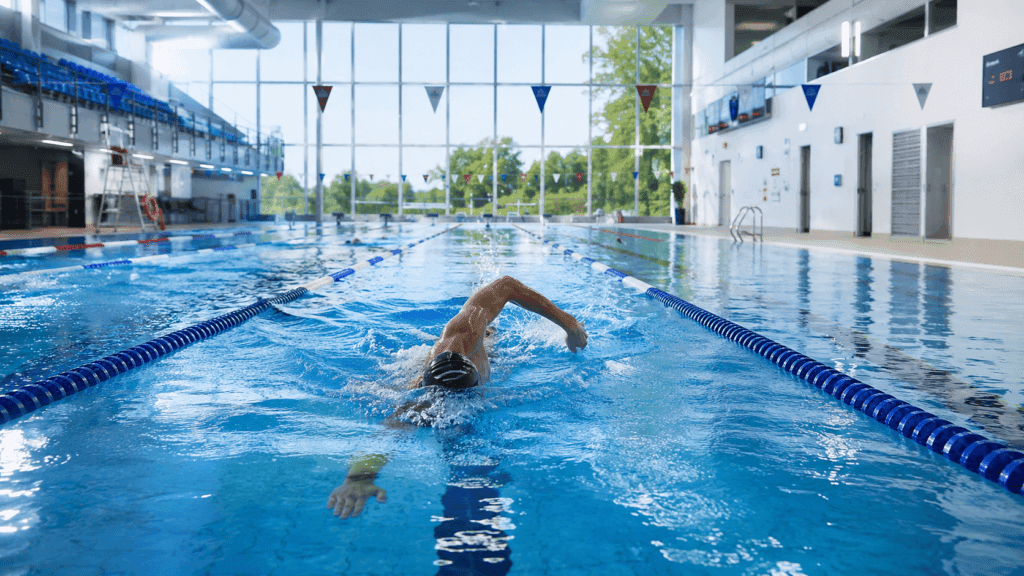
Pool length: Standard competition pools are 50m; most UK leisure centres have 25m pools. A minority of facilities have 33m pools, which are slightly awkward for tracking distance. 25m is perfectly adequate for fitness swimming — you’ll just be doing more turns.
Water temperature: Fitness swimmers tend to prefer slightly cooler water (around 28°C) because it helps regulate body temperature during sustained effort. Leisure pools catering to families often run warmer (30–32°C), which can make sustained lap swimming uncomfortable. Most councils publish pool temperature information on their websites.
Changing and parking: Practical considerations that matter more than people expect. A pool with poor changing facilities or no parking will erode your motivation over the course of a winter. Check Google reviews specifically for these aspects before signing up.
Classes and instruction: If you want to improve your technique or try aqua fitness classes, check what’s on the timetable. A facility with a strong swimming programme is almost always a better investment than one that just has a pool and little else around it.
GymPal lists swimming pools and leisure centres across the UK, with facility details and booking information in one place. Find swimming pools near you on GymPal and filter by location to see what’s available in your area.
Making Swimming a Habit: Practical Tips for Long-Term Consistency
The biggest challenge with any fitness routine is building the habit, and swimming has a few specific hurdles — the kit, the changing rooms, the wet hair situation — that can make it feel like more friction than a run or a gym session.
Here’s how to reduce that friction:
- Keep your kit packed: A dedicated swim bag that’s always ready to go removes a significant cognitive barrier. Once the decision to go is made, you shouldn’t have to think about what to pack.
- Book a slot: Many pools use an online booking system for lane swimming. Booking a specific slot creates commitment — you’re less likely to skip when there’s a reserved place waiting.
- Go at the same time each week: Habit research consistently shows that associating a cue (time + place) with behaviour is the fastest route to automaticity. Pick two or three consistent slots and protect them.
- Track distance, not time: Distance is more motivating than duration for most swimmers. A goal of “swimming 1km” feels more concrete than “swimming for 30 minutes.”
- Get the right goggles: This sounds trivial but it genuinely matters. Goggles that leak, fog, or don’t fit make every swim miserable. Spend £20–£30 on a decent pair (Speedo Biofuse, Arena Cobra, or Zoggs Predator are all solid UK choices) and you’ll enjoy sessions far more.
Ready to Get in the Water?
Swimming is one of the most complete workouts available in the UK — and with thousands of leisure centres, private health clubs, and outdoor pools across the country, access has never been easier. Whether you’re after an intense interval session, a recovery swim between harder training days, or something genuinely joint-friendly that you can sustain for decades, the pool delivers.
The hardest part is simply showing up for the first few sessions before it becomes automatic. After that, most people who commit to regular swimming can’t imagine going back to not having it in their training week.
Ready to find your nearest swimming facility? Search for swimming pools and leisure centres on GymPal — it’s the fastest way to find venues, check facilities, and compare what’s on offer in your area.

I am Adam Hall, a dedicated fitness professional with over ten years of experience in the UK’s fitness industry. I earned my Master’s degree in Sports Science from Loughborough University and have worked with several top fitness studios across the UK. My certifications include a Level 3 Personal Trainer Certificate and a specialised Strength and Conditioning Coach accreditation.
Starting my career as a personal trainer, I quickly moved up to manage multiple gym locations, overseeing their operations and training programs. Beyond managing gyms, I regularly contribute to well-known fitness magazines and have been featured in articles for “Health & Fitness” and “Men’s Health”. My passion also extends online where I run a popular blog on GymPal’s AI-powered directory platform detailing insights into choosing the right fitness venues across the UK. With hundreds of posts reaching thousands of readers monthly, my goal is to influence positive changes in how people approach health and exercise throughout the country.